
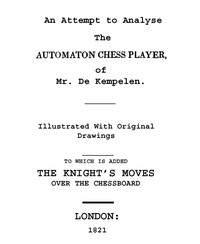
An Attempt to Analyse the Automaton Chess Player of Mr. De Kempelen by Willis
For nearly fifty years, a life-sized wooden figure known as the Mechanical Turk toured Europe, astonishing crowds by playing—and often winning—games of chess against human opponents. Created by Wolfgang von Kempelen in 1770, it was presented as a pure automaton, a machine that could think. The public and intellectuals alike were captivated. Could it be real? Was this the dawn of artificial intelligence? The secret was closely guarded, passing from owner to owner, wrapped in layers of theatrical ceremony.
The Story
This isn't a novel, but the plot is fantastic. Robert Willis, a brilliant and meticulous engineer, attended a showing of the Turk in London. Instead of simply being amazed, he got suspicious. He watched the demonstrations, noted the cabinet's dimensions, the opening of doors, and the showman's careful routines. Then, he went home and worked it out on paper. Willis published this short book to present his deduction to the world. He provides detailed scale drawings of the cabinet and explains, with calm, irrefutable logic, how a human chess master could be concealed inside, sliding between compartments as doors were opened in a specific sequence. He doesn't just say 'there's a person in there'; he proves exactly how it was physically possible, turning a magical spectacle into a clever bit of mechanical stagecraft.
Why You Should Read It
What I love most is watching a razor-sharp mind at work. Willis writes with the quiet confidence of someone who has solved the puzzle. There's no grandstanding—just clear reasoning. You feel like you're right there with him, measuring the cabinet in your mind, following the path of the hidden player. It's a masterclass in critical thinking. Beyond that, it's a snapshot of a time when technology felt magical, and this book represents the moment the curtain was pulled back. It’s about our timeless desire to believe in wonders and the equal desire to understand them.
Final Verdict
This is a niche gem, but a perfect one for the right reader. It's ideal for fans of historical mysteries, magic history, or early popular science. If you enjoy podcasts like 'Stuff You Missed in History Class' or books that explain how famous illusions worked, you'll be captivated. It's short, focused, and incredibly satisfying. A word of caution: it's a technical pamphlet from 1821, so the language is formal (though clear). It's not a breezy beach read. But for anyone curious about one of history's greatest hoaxes and the man who cracked it open with a pencil and ruler, it's absolutely essential.
There are no legal restrictions on this material. Preserving history for future generations.
Karen Hernandez
5 months agoI was particularly interested in the case studies mentioned here, the transition between theoretical knowledge and practical application is seamless. This should be on the reading list of every serious professional.
Emily Taylor
8 months agoAs a professional in this niche, the objective evaluation of the pros and cons is very refreshing. I feel much more confident in my knowledge after finishing this.
Karen Williams
3 weeks agoIt effectively synthesizes complex ideas into a coherent whole.
Elijah Martinez
1 year agoAfter finishing this book, the emotional weight of the story is balanced perfectly. I couldn't put it down.








Joseph Williams
1 week agoA sophisticated analysis that fills a gap in the literature.