
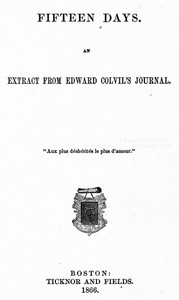
Fifteen Days: An Extract from Edward Colvil's Journal by Mary Lowell Putnam
Let's set the scene. It's the mid-19th century, and a man named Edward Colvil is on a transatlantic voyage. 'Fifteen Days' presents itself as his private journal, discovered and shared by Mary Lowell Putnam. There's no grand plot twist or villain in the traditional sense. Instead, the story lives in the quiet moments. Edward writes about the sea, the other passengers, his memories, and the books he's reading. But woven through all these observations is one persistent thread: he is grappling with a profound personal choice. We never learn all the specifics, which is part of the magic—it forces us to focus on the process of decision-making itself. The conflict isn't with the world, but within his own conscience and heart.
Why You Should Read It
This book is a masterclass in interiority. Putnam (through Colvil) captures the meandering, repetitive, and deeply human way we think when we're alone with a big problem. One minute he's analyzing a philosophical text, the next he's noting the color of the waves, and then he's right back to his dilemma. It feels authentic. You're not just told he's conflicted; you experience the zigzag of his thoughts. It's also a fascinating look at a certain kind of 19th-century mind—intellectual, morally serious, and intensely reflective. Reading it feels like meditation. It slows you down and makes you consider how we all weigh our own choices, big and small.
Final Verdict
This isn't a book for someone craving a fast-paced adventure. It's perfect for readers who love character studies, historical atmosphere, and beautiful, thoughtful prose. If you enjoy novels where the setting is a state of mind, or if you've ever been captivated by the intimate voice of a diary or letters, you'll find a lot to love here. Think of it as a literary getaway: a chance to unplug, step into a quieter time, and spend fifteen days in deep conversation with a fascinating, complex mind.
This content is free to share and distribute. You do not need permission to reproduce this work.
Linda Anderson
2 months agoI've gone through the entire material twice now, and the attention to detail regarding the core terminology is flawless. Well worth the time invested in reading it.
Joseph Lopez
1 year agoThe methodology used in this work is academically sound.
Linda Lee
9 months agoThe layout of the digital version made it easy to start immediately, the inclusion of diverse viewpoints strengthens the overall narrative. A solid investment for anyone's personal development.
Barbara Smith
11 months agoThe clarity of the introduction set high expectations, and the wealth of information provided exceeds the average market standard. An excellent example of how quality digital books should be formatted.





William White
8 months agoUnlike many other resources I've purchased before, the insights into future trends are particularly thought-provoking. It definitely lives up to the reputation of the publisher.