
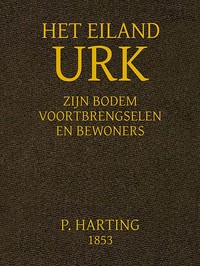
Het Eiland Urk: Zijn Bodem, voortbrengselen en bewoners by Pieter Harting
Published in 1853, Het Eiland Urk is a unique snapshot. It's not a novel with a traditional plot, but a detailed portrait of a place at a specific moment in time. The author, Pieter Harting, was a professor of medicine and natural history. He visited Urk when it was still a true island in the Zuiderzee, before land reclamation connected it to the mainland. His book is his report.
The Story
Harting structures his investigation like a scientist exploring a new world. First, he examines the island's very foundation—its "bodem" (soil). He's fascinated by its composition and how it resists the sea. Next, he documents the "voortbrengselen" (products). What grows here? What do people fish for? This is a catalog of survival. Finally, and most compellingly, he turns to the "bewoners" (inhabitants). He describes their daily lives, their fishing traditions, their distinct dialect and clothing, and their strong communal identity shaped by isolation. The "story" is the unfolding of his understanding, from rock and soil to the spirit of the people.
Why You Should Read It
What makes this old book special is Harting's voice. He's not a cold observer. You can feel his curiosity and respect. He marvels at how the Urkers have adapted, and he portrays them with a dignity that wasn't always given to rural communities. Reading it today, it becomes a bittersweet record. We know the sea around Urk was later drained, transforming its world entirely. Harting captured the island's last chapter as a solitary outpost. The book is a love letter to a way of life about to change forever.
Final Verdict
This is a perfect read for anyone who loves micro-histories, Dutch culture, or quiet, observational writing. It's for the reader who picks up Susan Orlean or John McPhee to learn about orchid thieves or the geology of oranges. You won't find thrilling action, but you will find a profound sense of place. If the idea of a thoughtful, 19th-century scientist giving you a personal tour of a vanished island sounds fascinating, then Harting's Urk is a hidden treasure waiting for you.
This masterpiece is free from copyright limitations. Enjoy reading and sharing without restrictions.
Robert White
3 months agoThe information is current and very relevant to today's needs.
Mary Garcia
7 months agoAs someone working in this industry, I found the insights very accurate.
Paul Williams
7 months agoMy first impression was quite positive because the critical analysis of current industry standards is very timely. I'm genuinely impressed by the quality of this digital edition.
Elizabeth Smith
4 weeks agoIf you're tired of surface-level information, the breakdown of complex theories into digestible segments is masterfully done. It definitely lives up to the reputation of the publisher.
Matthew Rodriguez
1 year agoI was skeptical about the depth of this book at first, but the way it challenges the status quo is both daring and well-supported. Definitely a five-star contribution to the field.