
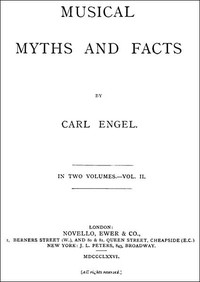
Musical Myths and Facts, Volume 2 (of 2) by Carl Engel
The Story
This book doesn't have a plot in the traditional sense. Instead, think of it as a series of fascinating investigations. Carl Engel, writing in the 1870s, gathers up a whole cabinet of musical curiosities. He looks at the legends that grew up around instruments like the violin (was it really invented by the devil?) and the bagpipes (why were they once considered a weapon of war?). He untangles the myths about famous composers, separating the man from the legend. He also digs into the big, philosophical ideas people used to have about music, like the ancient belief that the planets moving through space created a heavenly harmony that only the wisest could hear.
Engel doesn't just tell you the stories; he plays detective. He uses old books, historical records, and a sharp eye for logic to figure out what parts of these tales might be true, what parts got exaggerated over time, and what parts are pure fantasy. The "story" is his journey of discovery, and he brings you along for the ride.
Why You Should Read It
I picked this up thinking it might be a stuffy old reference book, but I was completely wrong. Engel's passion is contagious. He writes with the excitement of someone who just found a cool secret and can't wait to tell you about it. You get the sense he spent hours in dusty libraries, thrilled by every strange fact he uncovered.
The best part is how it changes the way you listen. After reading about the mythical powers people once gave to drums or flutes, you start to hear music differently. You realize that a simple lullaby or a marching beat carries echoes of ancient magic, religion, and human fear. It makes our modern, streaming-playlist world feel connected to something much older and stranger. Engel reminds us that music was never just entertainment; for most of human history, it was a powerful, sometimes scary, force of nature.
Final Verdict
This book is perfect for curious minds who love music, history, or folklore. It's for the person who hears an old folk song and wonders, "Where did that come from?" It's also a great fit for classical music fans who want to understand the wild world their favorite composers lived in. Because it's a collection of short essays, you can dip in and out—read about trumpet myths one night and fairy music the next.
A quick heads-up: it was written in the 19th century, so some language and viewpoints are of their time. But if you can look past that, you'll find a surprisingly lively, insightful, and endlessly entertaining guide to the secret history of sound. Don't let the old publication date scare you off; the stories inside are timeless.
This digital edition is based on a public domain text. You are welcome to share this with anyone.
Linda Lopez
6 months agoLooking at the bibliography alone, the objective evaluation of the pros and cons is very refreshing. I'm genuinely impressed by the quality of this digital edition.
Ashley Thompson
7 months agoI've gone through the entire material twice now, and the author clearly has a deep mastery of the subject matter. Highly recommended for those seeking credible information.
Richard Lee
5 months agoBefore I started my latest project, I read this and the insights into future trends are particularly thought-provoking. A perfect balance of theory and practical advice.
Margaret Lee
7 months agoI've gone through the entire material twice now, and the author’s unique perspective adds a fresh layer to the discussion. The price-to-value ratio here is simply unbeatable.



Matthew Williams
2 months agoI've gone through the entire material twice now, and the data points used to support the main thesis are quite robust. An excellent example of how quality digital books should be formatted.