
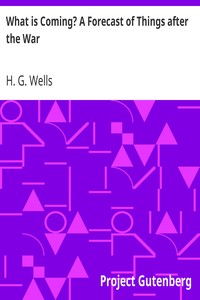
What is Coming? A Forecast of Things after the War by H. G. Wells
Published in the muddy, bloody middle of the First World War, H.G. Wells's What is Coming? isn't a novel. It's something stranger: a seasoned futurist's best attempt to map the immediate aftermath of a conflict whose end he couldn't yet see. Written with the urgency of a journalist and the scope of a social scientist, Wells looks at the warring nations and tries to project the political, social, and technological ripples that will define the post-war world.
The Story
There's no traditional plot here, but there is a powerful narrative drive: the quest to understand the consequences of the Great War. Wells systematically examines the combatants—Britain, France, Germany, the USA—diagnosing their national spirits and war aims. He then builds his forecast. He argues the war will inevitably lead to a massive, league-like association of nations to prevent future conflicts (a startlingly accurate core idea). He predicts the end of traditional aristocracy, the rise of a more organized, technocratic state, and huge shifts in education and women's roles. He also grapples with darker possibilities, like a resentful, militarized Germany laying the groundwork for a second act—a worry that reads as tragically prophetic.
Why You Should Read It
This book is captivating because it lets you inside the head of a genius at a specific, fraught moment. You feel his hope for a rational, unified world built from the ashes, but also his anxieties and the limits of his 1916 perspective. His hits (like foreseeing a European entity) are brilliant. His misses (like underestimating nationalism) are just as telling. It’s not about getting a perfect score; it’s about witnessing the act of forecasting itself. Reading it today, with all our hindsight, creates a unique dialogue across time. You find yourself nodding along one paragraph and talking back to the page the next.
Final Verdict
Perfect for history buffs, science fiction fans curious about Wells's non-fiction mind, and anyone who loves 'what-if' scenarios. If you enjoy books that make you think about how people in the past imagined your present, this is a must-read. It’s a short, dense, and profoundly interesting look at a crossroads in history, written by someone standing right in the middle of it, squinting into the fog of the future.
This book is widely considered to be in the public domain. You do not need permission to reproduce this work.
William Williams
1 month agoAfter spending a few days with this digital edition, the case studies and practical examples provided add immense value. An excellent example of how quality digital books should be formatted.
Barbara Smith
5 months agoThought-provoking and well-organized content.
Richard Harris
2 years agoAfter spending a few days with this digital edition, the nuanced approach to the central theme was better than I expected. A rare gem in a sea of mediocre content.
William White
8 months agoThe analytical framework presented is both innovative and robust.



Karen Martin
3 months agoAfter spending a few days with this digital edition, the objective evaluation of the pros and cons is very refreshing. If you want to master this topic, start right here.