
Elevator Systems of the Eiffel Tower, 1889 — Key Ideas to Explore

(11 User reviews)   1549
In Category - Inventions Industry
Vogel, Robert M. Project Gutenberg 2010
Tour Eiffel (Paris, France); Elevators -- History Readers of public-domain and historical texts
Project Gutenberg digital edition en

Edition facts

Words: 16,496
Reading time: 72 min
Text sections: 3
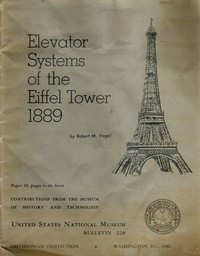
This paper by Smithsonian curator Robert M. Vogel examines the design and engineering of the three elevator systems installed in the Eiffel Tower for the 1889 Universal Exposition, focusing on the unprecedented challenges of capacity, height, and curved shafts, and the resulting innovations that presaged skyscraper elevators.
Share
Editorial Edition Score 4.5/5

Calculated from edition completeness, EPUB availability, text structure and catalogue metadata. Not a user rating.

Edition quality

Read the Text

is was master mechanic.

The importance of this invention soon became evident to Otis, and he introduced his device to the public three years later during the second season of the New York Crystal Palace Exhibition, in 1854. Here he would demonstrate dramatically the perfect safety of his elevator by cutting the hoisting rope of a suspended platform on which he himself stood, uttering the immortal words which have come to be inseparably associated with the history of the elevator--"All safe, gentlemen!"[4]

The invention achieved popularity slowly, but did find increasing favor in manufactories throughout the eastern United States. The significance of Otis' early work in this field lay strictly in the safety features of his elevators rather than in the hoisting equipment. His earliest systems were operated by machinery similar to that of the teagle elevator in which the hoisting drum was driven from the mill shafting by simple fast and loose pulleys with crossed and straight belts to raise, lower, and stop. This scheme, already common at the time, was itself a direct improvement on the ancient hand-powered drum hoist.

The first complete elevator machine in the United States, constructed in 1855, was a complex and inefficient contrivance built around an oscillating-cylinder steam engine. The advantages of an elevator system independent of the mill drive quickly became apparent, and by 1860 improved steam elevator machines were being produced in some quantity, but almost exclusively for freight service. It is not clear when the first elevator was installed explicitly for passenger service, but it was probably in 1857, when Otis placed one in a store on Broadway at Broome Street in New York.

In the decade following the Civil War, tall buildings had just begun to emerge; and, although the skylines of the world's great cities were still dominated by church spires, there was increasing activity in the development of elevator apparatus adapted to the transportation of people as well as of merchandise. Operators of hotels and stores gradually became aware of the commercial advantages to be gained by elevating their patrons even one or two floors above the ground, by machinery. The steam engine formed the foundation of the early elevator industry, but as building heights increased it was gradually replaced by hydraulic, and ultimately by electrical, systems.

The progression from an elevator machine powered by the line shafting of a mill to one in which the power source was independent would appear a simple and direct one. Nevertheless, it was about 40 years after the introduction of the powered elevator before it became common to couple elevator machines directly to separate engines. The multiple belt and pulley transmission system was at first retained, but it soon became evident that a more satisfactory service resulted from stopping and reversing the engine itself, using a single fixed belt to connect the engine and winding mechanism. Interestingly, the same pattern was followed 40 years later when the first attempts were made to apply the electric motor to elevator drive.

By 1870 the steam elevator machine had attained its ultimate form, which, except for a number of minor refinements, was to remain unchanged until the type became completely obsolete toward the end of the century.

By the last quarter of the century, a continuous series of improvements in the valving, control systems, and safety features of the steam machine had made possible an elevator able to compete with the subsequently appearing hydraulic systems for freight and low-rise passenger service insofar as smoothness, control, and lifting power were concerned. However, steam machinery began to fail in this competition as the increasing height of buildings rapidly extended the demands of speed and length of rise.

The limitation in rise constituted the most serious shortcoming of the steam elevator (figs. 8-10), an inherent defect that did not exist in the various hydraulic systems.

Since the only practical way in which the power of a steam engine could be applied to the haulage of elevator cables was through a rotational system, the cables invariably were wound on a drum. The travel or rise of the car was therefore limited by the cable capacity of the winding drum. As building heights increased, drums became necessarily longer and larger until they grew so cumbersome as to impose a serious limitation upon further upward growth. A drum machine rarely could be used for a lift of more than 150 feet.[5]

Another organic difficulty existing in drum machines was the dangerous possibility of the car--or the counterweight, whose cables often wound on the drum--being drawn past the normal top limit and into the upper supporting works. Only safety stops could prevent such an occurrence if the operator failed to stop the car at the top or bottom of the shaft, and even these were not always effective. Hydraulic machines were not susceptible to this danger, the piston or plunger being arrested by the ends of the cylinder at the extremes of travel.

THE HYDRAULIC ELEVATOR

The rope-geared hydraulic elevator, which was eventually to become known as the "standard of the industry," is generally thought to have evolved directly from an invention of the English engineer Sir William Armstrong (1810-1900) of ordnance fame. In 1846 he developed a water-powered crane, utilizing the hydraulic head available from a reservoir on a hill 200 feet above.

The system was not basically different from the simple hydraulic press so well known at the time. Water, admitted to a horizontal cylinder, displaced a piston and rod to which a sheave was attached. Around the sheave passed a loop of chain, one end of which was fixed, the other running over guide sheaves and terminating at the crane arm with a lifting hook. As the piston was pressed into the cylinder, the free end of the chain was drawn up at triple the piston speed, raising the load. The effect was simply that of a 3-to-1 tackle, with the effort and load elements reversed. Simple valves controlled admission and exhaust of the water. (See fig. 11.)

The success of this system initiated a sizable industry in England, and the hydraulic crane, with many modifications, was in common use there for many years. Such cranes were introduced in the United States in about 1867 but never became popular; they did, however, have a profound influence on the elevator art, forming the basis of the third generic type to achieve widespread use in this country.

The ease of translation from the Armstrong crane to an elevator system could hardly have been more evident, only two alterations of consequence being necessary in the passage. A guided platform or car was substituted for the hook; and the control valves were connected to a stationary endless rope that was accessible to an operator on the car.

The rope-geared hydraulic system (fig. 13) appeared in mature form in about 1876. However, before it had become the "standard elevator" through a process of refinement, another system was introduced which merits notice if for no other reason than that its popularity for some years seems remarkable in view of its preposterously unsafe design. Patented by Cyrus W. Baldwin of Boston in January 1870, this system was termed the Hydro-Atmospheric Elevator, but more commonly known as the water-balance elevator (fig. 12). It employed water not under pressure but simply as mass under the influence of gravity. The elevator car's supporting cables ran over sheaves at the top of the shaft to a large iron bucket, which traveled in a closed tube or well adjacent to and the same length as the shaft. To raise the car, the operator caused a valve to open, filling the bucket with water from a roof tank. When the weight of water was sufficient to overbalance the loaded car, the bucket descended, raising the car. On its ascent the car was stopped at intermediate floors by a strong brake that gripped the guides. Upon reaching the top, the operator was able to open a valve in the bucket, now at the bottom of its travel, and discharge its contents into a basement tank, to be pumped back to the roof. No longer counterbalanced, the car could descend, its speed controlled solely by the brake.

The great popularity of this novel system apparently was due to its smooth operation, high speed, simplicity, and economy of operation. Managed by a skillful operator, it was capable of speeds far greater than other systems could then achieve--up to a frightening 1,800 feet per minute.[6]

In addition to the element of potential danger from careless operation or failure of the brake, the Baldwin system was extremely expensive to install as a result of the second shaft, which of course was required to be more or less watertight.

Much of the water-balance elevator's development and refinement was done by William E. Hale of Chicago, who also made most of the installations. The system has, therefore, come to bear his name more commonly than Baldwin's.

The popularity of the water-balance system waned after only a few years, being eclipsed by more rational systems. Hale eventually abandoned it and became the western agent for Otis--by this time prominent in the field--and subsequently was influential in development of the hydraulic elevator.

The rope-geared system of hydraulic elevator operation was so basically simple that by 1880 it had been embraced by virtually all manufacturers. However, for years most builders continued to maintain a line of steam and belt driven machines for freight service. Inspired by the rapid increase of taller and taller buildings, there was a concentrated effort, heightened by severe competition, to refine the basic system.

By the late 1880's a vast number of improvements in detail had appeared, and this form of elevator was considered to be almost without defect. It was safe. Absence of a drum enabled the car to be carried by a number of cables rather than by one or two, and rendered overtravel impossible. It was fast. Control devices had received probably the most attention by engineers and were as perfect and sensitive as was possible with mechanical means. Cars with lever control could be run at the high speeds required for high buildings, yet they could be stopped with a smoothness and precision unattainable earlier with systems in which the valves were controlled by an endless rope, worked by the operator. It was almost completely silent, and when the cylinder was placed vertically in a well near the shaft, practically no valuable floor space was occupied. But most important, the length of rise was unlimited because no drum was used. As greater rises were required, the multiplication of the ropes and sheaves was simply increased, raising the piston-car travel ratio and permitting the cylinder to remain of manageable length. The ratio was often as high as 10 or 12 to 1, the car moving 10 or 12 feet to the piston's 1.

In addition to its principal advantages, the hydraulic elevator could be operated directly from municipal water mains in the many cities where there was sufficient pressure, thus eliminating a large investment in tanks, pumps and boilers (fig. 14).

By far the greatest development in this specialized branch of mechanical engineering occurred in the United States. The comparative position of American practice, which will be demonstrated farther on, is indicated by the fact that Otis Brothers and other large elevator concerns in the United States were able to establish offices in many of the major cities of Europe and compete very successfully with local firms in spite of the higher costs due to shipment. This also demonstrates the extent of error in the oft-heard statement that the skyscraper was the direct result of the elevator's invention. There is no question that continued elevator improvement was an essential factor in the rapid increase of building heights. However, consideration of the situation in European cities, where buildings of over 10 stories were (and still are) rare in spite of the availability of similar elevator techniques, points to the fundamental matter of tradition. The European city simply did not develop with the lack of judicial restraint which characterized metropolitan growth in the United States. The American tendency to confine mercantile activity to the smallest possible area resulted in excessive land values, which drove buildings skyward. The elevator followed, or, at most, kept pace with, the development of higher buildings.

European elevator development--notwithstanding the number of American rope-geared hydraulic machines sold in Europe in the 10 years or so preceding the Paris fair of 1889--was confined mainly to variations on the direct plunger type, which was first used in English factories in the 1830's. The plunger elevator (fig. 16), an even closer derivative of the hydraulic press than Armstrong's crane, was nothing more than a platform on the upper end of a vertical plunger that rose from a cylinder as water was forced in.

There were two reasons for this European practice. The first and most apparent was the rarity of tall buildings. The drilling of a well to receive the cylinder was thus a matter of little difficulty. This well had to be equivalent in depth to the elevator rise. The second reason was an innate European distrust of cable-hung elevator systems in any form, an attitude that will be discussed more fully farther on.

THE ELECTRIC ELEVATOR

At the time the Eiffel Tower elevators were under consideration, water under pressure was, from a practical standpoint, the only agent capable of fulfilling the power and control requirements of this particularly severe service. Steam, as previously mentioned, had already been found wanting in several respects. Electricity, on the other hand, seemed to hold promise for almost every field of human endeavor. By 1888 the electric motor had behind it a 10- or 15-year history of active development. Frank J. Sprague had already placed in successful operation a sizable electric trolley-car system, and was manufacturing motors of up to 20 horsepower in commercial quantity. Lighting generators were being produced in sizes far greater. There were, nevertheless, many obstacles preventing the translation of this progress into machinery capable of hauling large groups of people a vertical distance of 1,000 feet with unquestionable dependability.

The first application of electricity to elevator propulsion was an experiment of the distinguished German electrician Werner von Siemens, who, in 1880, constructed a car that successfully climbed a rack by means of a motor and worm gearing beneath its deck (figs. 17, 18)--again, the characteristic European distrust of cable suspension. However, the effect of this success on subsequent development was negligible. Significant use of electricity in this field occurred somewhat later, and in a manner parallel to that by which steam was first applied to the elevator--the driving of mechanical (belt driven) elevator machines by individual motors. Slightly later came another application of the "conversion" type. This was the simple substitution of electrically driven pumps (fig. 21) for steam pumps in hydraulic installations. It will be recalled that pumps were necessary in cases where water main pressure was insufficient to operate the elevator directly.

In both of these cases the operational demands on the motor were of course identical to those on the prime movers which they replaced; no reversal of direction was necessary, the speed was constant, and the load was nearly constant. Furthermore, the load could be applied to the motor gradually through automatic relief valves on the pump and in the mechanical machines by slippage as the belt was shifted from the loose to the fast pulleys. The ultimate simplicity in control resulted from permitting the motor to run continuously, drawing current only in proportion to its loading. The direct-current motor of the 1880's was easily capable of such service, and it was widely used in this way.

Adaptation of the motor to the direct drive of an elevator machine was quite another matter, the difficulties being largely those of control. At this time the only practical means of starting a motor under load was by introducing resistance into the circuit and cutting it out in a series of steps as the speed picked up; precisely the method used to start traction motors. In the early attempts to couple the motor directly to the winding drum through worm gearing, this "notching up" was transmitted to the car as a jerking motion, disagreeable to passengers and hard on machinery. Furthermore, the controller contacts had a short life because of the arcing which resulted from heavy starting currents. In all, such systems were unsatisfactory and generally unreliable, and were held in disfavor by both elevator experts and owners.

There was, moreover, little inducement to overcome the problem of control and other minor problems because of a more serious difficulty which had persisted since the days of steam. This was the matter of the drum and its attendant limitations. The motor's action being rotatory, the winding drum was the only practical way in which to apply its motive power to hoisting. This single fact shut electricity almost completely out of any large-scale elevator business until after the turn of the century. True, there was a certain amount of development, after about 1887, of the electric worm-drive drum machine for slow-speed, low-rise service (fig. 19). But the first installation of this type that was considered practically successful--in that it was in continuous use for a long period--was not made until 1889,[7] the year in which the Eiffel Tower was completed.

Pertinent is the one nearly successful attempt which was made to approach the high-rise problem electrically. In 1888, Charles R. Pratt, an elevator engineer of Montclair, New Jersey, invented a machine based on the horizontal cylinder rope-geared hydraulic elevator, in which the two sets of sheaves were drawn apart by a screw and traveling nut. The screw was revolved directly by a Sprague motor, the system being known as the Sprague-Pratt. While a number of installations were made, the machine was subject to several serious mechanical faults and passed out of use around 1900. Generally, electricity as a practical workable power for elevators seemed to hold little promise in 1888.[8]

The Tower's Elevators

A great part of the Eiffel Tower's worth and its _raison d'être_ lay in the overwhelming visual power by which it was to symbolize to a world audience the scientific, artistic, and, above all, the technical achievements of the French Republic. Another consideration, in Eiffel's opinion, was its great potential value as a scientific observatory. At its summit grand experiments and observations would be possible in such fields as meteorology and astronomy. In this respect it was welcomed as a tremendous improvement over the balloon and steam winch that had been featured in this service at the 1878 Paris exposition. Experiments were also to be conducted on the electrical illumination of cities from great heights. The great strategic value of the Tower as an observation post also was recognized. But from the beginning, sight was never lost of the structure's great value as an unprecedented public attraction, and its systematic exploitation in this manner played a part in its planning, second perhaps only to the basic design.

The conveyance of multitudes of visitors to the Tower's first or main platform and a somewhat lesser number to the summit was a technical problem whose seriousness Eiffel must certainly have been aware of at the project's onset. While a few visitors could be expected to walk to the first or possibly second stage, 377 feet above the ground, the main means of transport obviously had to be elevators. Indeed, the two aspects of the Tower with which the Exposition commissioners were most deeply concerned were the adequate grounding of lightning and the provision of a reliable system of elevators, which they insisted be unconditionally safe.

To study the elevator problem, Eiffel retained a man named Backmann who was considered an expert on the subject. Apparently Backmann originally was to design the complete system, but he was to prove inadequate to the task. As his few schemes are studied it becomes increasingly difficult to imagine by what qualifications he was regarded as either an elevator expert or designer by Eiffel and the Commission. His proposals appear, with one exception, to have been decidedly retrogressive, and, further, to incorporate the most undesirable features of those earlier systems he chose to borrow from. Nothing has been discovered regarding his work, if any, on elevators for the lower section of the Tower. Realizing the difficulty of this aspect of the problem, he may not have attempted its solution, and confined his work to the upper half where the structure permitted a straight, vertical run.

Robert M. Vogel, associate curator of mechanical and civil engineering at the Smithsonian Institution, wrote this paper for the Museum of History and Technology. It traces the evolution of powered passenger elevators from mid-19th-century developments to the three distinct systems installed in the Eiffel Tower for the 1889 Universal Exposition. The tower's elevators faced unprecedented challenges in capacity, rise height, and the novel problem of fitting shafts to the curvature of the tower's legs. Vogel presents the resulting equipment as the first capable of meeting the vertical transportation demands of the emerging skyscraper.

Precedent and Novelty in Tower Design

Vogel emphasizes that the Eiffel Tower differed from contemporary monumental works like the Brooklyn Bridge or the Forth Bridge, which evolved naturally from established precedent. For the tower, Eiffel had virtually no structural history to draw upon, aside from his own firm's railway bridge piers. This lack of precedent extended to the elevator systems, where the problems of capacity and height were far greater than any previously encountered. The author notes that the tower's builder had great confidence in his engineering ability, but the project's uniqueness meant that every component required novel solutions.

The Otis Safety Dispute

A central episode in the paper is the conflict between Eiffel and the Otis Brothers Company over the elevator safety system. Otis proposed a modified version of its standard safety device, using leaf springs to apply brake shoes gradually. However, Eiffel, acting on behalf of the Commission, demanded a rack and pinion safety system derived from European cog railways, which allowed manual lowering even after cable failure. The Otis engineer Thomas E. Brown Jr. objected, citing the system's noise and speed limitations. W. E. Hale of Otis called the rack and pinion an "abortion" that would make the company "the laughing stock of the world." The impasse was resolved only after Eiffel's own judgment was overruled by the Commission.

Engineering Constraints and Innovations

Vogel details how the tower's curved legs forced elevator shafts to follow a sloping path, a problem without precedent. The three systems—by Otis, Roux-Combaluzier, and Backmann—each approached this challenge differently. The paper describes the Otis system's use of a counterweight carriage and power cylinder, and includes technical illustrations adapted from Eiffel's own publication. The author also notes that the elevators' design anticipated the needs of skyscrapers, making the tower a testbed for vertical transportation technology. Throughout, Vogel maintains a focus on mechanical specifics, such as cable arrangements and safety mechanisms, rather than architectural aesthetics.

Readers interested in the intersection of 19th-century engineering and exhibition culture will find Vogel's paper a focused technical account. It is best approached as a primary document of mechanical history, not a general history of the tower. The excerpts reveal a work grounded in archival sources and contemporary engineering reports, offering a detailed look at a pivotal moment in elevator design.

Alexander Mitchell
1 week ago

Luke Hill
1 week ago

Oliver Walker
1 week ago

Michael Thompson
6 days ago

Mila Brown
3 weeks ago

4.5
4.5 out of 5 (11 User reviews )

Add a Review

Your Rating *
  • ...
    Rebecca Proctor - 3 weeks ago
    While the topic is intriguing, the book suffers from a lack of engaging narrative. The technical explanations are dense and assume prior knowledge, making it inaccessible to lay readers. Additionally, the illustrations are poor and not well-integrated with the text. I was disappointed with the shallow treatment of the social and cultural impact of this engineering feat.

  • ...
    Melissa Dominguez - 3 weeks ago
    Provides a solid overview of the elevator technology used in the Eiffel Tower, with interesting historical anecdotes. However, the focus is very narrow, and the prose can be dry at times. If you're a serious engineering buff, you'll appreciate the details, but casual readers might find it overly technical.

  • ...
    Robert Knight - 1 week ago
    A fascinating deep dive into the engineering marvel that was the Eiffel Tower's elevator system. The author's detailed explanation of the hydraulic and electric mechanisms, along with the historical context, makes this a must-read for anyone interested in industrial history. The diagrams and technical descriptions are clear and engaging, bringing the 1889 World's Fair to life.


Reader reflection

Record your reading impressions

A brief reflection can help important ideas stay with you longer.

Your progress 0 / 10
1

What is your current status with this title?

2

Was reading this book enjoyable?

3

Would you recommend this book to another reader?

4

How much effort did this book require?

Related eBooks