1

Elevator Systems of the Eiffel Tower, 1889 — Key Ideas to Explore
(0 User reviews)
1608
Project Gutenberg
2010
Not confirmed
Tour Eiffel (Paris, France); Elevators -- History
Readers of public-domain and historical texts
Project Gutenberg digital edition
en
Edition facts
Words
16,496
Reading time
72 min
Text sections
3
The source record for Elevator Systems of the Eiffel Tower, 1889 — Key Ideas to Explore measures this digital text at 16,496 words, 1 hr 12 min estimated reading time, and 3 detected text sections.
The text analysis averages about 20.3 words per sentence, while the detected sections provide another way to judge how the source is divided.
Project Gutenberg metadata also associates the work with “Tour Eiffel (Paris, France),” connecting these edition facts with the source record’s subject description.
Source:
Project Gutenberg record #32282
This paper by Smithsonian curator Robert M. Vogel examines the design and engineering of the three elevator systems installed in the Eiffel Tower for the 1889 Universal Exposition, focusing on the unprecedented challenges of capacity, height, and curved shafts, and the resulting innovations that presaged skyscraper elevators.
Editorial Edition Score
4.5/5
★★★★★
★★★★★
Calculated from edition completeness, EPUB availability, text structure and catalogue metadata. Not a user rating.
How this score is calculated
- Description quality20 pts
- Title & short description10 pts
- Source metadata20 pts
- Text length15 pts
- Chapters / structure15 pts
- EPUB file integrity20 pts
Total of 100 points, scaled to a 2.5-5.0 range. Editions with an empty description or a missing EPUB file are not scored.
Edition quality
Read the Text
Otis was master mechanic.
The importance of this invention soon became evident to Otis, and he introduced his device to the public three years later during the second season of the New York Crystal Palace Exhibition, in 1854. Here he would demonstrate dramatically the perfect safety of his elevator by cutting the hoisting rope of a suspended platform on which he himself stood, uttering the immortal words which have come to be inseparably associated with the history of the elevator--"All safe, gentlemen!"[4]
The invention achieved popularity slowly, but did find increasing favor in manufactories throughout the eastern United States. The significance of Otis' early work in this field lay strictly in the safety features of his elevators rather than in the hoisting equipment. His earliest systems were operated by machinery similar to that of the teagle elevator in which the hoisting drum was driven from the mill shafting by simple fast and loose pulleys with crossed and straight belts to raise, lower, and stop. This scheme, already common at the time, was itself a direct improvement on the ancient hand-powered drum hoist.
The first complete elevator machine in the United States, constructed in 1855, was a complex and inefficient contrivance built around an oscillating-cylinder steam engine. The advantages of an elevator system independent of the mill drive quickly became apparent, and by 1860 improved steam elevator machines were being produced in some quantity, but almost exclusively for freight service. It is not clear when the first elevator was installed explicitly for passenger service, but it was probably in 1857, when Otis placed one in a store on Broadway at Broome Street in New York.
In the decade following the Civil War, tall buildings had just begun to emerge; and, although the skylines of the world's great cities were still dominated by church spires, there was increasing activity in the development of elevator apparatus adapted to the transportation of people as well as of merchandise. Operators of hotels and stores gradually became aware of the commercial advantages to be gained by elevating their patrons even one or two floors above the ground, by machinery. The steam engine formed the foundation of the early elevator industry, but as building heights increased it was gradually replaced by hydraulic, and ultimately by electrical, systems.
The progression from an elevator machine powered by the line shafting of a mill to one in which the power source was independent would appear a simple and direct one. Nevertheless, it was about 40 years after the introduction of the powered elevator before it became common to couple elevator machines directly to separate engines. The multiple belt and pulley transmission system was at first retained, but it soon became evident that a more satisfactory service resulted from stopping and reversing the engine itself, using a single fixed belt to connect the engine and winding mechanism. Interestingly, the same pattern was followed 40 years later when the first attempts were made to apply the electric motor to elevator drive.
By 1870 the steam elevator machine had attained its ultimate form, which, except for a number of minor refinements, was to remain unchanged until the type became completely obsolete toward the end of the century.
By the last quarter of the century, a continuous series of improvements in the valving, control systems, and safety features of the steam machine had made possible an elevator able to compete with the subsequently appearing hydraulic systems for freight and low-rise passenger service insofar as smoothness, control, and lifting power were concerned. However, steam machinery began to fail in this competition as the increasing height of buildings rapidly extended the demands of speed and length of rise.
The limitation in rise constituted the most serious shortcoming of the steam elevator (figs. 8-10), an inherent defect that did not exist in the various hydraulic systems.
Since the only practical way in which the power of a steam engine could be applied to the haulage of elevator cables was through a rotational system, the cables invariably were wound on a drum. The travel or rise of the car was therefore limited by the cable capacity of the winding drum. As building heights increased, drums became necessarily longer and larger until they grew so cumbersome as to impose a serious limitation upon further upward growth. A drum machine rarely could be used for a lift of more than 150 feet.[5]
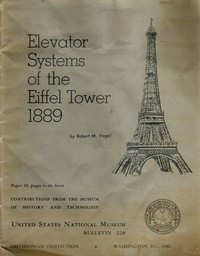
Robert M. Vogel, associate curator of mechanical and civil engineering at the Smithsonian Institution, wrote this paper for the Museum of History and Technology. It traces the evolution of powered passenger elevators from mid-19th-century developments to the three distinct systems installed in the Eiffel Tower for the 1889 Universal Exposition. The tower's elevators faced unprecedented challenges in capacity, rise height, and the novel problem of fitting shafts to the curvature of the tower's legs. Vogel presents the resulting equipment as the first capable of meeting the vertical transportation demands of the emerging skyscraper.
Precedent and Novelty in Tower Design
Vogel emphasizes that the Eiffel Tower differed from contemporary monumental works like the Brooklyn Bridge or the Forth Bridge, which evolved naturally from established precedent. For the tower, Eiffel had virtually no structural history to draw upon, aside from his own firm's railway bridge piers. This lack of precedent extended to the elevator systems, where the problems of capacity and height were far greater than any previously encountered. The author notes that the tower's builder had great confidence in his engineering ability, but the project's uniqueness meant that every component required novel solutions.
The Otis Safety Dispute
A central episode in the paper is the conflict between Eiffel and the Otis Brothers Company over the elevator safety system. Otis proposed a modified version of its standard safety device, using leaf springs to apply brake shoes gradually. However, Eiffel, acting on behalf of the Commission, demanded a rack and pinion safety system derived from European cog railways, which allowed manual lowering even after cable failure. The Otis engineer Thomas E. Brown Jr. objected, citing the system's noise and speed limitations. W. E. Hale of Otis called the rack and pinion an "abortion" that would make the company "the laughing stock of the world." The impasse was resolved only after Eiffel's own judgment was overruled by the Commission.
Engineering Constraints and Innovations
Vogel details how the tower's curved legs forced elevator shafts to follow a sloping path, a problem without precedent. The three systems—by Otis, Roux-Combaluzier, and Backmann—each approached this challenge differently. The paper describes the Otis system's use of a counterweight carriage and power cylinder, and includes technical illustrations adapted from Eiffel's own publication. The author also notes that the elevators' design anticipated the needs of skyscrapers, making the tower a testbed for vertical transportation technology. Throughout, Vogel maintains a focus on mechanical specifics, such as cable arrangements and safety mechanisms, rather than architectural aesthetics.
Readers interested in the intersection of 19th-century engineering and exhibition culture will find Vogel's paper a focused technical account. It is best approached as a primary document of mechanical history, not a general history of the tower. The excerpts reveal a work grounded in archival sources and contemporary engineering reports, offering a detailed look at a pivotal moment in elevator design.
I keep thinking about how Vogel’s paper made me feel the weight of those machines—how much faith it took to step into that curved, rising box. It reminded me of another quiet reckoning, the way Maria Mitchell: Life, Letters, and Journals — Context and Discussion holds a person’s own steady climb, her doubts and all. That lingering hum stayed with me.
There are no reviews for this eBook.
There are no comments for this eBook.
Reader reflection
Record your reading impressions
A brief reflection can help important ideas stay with you longer.
Your progress
0
/
10
2
Was reading this book enjoyable?
3
Would you recommend this book to another reader?
4
How much effort did this book require?
5
Did this book create an emotional response?
6
Which part made the strongest impression?
7
How would you describe its reading pace?
8
Did the book meet your expectations?
9
What is the main idea you are taking away?
10