1

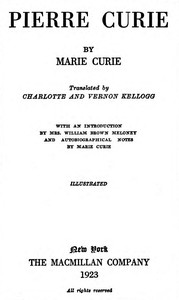
Pierre Curie — Edition Insights
(0 User reviews)
814
Project Gutenberg
2022
Not confirmed
Physicists -- France -- Biography; Curie, Pierre, 1859-1906; Chemists -- France -- Biography
Readers of public-domain and historical texts
Project Gutenberg digital edition
en
Edition facts
Words
52,074
Reading time
227 min
Text sections
6
The catalog record for Pierre Curie — Edition Insights provides practical reading context through 52,074 words, 3 hr 47 min estimated reading time, and 6 detected text sections.
The text analysis averages about 22.3 words per sentence, while the detected sections provide another way to judge how the source is divided.
Project Gutenberg metadata also associates the work with “Physicists -- France -- Biography,” connecting these edition facts with the source record’s subject description.
Source:
Project Gutenberg record #69617
Marie Curie's biography of Pierre Curie, structured around his scientific development and their shared work, uses recurring images of inadequate laboratories and the hangar to underscore the gap between his genius and institutional support.
Editorial Edition Score
4.7/5
★★★★★
★★★★★
Calculated from edition completeness, EPUB availability, text structure and catalogue metadata. Not a user rating.
How this score is calculated
- Description quality20 pts
- Title & short description10 pts
- Source metadata20 pts
- Text length15 pts
- Chapters / structure15 pts
- EPUB file integrity20 pts
Total of 100 points, scaled to a 2.5-5.0 range. Editions with an empty description or a missing EPUB file are not scored.
Edition quality
Public-domain source text
Read the source text
The source text is kept in the dedicated reader, separate from this catalogue record and its commentary.
Marie Curie opens this biography with a frank admission of hesitation, noting that she would have preferred the task to fall to a relative or childhood friend who knew Pierre's earliest years intimately. The narrative she constructs is therefore a deliberate composite: she draws on memories from Pierre's brother Jacques, details Pierre himself related, and her own observations from their life together. This layered approach shapes the book's structure, which moves chronologically through Pierre's scientific milestones while repeatedly circling back to a single, poignant image—the makeshift hangar where much of their radium research was conducted.
The Hangar as a Recurring Image
The hangar at the School of Physics appears as a persistent motif. Marie describes it as a place where they “had known such happy work days, despite their attendant difficulties,” and she returns to it even after Pierre's death, making a final pilgrimage alone. On the blackboard, she finds his writing still visible, and the space remains “all impregnated with his memory.” This image recurs not as a symbol of triumph but of inadequate conditions: the hangar was a humble refuge, and its eventual demolition for a new building underscores the irony that Pierre never received a proper laboratory. The hangar becomes a quiet, repeated anchor for the narrative's emotional weight.
The Laboratory as an Unfulfilled Need
Throughout the biography, the lack of a suitable laboratory is a structural refrain. Marie notes that even after Parliament created a new chair for Pierre, no laboratory was simultaneously funded. He kept a small workroom at the P.C.N. and secured a large unused room and a temporary building of two rooms and a study. The text states bluntly that “one of the first French scientists never had an adequate laboratory to work in,” despite his genius being evident from age twenty. This absence is tied to his refusal of the Légion d'Honneur in 1903: his letter famously declares, “I do not in the least feel the need of a decoration, but that I do feel the greatest need for a laboratory.” The narrative thus uses the laboratory as a measure of institutional neglect.
Movement Between Public Recognition and Private Frustration
The biography shifts between scenes of professional advancement and scenes of material constraint. After Pierre's appointment as professor at the Sorbonne, he gained freedom to design his course, yet the text immediately notes that he was “often ill” and still lacked proper facilities. The narrative moves from the honor of the Nobel Conference—where Pierre raised the ethical question of whether humanity is “sufficiently mature to profit” from discoveries—to the cramped reality of the hangar. This oscillation between public achievement and private limitation gives the biography a rhythmic tension, highlighting the gap between Pierre's growing reputation and the persistent inadequacy of his working conditions.
The Ethical Question as a Structural Frame
The book opens with Pierre's own words from his 1903 Nobel Conference, where he compares radium's potential danger to Nobel's explosives and expresses belief that humanity will gain more good than evil from future discoveries. This ethical framing recurs implicitly in the narrative's focus on the scientist's responsibility and the nation's waste of genius. Marie's closing reflection on the “irreparable” loss of the nation's “best children” echoes Pierre's earlier concern. The structure thus bookends Pierre's scientific story with a moral question about the uses of knowledge, giving the biography a philosophical coherence beyond the chronological account of discoveries.
Readers attentive to the biography's structure will notice how Marie Curie weaves Pierre's own words—from letters, lectures, and conversations—into the narrative, creating a portrait that is both intimate and documentary. The recurring focus on physical spaces, especially the hangar and the absent laboratory, invites reflection on how scientific progress is shaped by material conditions. This is not a hagiography but a carefully constructed account that lets the gaps and frustrations speak as loudly as the achievements.
Rain dripped against the pane while I finished Marie Curie’s portrait of Pierre, her quiet frustration with that leaky hangar lingering in my chest. Their shared ingenuity, forced into makeshift spaces, reminded me of something I stumbled upon later—a simpler, stubborn brilliance built from tin foil and glass. The BYU Solar Cooker/Cooler — Context and Discussion felt like finding the same patient fire, only catching it in sunlight.
There are no reviews for this eBook.
There are no comments for this eBook.
Reader reflection
How did this book work for you?
Your answers remain private and are stored only in this browser.
Your progress
0
/
10
2
How much did you enjoy the reading experience?
3
Is this a title you would suggest to others?
4
What was the reading difficulty like?
5
How much did the book move you?
6
Did anything about the book feel genuinely new?
7
Was the book moving at the right speed?
8
How understandable was the text?
9
What is the main idea you are taking away?
10