
Water and power for San Francisco from Hetch-Hetchy Valley in Yosemite National Park — Story, Setting & Ideas
Edition facts
Calculated from edition completeness, EPUB availability, text structure and catalogue metadata. Not a user rating.
Read the Text
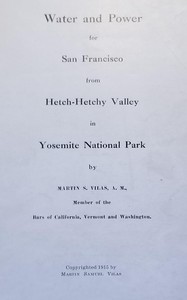
Water and Power for San Francisco from Hetch-Hetchy Valley in Yosemite National Park
by MARTIN S. VILAS, A. M., Member of the Bars of California, Vermont and Washington.
Copyrighted 1915 by MARTIN SAMUEL VILAS
UNSOLICITED STATEMENTS
Of U. S. Senator Elect and Ex-Mayor Phelan, Congressman Raker and San Francisco Officials as to this Article
WASHINGTON, D. C., March 14, 1914.
I can assure you that your clean, clear presentation of the matter was admirable and much appreciated.
(Member of Congress from California and author of the Raker Bill).
SAN FRANCISCO, CAL., February 4, 1914.
I think it was a valuable contribution to the data on that subject and indicates a considerable study upon your part.
(Member of Board of Supervisors, City of San Francisco).
SAN FRANCISCO, CAL., February 2, 1914.
I read your article in the _Chronicle_ on Hetch Hetchy and want to compliment you on the thoroughness with which you handled the subject.
(Clerk, Board of Supervisors, City of San Francisco).
SAN FRANCISCO, CAL., January 29, 1914.
I ... feel that you are entitled to considerable praise for the concise and clear manner in which you have covered a very comprehensive subject.
(Member of Board of Supervisors, City of San Francisco).
SAN FRANCISCO, CAL., January 29, 1914.
I read with much interest and satisfaction your very comprehensive and accurate article on the Hetch-Hetchy.
(Ex-Mayor of San Francisco and U. S. Senator elect from California).
SAN FRANCISCO, CAL., January 26, 1914.
I beg to compliment you on the clearness and conciseness with which you have stated many of the controversial points involved in same. I have had so much of it in the past year and I had to take up so many angles of the conflict that your resumé is decidedly refreshing.
(City Engineer, City of San Francisco).
SAN FRANCISCO, CAL., January 29, 1914.
... I beg to say to you in person what I long since wrote to the editor of the _Chronicle_. I stated to him that the article was a very valuable contribution to the literature on the Hetch-Hetchy subject, and was the best general exposition of the case that I had read in any newspaper and that, furthermore, the article was practically free from error. I have long since added it to my scrap book.
ALEXANDER T. VOGELSANG.
(Member of Board of Supervisors, City of San Francisco, and member of law firm of Vogelsang & Brown).
SAN FRANCISCO, CAL., February 6, 1914.
I consider it the best resumé of the Hetch-Hetchy scheme that has been written. I sent to the _Chronicle_ for ten more copies after reading it in order that I might use it in the future.
I trust that the article will have a very wide circulation, for it cannot but help convince every fair minded individual not only that San Francisco’s application for rights has not been hastily considered but fair play demanded the grant.
Speaking for myself, I thank you very much for your kindly interest in the matter and for your very careful and comprehensive article.
(City Attorney of the City of San Francisco).
HOW THE RAKER BILL AFFECTS YOSEMITE NATIONAL PARK, SAN FRANCISCO, AND THE REST OF CALIFORNIA
Facts Regarding Mountain Supply
History of City’s Fight for Pure and Adequate Water
BENEFITS TO BE DERIVED
Bay Counties and Irrigation Districts Provided for In National Grant
The Raker Bill, named for John E. Raker of Modoc county, Cal., a member of Congress, was reported unanimously by the House Committee on the Public Lands at the special session of Congress in the summer of 1913, after a hearing occupying several days, and under its recommendation passed the House. This bill was reported favorably by the Senate Committee on the Public Lands, and, after a hard fought contest, occupying a week on the floor of the Senate, passed that body December 6th, 1913, by a vote of 43 to 25. It received the approval of President Wilson and became a law on December 19, 1913.
The enactment of this bill ended a continuous effort on the part of San Francisco, covering a period of many years, to obtain the legal right to take water from Hetch-Hetchy. It marked the end of a contest, spirited and hard fought, which was participated in by the magazines and press the country over, and in which the great majority of publications outside of California opposed the plan of San Francisco.
As this legislation affords legal opportunity for a water project primarily for domestic use, which is in itself a signal and notable work of engineering; as it affects vitally and strongly the irrigation interests of a state having a length of about 775 miles and a land surface greater than the combined areas of the six New England States, of New York, New Jersey, Delaware and Ohio—a State which James Bryce characterized as an empire within itself; as it gives a State a very important easement, likely to be enduring, in a national park sharing alone with the great Yellowstone National Park in distinctiveness and notoriety; as it is designed to provide the legal means of furnishing water and much power for the next 100 years for a rapidly growing metropolitan section, now more numerously peopled than any other west of Chicago, the Raker Bill and its accessories are of national interest.
For the foregoing reasons inquiry is made:
First—What is Hetch-Hetchy, and what, if any, are the present holdings and interests of San Francisco in the Yosemite National Park?
Second—What is the Raker Bill?
Third—What will be the operative effects of the Raker Bill on San Francisco and the rest of California outside the Yosemite National Park?
Fourth—What will be the operative effects of the Raker Bill on the Yosemite National Park?
I. What is Hetch-Hetchy, and what, if any are the present holdings and interests of San Francisco in the Yosemite National Park?
(1) Until the agitation connected with obtaining water for San Francisco brought in the name of Hetch-Hetchy, the writer supposed Hetch-Hetchy to be probably the name of some Indian chief, some new brand of cigars or some noted trotting horse. Possibly some of those who read this article are still nearly as ignorant as was the writer then.
Hetch-Hetchy is the name of a valley through which flows the Tuolumne River, and has tributary to it a watershed comprising 459 square miles. It lies entirely in Tuolumne County, California, entirely in the Yosemite National Park, of which it is the northern portion, and about 165 miles from San Francisco.
The Yosemite National Park contains about 1500 square miles. Hetch-Hetchy Valley is separated from the Yosemite Valley by a mountain range having a mean elevation of over 8500 feet, and distant from that valley about thirty-five miles by mountain trail. The floor of the valley is between 3000 and 4000 feet in altitude, is level and grass covered, and two or three miles long and nearly half a mile wide. It is surrounded by steep cliffs, out of which extend deep gorges. Just back of Hetch-Hetchy is a gorge a mile deep and one and a half miles wide. The sides of the valley are granite and very steep and precipitous, rising to a height of between 2000 and 5000 feet in different places. The valley is divided into two parts by a large ridge of rocks extending nearly across the middle. The upper end of it is a high, dry area, covered with tall pine trees, varying between 200 and 300 feet high, and with live oak and other kinds of trees, thus forming a natural park. The grasses, shrubs, flowers and trees are beautiful. Several distinguished naturalists have pronounced the natural growth as very unusual. There are a greater variety of trees and larger oaks in the Hetch-Hetchy Valley than in the Yosemite.
The area tributary to Hetch-Hetchy is very rough. Edmund A. Whitman, a lawyer of Boston and president of the Society for the Protection of National Parks; who has several times visited Hetch-Hetchy, in his testimony before the House Committee on the Public Lands last summer, stated:
“I cannot attempt to describe to you the character of the country. It is some of the roughest God ever made. You do not find little places here and there with grass and water, but the largest part of the country is the roughest sort, where camping is as impossible as it would be on the top of this table. Camping and the use of the park reduces itself to one thing—the feed of horses. There are only three places in the entire park where you can take care of horses.”
Hetch-Hetchy Valley is difficult of access. Because of the high, rough country surrounding it but few people visit it. Thus while 6000 or 7000 people visit the Yosemite Valley each year, less than 300 visit Hetch-Hetchy Valley. The valley, difficult to reach in summer, is rendered almost inaccessible as soon as the early snows begin to fall, and in winter is enshrouded in four or five feet of snow.
The summer season in that high altitude is short, and rendered shorter than the ordinary in Hetch-Hetchy by the cooling effect of the mountain streams, almost icy cold, and by the surrounding mountain peaks, snow-capped except for a small part of the year.
The Tuolumne River rises on the eastern side of California among the highest crests of the Sierras and for five or six miles flows through a meadow, but during the next twenty miles drops 3000 feet, in which distance some of the falls in the river are beautiful and picturesque. Next it flows for about two miles through Hetch-Hetchy Valley, then becomes a rushing mountain torrent for twenty miles more, and finally empties into the San Joaquin River in Stanislaus County, almost directly east of the southern end of San Francisco Bay.
Lake Eleanor and Cherry Valley are northwest of Hetch-Hetchy. Lake Eleanor, distant about eight miles, is approximately 1000 feet higher than Hetch-Hetchy. Cherry Valley is distant about twelve miles and is approximately 1000 feet higher than Eleanor. Cherry Valley has tributary to it 114 square miles of territory, all in the Stanislaus National Park. Lake Eleanor and the seventy-nine square miles tributary to it are entirely in the Yosemite National Park. The outlets of Cherry Valley and of Lake Eleanor empty into the Tuolumne River several miles nearer the San Joaquin than Hetch-Hetchy.
(2) A report of the State Geologist of California in 1879 suggested Hetch-Hetchy Valley and Lake Eleanor as possible sources of water supply for the city of San Francisco.
In 1883 a corporation was formed to supply water to San Francisco from the sources of the Tuolumne River. Filings were made and considerable work put in. In 1901 the City Engineer was directed to examine the available sources of water supply for San Francisco. He investigated fourteen different sources and under suggestion of the reclamation service spent about $50,000 in detailed investigation of the sources of the Tuolumne, with a view to utilization at Hetch-Hetchy and Lake Eleanor. That was before the section was taken into the Yosemite National Park in 1905.
The city engineer made his report in 1901 when James D. Phelan was Mayor. This report was immediately approved by the Board of Public Works and since then has been the settled municipal policy of San Francisco so far as water is concerned. This report recommended the Tuolumne River in the following words:
“This source presents the following unrivalled advantages: Absolute purity by reason of the unhabitable character of the entire watershed tributary to the reservoirs and largely within a forest reservation. Abundance far beyond possible future demands for all purposes. Largest and most numerous sites for storage; freedom from complication of water rights; power possibilities outside the reservation.
“It has the drawback of distance to overcome, requiring the constructing of conduits aggregating 142 miles in length. But considering the partial and rapid rate of pollution to which all other sources may in the future be subjected, particularly nearby sources, the Tuolumne River is far superior to any other.”
Thereupon, Mayor Phelan posted notices on the banks of the Tuolumne on July 29, 1901, of his claim to 10,000 miner’s inches of the waters of that river, “for irrigation, manufacturing purposes, water power and domestic use.” Phelan, when his rights matured, assigned them to the city, as the law did not allow a municipality to make a filing.
Under a grant issued May 11, 1908, by James R. Garfield, Secretary of the Interior, San Francisco obtained permission to store the waters of Lake Eleanor and Cherry Valley, develop them to their highest capacity, and when they should prove insufficient for the needs of the city, to store water in the Hetch-Hetchy Valley by crossing it with a dam. Secretary Garfield conditioned in this grant that San Francisco should submit the proposition to the people of the city for ratification, should buy up all the land held by private owners around Hetch-Hetchy and Lake Eleanor and hold such land for the city.
This proposition was voted upon by the legal voters of San Francisco in November, 1909, in a resolution as to whether or not they wished to acquire a means of water supply in the sources of the Tuolumne River, according to the terms of the Garfield permit, and to vote a municipal bond issue of $600,000 to obtain the land and water rights necessary therefor. The proposition was carried by a vote of more than five to one.
Thereupon San Francisco paid $174,311.20 for 720 acres of privately owned land in the Hetch-Hetchy Valley and for certain other lands so held which were not on the floor of the valley, but which, under the permit, the city must buy for camp sites, so that when campers were excluded from the floor of the valley they still might have a place to camp. These 720 acres comprise about two-thirds of the floor of Hetch-Hetchy Valley. They are now held by San Francisco in fee simple title. Next the city bought standing timber from the Government around Lake Eleanor for $13,428.77. Then out of the $600,000 voted, the city bought the land and water rights claimed by private owners around Lake Eleanor for $400,000.
In January, 1910, under the suggestion of Secretary of the Interior Ballinger, the proposition to obtain water for the city from the sources of Tuolumne and to authorize the issuance of bonds in the amount of $45,000,000 was submitted to the legal voters of San Francisco. Some 30,000 votes were cast and only about 1200 votes were in opposition.
The city supposed it had bought all available water rights of Lake Eleanor and Cherry Valley. That the city had not soon developed, and it expended $600,000 more to control these rights. The expense of investigations around the sources of the Tuolumne has been $300,000 or $400,000. Hence, upon the project San Francisco has already paid out in excess of $1,500,000, probably nearly $1,700,000.
Of the $174,000 spent on lands in Hetch-Hetchy, $81,306.18 were spent for 720 acres. For the exchange lands $92,457.02 were expended. 640 acres outside the valley proper were bought for camp sites under the order of the Secretary of the Interior. At Lake Eleanor private persons owned nearly all the dam sites. Now San Francisco owns about one-half and the United States Government about one-half. Here the development will be very expensive.
At Cherry Valley almost everything is owned by San Francisco. Owners of property around Cherry Valley and Lake Eleanor received $1,000,000 for property which cost them approximately $100,000. The area in the irrigation districts below the dam sites is mostly included in the Turlock-Modesto district. In the vicinity of Hetch-Hetchy Valley the city owns 1040 acres and around Lake Eleanor, all in the National Park, 920.33 acres more, making a total inside the park of 1960.33 acres. In Cherry Creek the city owns 860 acres below Hetch-Hetchy, in Hog Ranch 322.45 acres, and in Ike Dye Ranch 163.68 acres, making a total of 3406.46 acres.
Secretary Ballinger, in 1909, requested the matter be taken up de novo. At the direction of President Taft a board of three army officers was assigned by the Chief of Engineers to investigate and report on the subject of water supply for San Francisco as bearing particularly upon the need of the sources of the Tuolumne for San Francisco. This board of engineers was appointed in 1911 and consisted of Colonel John Biddle, Colonel Spencer Cosby and Colonel Harry Taylor. It occupied two years in a thorough investigation of all available sources of water supply for San Francisco and made a complete, detailed report, February 19, 1913. This board testified at length before the Committee on the Public Lands of the House of Representatives in its hearings on the Raker Bill. The statements of its chairman, Colonel John Biddle, formed the most exhaustive, detailed and apparently accurate testimony there given upon the available water supplies for San Francisco.
Secretary of the Interior Fisher, successor of Secretary Ballinger, wished the subject investigated as an absolutely new proposition. John R. Freeman of Providence, R. I., perhaps the ablest engineer in the country upon water supplies, was engaged and spent much time in California upon the subject at a cost of about $300,000. Two years were occupied by these investigations, entirely independent of the work of the board of army engineers. The result of the research of Engineer John R. Freeman was a comprehensive report recommending that this source is preferable to all others, and that the Hetch-Hetchy Valley be developed first and Lake Eleanor Valley and Cherry Creek be made secondary and accessory to Hetch-Hetchy. In November, 1913, Secretary Fisher came to San Francisco and held a hearing lasting ten days, when the entire matter was presented. Within a week of the retirement of Secretary Fisher from the Cabinet with the going out of President Taft, the Secretary recommended that some action be taken on the part of Congress, as the acts of 1901 to 1905, together with the Garfield permit, were somewhat indefinite and the precise authority of the Secretary of the Interior therein questionable. Hence the Raker Bill.
II. What is the Raker Bill?
This bill is entitled “A bill granting to the city and county of San Francisco certain rights of way in, over and through certain public lands, the Yosemite National Park and Stanislaus National Forest, and the public lands in the State of California, and for other purposes.” It is in eleven sections.
The bill grants to the city and county of San Francisco necessary rights of way through the public lands of the United States to Hetch-Hetchy Valley, Lake Eleanor and Cherry Valley for the purpose of constructing, operating and maintaining aqueducts “for conveying water for domestic purposes and uses to the city and county of San Francisco, and such other municipalities and water districts as, with the consent of the city and county of San Francisco, or in accordance with the laws of the State of California in force at the time application is made, may hereafter participate in the beneficial use of the rights and privileges of this act,” and “for the purpose of constructing, operating and maintaining power and electric plants, poles and lines for generation, sale and distribution of electric energy; also for the purpose of constructing, operating and maintaining telephone and telegraph lines.”
The whole construction and maintenance is under such conditions and regulations as may be fixed by the Secretary of the Interior and the Secretary of Agriculture within their respective jurisdictions.
Section 7 is as follows:
“That for and in consideration of the grant by the United States as provided for in this act, the said grantee shall be required to assign free of cost to the United States all roads and trails built under the provisions hereof; and, further, after the expiration of five years from the passage of this act the grantee shall be required to pay to the United States the sum of $15,000 annually for a period of ten years, beginning with the expiration of the five-year period before mentioned, and for the remainder of the term of the grant, shall, unless otherwise provided by Congress, pay the sum of $30,000 annually, said sums to be paid on the 1st day of July of each year. Said sums shall be kept in a separate fund by the United States, to be applied to the building and maintenance of roads and trails and other improvements in the Yosemite National Park and other national parks in the State of California. The Secretary of the Interior shall designate the uses to be made of sums paid under the provisions of this section, under the conditions specified herein.”
The sanitary regulations are strict under this bill. No offal or refuse can be placed “in the waters of any reservoir or stream or within 300 feet thereof within the watershed above and around said reservoir sites.”
A filtration plant may be installed at the discretion of the grantee.
Martin S. Vilas opens his 1915 pamphlet not with his own argument but with a chorus of endorsements from San Francisco officials—Congressman Raker, ex-Mayor Phelan, City Engineer O'Shaughnessy—each praising the "clearness and conciseness" of his newspaper article. This prefatory strategy immediately establishes the work as a piece of advocacy, positioning Vilas as a credible spokesman for the city's water needs. The text that follows is a tightly reasoned brief for the Hetch-Hetchy project, blending legal authority, engineering data, and civic urgency.
Endorsements as Argument
The opening pages of Vilas's pamphlet are unusual: they consist entirely of unsolicited testimonials from five city officials and the congressman who authored the Raker Bill. Each letter, dated early 1914, commends Vilas's earlier newspaper article for its "comprehensive and accurate" treatment of the Hetch-Hetchy controversy. By foregrounding these endorsements, Vilas borrows institutional authority before presenting his own case. The letters also reveal the tight network of municipal power—the mayor, supervisors, city engineer, and congressman all speak in a unified voice. This chorus of approval frames the pamphlet as an official document rather than a personal opinion, a rhetorical move that shapes the reader's expectation of objectivity.
Numbers and Need
Vilas builds his argument on a foundation of specific figures: San Francisco needs 75 million gallons daily, one-third of the city hauls water in barrels, and the Spring Valley Water Company's Calaveras dam offers uncertain relief. He cites City Engineer O'Shaughnessy's testimony before a House committee, quoting his description of "explorations all over the city" to find emergency water sources. The pamphlet then projects future demand, claiming the Hetch-Hetchy system will supply 250 gallons per day per capita for a million people, with capacity to serve over three million by the year 2000. These numbers are not neutral data; they are selected to dramatize scarcity and justify the massive engineering solution—a dam 300 feet high, 83 miles of tunnels, and two power houses generating 145,000 horsepower.
Legal and Regional Framing
Vilas carefully situates the Hetch-Hetchy project within existing law and regional cooperation. He references the "metropolitan district act," which allows municipalities to form water supply associations, and notes that Oakland, Berkeley, and Alameda have already joined to condemn local water sources. The pamphlet portrays San Francisco as the natural leader for a regional solution, with surrounding cities looking "anxiously" to it for relief. This legal and geographic framing transforms a local infrastructure debate into a matter of regional destiny. Vilas also mentions the city's $6 million high-pressure auxiliary water system built after the 1906 disaster, linking the new project to a proven record of civic investment and resilience.
Vilas's pamphlet is best read as a primary document of Progressive-era municipal boosterism, where engineering, law, and publicity converge. Readers should note how the author shifts between technical description and civic rhetoric, and how the endorsements at the front condition the reception of the argument. The text offers a vivid snapshot of how urban water wars were waged a century ago—through statistics, testimonials, and appeals to regional growth.
Grace Nelson
1 month agoDavid Nguyen
1 month agoOwen Rodriguez
2 weeks agoElijah Davis
1 month ago-
Oscar Perez - 3 weeks ago
The book presents a detailed history of the Hetch Hetchy Valley and the dam project, with plenty of factual information. However, it occasionally gets bogged down in technical details and bureaucratic procedures, which might overwhelm casual readers. Still, it's a solid reference for anyone researching the topic. -
Courtney Ortega - 3 weeks ago
The author seems biased towards the project's proponents, downplaying the environmental destruction and the valid objections of preservationists like John Muir. The narrative is one-sided and lacks a balanced perspective. Readers seeking a fair assessment of this controversial topic should look elsewhere. -
Anna Reese - 2 weeks ago
An eye-opening account of the controversial Hetch Hetchy project that shaped San Francisco's water supply. The book does an excellent job of balancing the engineering challenges with the environmental and political debates, offering a comprehensive look at a pivotal moment in American conservation history. Highly recommended for environmentalists and history buffs.
Your personal reading reflection
Build a private reading journal entry for this title.
Luke Torres
3 weeks ago