1

Water and power for San Francisco from Hetch-Hetchy Valley in Yosemite National Park — Story, Setting & Ideas
(0 User reviews)
1543
Project Gutenberg
2022
Not confirmed
Water-supply -- California -- San Francisco; Hetch Hetchy Valley (Calif.)
Readers of public-domain and historical texts
Project Gutenberg digital edition
en
Edition facts
Words
10,039
Reading time
44 min
Text sections
3
The source record for Water and power for San Francisco from Hetch-Hetchy Valley in Yosemite National Park — Story, Setting & Ideas measures this digital text at 10,039 words, 44 min estimated reading time, and 3 detected text sections.
The text analysis averages about 23.6 words per sentence, while the detected sections provide another way to judge how the source is divided.
Project Gutenberg metadata also associates the work with “Water-supply -- California -- San Francisco,” connecting these edition facts with the source record’s subject description.
Source:
Project Gutenberg record #68805
This 1915 editorial note examines Martin S. Vilas's advocacy for the Hetch-Hetchy water project, focusing on his use of endorsements, statistical arguments, and legal framing to build a case for San Francisco's water rights.
Editorial Edition Score
4.5/5
★★★★★
★★★★★
Calculated from edition completeness, EPUB availability, text structure and catalogue metadata. Not a user rating.
How this score is calculated
- Description quality20 pts
- Title & short description10 pts
- Source metadata20 pts
- Text length15 pts
- Chapters / structure15 pts
- EPUB file integrity20 pts
Total of 100 points, scaled to a 2.5-5.0 range. Editions with an empty description or a missing EPUB file are not scored.
Edition quality
Read the Text
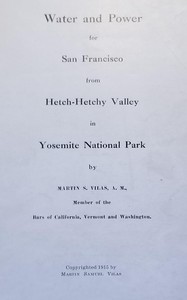
Water and Power for San Francisco from Hetch-Hetchy Valley in Yosemite National Park
by MARTIN S. VILAS, A. M., Member of the Bars of California, Vermont and Washington.
Copyrighted 1915 by MARTIN SAMUEL VILAS
UNSOLICITED STATEMENTS
Of U. S. Senator Elect and Ex-Mayor Phelan, Congressman Raker and San Francisco Officials as to this Article
WASHINGTON, D. C., March 14, 1914.
I can assure you that your clean, clear presentation of the matter was admirable and much appreciated.
(Member of Congress from California and author of the Raker Bill).
SAN FRANCISCO, CAL., February 4, 1914.
I think it was a valuable contribution to the data on that subject and indicates a considerable study upon your part.
(Member of Board of Supervisors, City of San Francisco).
SAN FRANCISCO, CAL., February 2, 1914.
I read your article in the _Chronicle_ on Hetch Hetchy and want to compliment you on the thoroughness with which you handled the subject.
(Clerk, Board of Supervisors, City of San Francisco).
SAN FRANCISCO, CAL., January 29, 1914.
I ... feel that you are entitled to considerable praise for the concise and clear manner in which you have covered a very comprehensive subject.
(Member of Board of Supervisors, City of San Francisco).
SAN FRANCISCO, CAL., January 29, 1914.
I read with much interest and satisfaction your very comprehensive and accurate article on the Hetch-Hetchy.
(Ex-Mayor of San Francisco and U. S. Senator elect from California).
SAN FRANCISCO, CAL., January 26, 1914.
I beg to compliment you on the clearness and conciseness with which you have stated many of the controversial points involved in same. I have had so much of it in the past year and I had to take up so many angles of the conflict that your resumé is decidedly refreshing.
(City Engineer, City of San Francisco).
SAN FRANCISCO, CAL., January 29, 1914.
... I beg to say to you in person what I long since wrote to the editor of the _Chronicle_. I stated to him that the article was a very valuable contribution to the literature on the Hetch-Hetchy subject, and was the best general exposition of the case that I had read in any newspaper and that, furthermore, the article was practically free from error. I have long since added it to my scrap book.
ALEXANDER T. VOGELSANG.
(Member of Board of Supervisors, City of San Francisco, and member of law firm of Vogelsang & Brown).
SAN FRANCISCO, CAL., February 6, 1914.
I consider it the best resumé of the Hetch-Hetchy scheme that has been written. I sent to the _Chronicle_ for ten more copies after reading it in order that I might use it in the future.
I trust that the article will have a very wide circulation, for it cannot but help convince every fair minded individual not only that San Francisco’s application for rights has not been hastily considered but fair play demanded the grant.
Speaking for myself, I thank you very much for your kindly interest in the matter and for your very careful and comprehensive article.
(City Attorney of the City of San Francisco).
HOW THE RAKER BILL AFFECTS YOSEMITE NATIONAL PARK, SAN FRANCISCO, AND THE REST OF CALIFORNIA
Facts Regarding Mountain Supply
History of City’s Fight for Pure and Adequate Water
BENEFITS TO BE DERIVED
Bay Counties and Irrigation Districts Provided for In National Grant
The Raker Bill, named for John E. Raker of Modoc county, Cal., a member of Congress, was reported unanimously by the House Committee on the Public Lands at the special session of Congress in the summer of 1913, after a hearing occupying several days, and under its recommendation passed the House. This bill was reported favorably by the Senate Committee on the Public Lands, and, after a hard fought contest, occupying a week on the floor of the Senate, passed that body December 6th, 1913, by a vote of 43 to 25. It received the approval of President Wilson and became a law on December 19, 1913.
The enactment of this bill ended a continuous effort on the part of San Francisco, covering a period of many years, to obtain the legal right to take water from Hetch-Hetchy. It marked the end of a contest, spirited and hard fought, which was participated in by the magazines and press the country over, and in which the great majority of publications outside of California opposed the plan of San Francisco.
Martin S. Vilas opens his 1915 pamphlet not with his own argument but with a chorus of endorsements from San Francisco officials—Congressman Raker, ex-Mayor Phelan, City Engineer O'Shaughnessy—each praising the "clearness and conciseness" of his newspaper article. This prefatory strategy immediately establishes the work as a piece of advocacy, positioning Vilas as a credible spokesman for the city's water needs. The text that follows is a tightly reasoned brief for the Hetch-Hetchy project, blending legal authority, engineering data, and civic urgency.
Endorsements as Argument
The opening pages of Vilas's pamphlet are unusual: they consist entirely of unsolicited testimonials from five city officials and the congressman who authored the Raker Bill. Each letter, dated early 1914, commends Vilas's earlier newspaper article for its "comprehensive and accurate" treatment of the Hetch-Hetchy controversy. By foregrounding these endorsements, Vilas borrows institutional authority before presenting his own case. The letters also reveal the tight network of municipal power—the mayor, supervisors, city engineer, and congressman all speak in a unified voice. This chorus of approval frames the pamphlet as an official document rather than a personal opinion, a rhetorical move that shapes the reader's expectation of objectivity.
Numbers and Need
Vilas builds his argument on a foundation of specific figures: San Francisco needs 75 million gallons daily, one-third of the city hauls water in barrels, and the Spring Valley Water Company's Calaveras dam offers uncertain relief. He cites City Engineer O'Shaughnessy's testimony before a House committee, quoting his description of "explorations all over the city" to find emergency water sources. The pamphlet then projects future demand, claiming the Hetch-Hetchy system will supply 250 gallons per day per capita for a million people, with capacity to serve over three million by the year 2000. These numbers are not neutral data; they are selected to dramatize scarcity and justify the massive engineering solution—a dam 300 feet high, 83 miles of tunnels, and two power houses generating 145,000 horsepower.
Legal and Regional Framing
Vilas carefully situates the Hetch-Hetchy project within existing law and regional cooperation. He references the "metropolitan district act," which allows municipalities to form water supply associations, and notes that Oakland, Berkeley, and Alameda have already joined to condemn local water sources. The pamphlet portrays San Francisco as the natural leader for a regional solution, with surrounding cities looking "anxiously" to it for relief. This legal and geographic framing transforms a local infrastructure debate into a matter of regional destiny. Vilas also mentions the city's $6 million high-pressure auxiliary water system built after the 1906 disaster, linking the new project to a proven record of civic investment and resilience.
Vilas's pamphlet is best read as a primary document of Progressive-era municipal boosterism, where engineering, law, and publicity converge. Readers should note how the author shifts between technical description and civic rhetoric, and how the endorsements at the front condition the reception of the argument. The text offers a vivid snapshot of how urban water wars were waged a century ago—through statistics, testimonials, and appeals to regional growth.
Some afternoons, I think of that 1915 editorial on Hetch-Hetchy, how Vilas framed water rights with such patient legal care. It felt less like persuasion than quiet accounting. That same steady glow lives in Artificial Light: Its Influence upon Civilization — Reading Notes, where progress hums softly through wires and filaments—two old friends, each turning a public need into a humble, luminous argument.
There are no reviews for this eBook.
There are no comments for this eBook.
Reader reflection
Your personal reading reflection
Build a private reading journal entry for this title.
Your progress
0
/
10
2
What was your overall reaction to the book?
3
Would you encourage someone else to read it?
4
How demanding did the text feel?
5
Did the book offer a fresh perspective?
6
Would you read this book again?
7
Could you follow the author’s main argument?
8
Did you relate to its people, ideas, or situations?
9
What is the main idea you are taking away?
10