
Catechism of the locomotive — A Closer Reading

(2 User reviews)   636
In Category - Inventions Industry
Forney, Matthias N. (Matthias Nace), 1835-1908, Kosak, Georg Project Gutenberg 2025
Locomotives -- Handbooks, manuals, etc. Readers of public-domain and historical texts
Project Gutenberg digital edition en

Edition facts

Words: 144,694
Reading time: 630 min
Text sections: 49
Forney's catechism dissects locomotive mechanics through question-and-answer format, blending translation of Kosak with original American practice. Excerpts reveal precise calculations of tractive force, debates over fulcrum points, and a preface detailing the book's hybrid origin.
Share
Editorial Edition Score 4.9/5

Calculated from edition completeness, EPUB availability, text structure and catalogue metadata. Not a user rating.

Edition quality

Read the Text

Text printed in italics or bold face in the source document have been transcribed between _underscores_ and =equal signs= respectively. Small capitals have been replaced with ALL CAPITALS. Characters between ~tildes~ represent the shape of the character rather than the character itself.

More Transcriber’s Notes and a list of changes made to the text may be found at the end of this text.

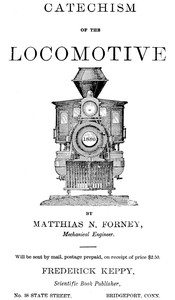
CATECHISM OF THE LOCOMOTIVE

BY MATTHIAS N. FORNEY, _Mechanical Engineer_.

Will be sent by mail, postage prepaid, on receipt of price $2.50.

FREDERICK KEPPY, _Scientific Book Publisher_, No. 38 STATE STREET, BRIDGEPORT, CONN.

Entered, according to Act of Congress, in the year 1874, by THE RAILROAD GAZETTE, In the office of the Librarian of Congress, at Washington.

Books, like individuals, have their histories, and it seems but proper that in introducing them somewhat of their ancestry should be detailed. The present book originated in this wise: the publishers of the RAILROAD GAZETTE procured a copy of the “Katechismus der Einrichtung und des Betriebes der Locomotive,” by Georg Kosak. As no English translation of this excellent little book was known to be in existence, the editors of the above paper determined to translate it and adapt it to the American practice in the construction and management of locomotive steam engines, and republish it in their journal. The translation was therefore made and submitted to the writer for revision and adaptation, according to the original intention. Before the latter was entertained, however, he had commenced writing an elementary treatise on the locomotive. In revising the first part of the translation of Mr. Kosak’s book, it was found that the latter occupied only to a very limited extent the ground which the writer had “staked out” in his own incomplete plan. He therefore concluded to abandon the original intention of “adapting” Mr. Kosak’s work, and determined to rewrite it and make substantially a new book of it. For the “idea,” however, and to some extent its plan, and for much valuable material, the author must acknowledge his indebtedness to Mr. Kosak. In some few cases the language of the translator has been employed, in part or in whole, without quotation marks, but with an acknowledgment in a foot-note. A similar plan has also been pursued in using some other books. This was done to avoid cutting up paragraphs and sentences into fragmentary parts with numerous quotation marks.

The following books have been consulted and used in writing the Catechism of the Locomotive: Heat considered as a Mode of Motion, by Prof. Tyndall; The Conservation of Energy, by Balfour Stewart; Railway Machinery, by D. K. Clark; Treatise on the Locomotive Engine, by Zerah Colburn; Treatise on the Steam Engine, by W. J. M. Rankine; Indicator Experiments on Locomotives, by Professor Bauschinger; Richards’ Steam Indicator, by Charles T. Porter; Die Schule des Locomotivführers, by J. Brosius and R. Koch; Mechanics, by A. Morin; The New Chemistry, by J. P. Cooke, Jr.; Combustion of Coal and the Prevention of Smoke, by C. Wye Williams; A Treatise on Steam Boilers, by Robert Wilson; Reports of the American Railway Master Mechanics’ Association; Link Valve Motion, by William S. Auchincloss, and Emergencies and How to Treat Them, by Dr. Joseph W. Howe.

For the title of the book an apology is perhaps needed, as the word Catechism is associated in nearly all persons’ minds we will trust with early religious and theological instruction, and therefore a Catechism of the Locomotive is very apt to sound more ludicrous than scientific. The title of Mr. Kosak’s book was adopted before it was determined to rewrite it, and it was afterwards not deemed best to change it. To those who are disposed to smile at it, the precedent of Mr. Bourne’s excellent Catechism of the Steam Engine is quoted, and if they will refer to Webster’s Dictionary for the definition of the word “catechism,” they will find that it means “an elementary book containing a summary of principles in any science or art, but appropriately in religion, reduced to the form of questions and answers, and sometimes with notes, explanations and reference to authorities,” which is exactly what the present book is intended to be.

To persons accustomed to books and study, the catechetical form is very apt to seem cumbrous and awkward, but it has some very decided advantages in writing for those who have not acquired studious habits of thought. To such the question asked presents first a distinct image of the subject to be considered, so that the explanation or instruction which follows is much more apt to be understood than it would be if no such question had been asked.

The author is indebted to Mr. D. B. Grant for the use of drawings from which most of the engravings of details of locomotives with which this book is illustrated have been made, and to other locomotive builders, whose engines are illustrated in the full-page plates, for the drawings thereof. He has also received very valuable aid from Mr. Richard H. Buel, Mechanical Engineer; Mr. William Buchanan, Master Mechanic of the Hudson River Railroad; Mr. Frank D. Child, Superintendent of the Hinkley Locomotive Works; and Mr. E. T. Jeffrey, Assistant Superintendent of Machinery of the Illinois Central Railroad.

The object in writing the book was to furnish a clear and easily understood description of the principles, construction and operation of the locomotive engine of the present day, a subject which is not concisely or adequately treated in any one similar book. If the author has succeeded in making what he has written plain to plain people, his aim will be fully accomplished.

_No. 73 Broadway_, NEW YORK.

Part I. The Steam Engine 1

II. The forces of Air and Steam 8

III. On Work, Energy and the Mechanical Equivalent of Heat 22

IV. The Slide-Valve 30

V. The Expansion of Steam 47

VI. General Description of a Locomotive Engine 62

VII. The Locomotive Boiler 71

VIII. The Boiler Attachments 115

IX. The Throttle-Valve and Steam-Pipes 155

X. The Cylinders, Pistons, Guide-Rods and Connecting- Rods 164

XI. The Valve-Gear 181

XII. The Running-Gear 268

XIII. Adhesion and Traction 319

XIV. Internal Disturbing Forces in the Locomotive 328

XV. Miscellaneous 335

XVI. Screw Threads, Bolts and Nuts 341

XVIII. Friction and Lubrication 358

XX. The Resistance of Trains 406

XXI. Proportions of Locomotives 412

XXII. Different Kinds of Locomotives 427

XXIII. Continuous Train Brakes 442

XXIV. Performance and Cost of Operating Locomotives 448

XXV. Water-Tanks and Turn-Tables 451

XXVI. Inspection of Locomotives 461

XXVII. Running Locomotives 478

XXVIII. Accidents to Locomotives 509

XXIX. Accidents and Injuries to Persons 533

XXX. Responsibility and Qualification of Locomotive Runners 544

List of Books for Mechanics, Locomotive Runners, Firemen, etc., 550

I. Table of the Properties of Steam 585

II. Table of Hyperbolic Logarithms 590

III. Table of the Properties of Different Kinds of Fuel 594

IV. Table of the Resistance of Trains 596

The Catechism of the Locomotive is intended for a large class of readers, among whom are all kinds of railroad officers and employes, consisting of locomotive runners, firemen, and the many different kinds of mechanics employed in railroad shops and in the construction of locomotive and other kinds of railroad machinery and material. Besides these there are many amateur engineers, students, and persons interested directly or indirectly in railroads, and a not inconsiderable class who are always seeking information on all subjects whatsoever. It is evident, therefore, that the only way to adapt the book to all the classes for whom it is intended, was to make it so plain that the “wayfaring man” will have no difficulty in comprehending it. It has therefore been written in as clear language as the writer could command, and the subjects presented are treated as simply and as plainly as his ability enabled him to do, and with the least possible employment of either scientific or practical technicalities. The only deviation from this plan will be found in the use of algebraic symbols to designate arithmetical calculations. This was done to save space, and because it was thought that they could be explained so that even those without any knowledge whatsoever of algebra could easily comprehend them. To such as have no such knowledge the following explanation is given:

Suppose it is necessary to add two numbers, say 1,872 and 468. The calculation, if made arithmetically, would be thus:

1,872 468 ----- 2,340

This it will be seen occupies the space of several lines of print. If we want to express this calculation algebraically, it can be done by simply writing the two numbers and placing the sign +, called _plus_, between the two, which indicates that they are to be added together, thus:

To indicate what the _sum_ will be, or what the two added together will amount to, the sign =, called _equal to_, or the sign of equality, is placed after the two numbers and between them and the sum, thus:

which can be read as follows:

1,872 _added to_ 468 _is equal to_ 2,340.

Now the only use of the algebraic signs + and = is that they save time in writing and room in printing, and when persons become accustomed to their use they make plain a number of operations at a single glance, as will be shown hereafter.

In the same way that the sign + means _added to_, the sign - means _less_ or subtracted from, thus:

which is the same as though it was printed as follows:

1,872 _less_ 468 _is equal to_ 1,404.

The sign × means _multiplied by_, or is the sign of multiplication. Thus:

1,872 × 468 = 876,096;

1,872 _multiplied by_ 468 _is equal to_ 876,096.

The sign ÷ means divided by, thus:

1,872 _divided by_ 468 _is equal to_ 4.

The same thing is expressed by putting a line under the dividend and writing the divisor under the line, thus:

These signs are combined in various ways. Thus, supposing we wanted to add 1,872 to 468 and then divide the sum by 117, it would be necessary, in order to represent the arithmetical calculation, to do it as follows:

1872 468 ---- 117)2340(20 234 ---- 0

Algebraically it would be stated thus:

1872 + 468 ---------- = 20 117

If you wanted to add 124 to the quotient 20 above, the calculation would be as follows:

1872 468 ---- 117)2340( 20 234 124 ---- --- 0 144

This operation could be expressed by writing it as follows:

1872 + 468 ---------- + 124 = 144. 117

If we wanted to multiply the quotient 20 by 124 we would simply put the sign × instead of + before 124, thus:

1872 + 468 ---------- × 124 = 2480. 117

The sign of subtraction or division can be used in the same way.

With these explanations it is believed that any one, with nothing more than an ordinary knowledge of the four elementary rules of arithmetic, can understand all the mathematics contained in the following pages. A little explanation may also be needed of the method of representing machinery and other structures by mechanical drawings.

If we want to represent the outside of any object, say an apple, we make a drawing of it as shown at _A_. Now if we want to show the inside of the apple, say the seeds and core, we can cut it in half and represent it as shown at _C_, which is then called a _section_ or _sectional view_ of the apple. If we represent it as it will appear if we are above it and looking down on it as shown at _B_, it is called a _top view_ or _plan_.

It is evident, too, that it might be desirable to show the arrangement of the seeds in the apple as they would appear if it was cut through in the other direction, say on the line _a b_, fig. _A_, and as is shown at _D_. There are therefore two kinds of sections; one _C_, in which the object is supposed to be cut through vertically, and therefore called a _vertical section_, the other when the object is supposed to be cut through horizontally, and therefore called a _horizontal section_, as shown at _D_.

It is also evident that in looking at a locomotive or any other object, the appearance of the engine depends upon our position in relation to it. Thus, if we stand on the side of it, we see that part of the engine, and a drawing which represents the side, is therefore called a _side view_ or _side elevation_. A drawing which represents a locomotive or other object as it would appear to us if we stood in front of it, is called a _front view_ or _front elevation_, and a representation of the back part of any object as it would appear to us if we stood behind it is called a _back view_ or _back elevation_. Plate I is a side view, Plate II a section, Plate III a top view or plan;[1] the vignette in the title page is a front view and fig. 71 a back view of a locomotive. If the drawing is made as the object would appear if it was turned upside down, and we were looking at it from above, then it is called an _inverted plan_.

[1] The boiler of the locomotive is supposed to be removed in Plate III.

It is obvious, too, that it is possible to make a great many different sectional views of nearly any object, especially of a machine. Thus, we could suppose a locomotive cut through vertically and lengthwise, as is shown in Plate II. Such a representation is called a _longitudinal_ section. A locomotive could also be cut through crosswise, as shown in fig. 40, which is called a _transverse section_. It is of course possible to represent a transverse section of a machine like a locomotive at a great many different points; for example, it could be shown as though it was cut through the smoke-stack as in fig. 40, or through the boiler farther back, as the latter is shown in fig. 42. Usually when a section is shown through a cylindrical object like a smoke-stack or boiler, it is shown through its centre. If, however, this is not apparent from the drawing or engraving, it should be stated at what point it is supposed to be taken, thus the section _D_ of the apple is on the line _a b_ of fig. _A_, and the section _C_ is on the line _c d_.

In drawing sections, the parts which are supposed to be cut in two are usually shaded with parallel diagonal lines drawn at equal distances apart, as shown in the sections of the apple at _C_ and _D_. Sections are also sometimes represented with solid black surfaces, as in Plates II and III, and in the engraving of a pump in fig. 66.

Objects which are behind others which are in front of them are often shown with dotted lines, so as to indicate their position. The seeds of the apple are thus indicated at _A_.

It is also customary, in drawings of machinery, to take great liberties with the objects represented and to show them with parts removed or broken away, if their construction can thus be made plainer. It should be remembered that the purpose of drawings of this kind is not to give a pictorial representation of the object as it appears to the eye, but to make its construction and mode of operation apparent to the mind. In such drawings therefore all perspective is disregarded. It would lead us too far were we to explain the reasons for this, and therefore readers must accept the assertion without the proof.

CATECHISM OF THE LOCOMOTIVE.

QUESTION 1. _What is the motive power employed in ordinary steam engines?_

_Answer._ The expansive force of steam.

QUESTION 2. _How is this expansive force of steam applied?_

_Answer._ It is applied by admitting it into a _cylinder_ (_A_, fig. 1) in which a _piston_, _B_, is fitted so as to move air-tight from one end of the cylinder to the other. The steam, if admitted at _C_, will force the piston _B_ to the opposite end[2] of the cylinder. When it has reached that end, if the steam is allowed to escape and a fresh supply is admitted to the cylinder through the opening _d_, it will move the piston back again. In this way, by alternately admitting steam at one end and exhausting it from the other, the piston receives a _reciprocating motion_, which is communicated to the outside of the cylinder by a rod, _R_, which is called the _piston-rod_, which works air-tight through an opening in one of the _cylinder-covers_, or _cylinder-heads_, as they are usually called.

[2] In all ordinary locomotives, the cylinders are so placed that the head _C_ through which the piston-rod works is behind, and the other head _D_ in front. The two ends of the cylinder are therefore designated the _front_ and _back ends_, respectively.

QUESTION 3. _How is this reciprocating motion of the piston converted into rotary motion?_

_Answer._ By connecting the end of the piston-rod _R_ (fig. 2) by another rod, _E_; called a _connecting-rod_, with a crank, _P_, which is attached to a revolving shaft, _S_. It is apparent that if the piston _B_ is moved in the direction shown by the dart _R_, a rotary motion will be given to the crank in the direction of the dart _N_. When, however, the crank reaches the position shown by the dotted lines in fig. 5, it is plain that a force applied to move the piston in either direction will no longer produce a rotary movement of the crank and shaft. The same thing will occur when the crank is in the opposite position, shown by the full lines. These two positions are called the _dead-points_ of the crank.

QUESTION 4. _How is the crank of an ordinary steam engine carried past the dead-points?_

_Answer._ Stationary engines are usually provided with a large and heavy wheel, called a _fly-wheel_ (_F F_, fig. 2) which is attached to the shaft _S_. This wheel receives a sufficient amount of momentum from the crank, while the latter is moving from one dead-point to the other, to carry it past those points.

QUESTION 5. _How is the steam admitted to and exhausted from the cylinder?_

_Answer._ It is admitted through two channels, _c_, _d_, fig. 2, called _steam-ways_, cast in the cylinder. These ways terminate in a smooth flat surface, _f f_, called the _valve-seat_. Their openings in the valve-seat are called _steam-ports_. Between them is another port or cavity, _g_, called the _exhaust-port_, which communicates with the open air. The form of these ports is long and narrow, as shown in fig. 4, which represents a plan of them. Over these ports a valve, _V_, called a _slide-valve_, usually made of cast iron, with a cavity, _H_, on its under side, is fitted so that by moving it backwards or forwards it will alternately cover and uncover the two steam-ports. The valve and valve-seat are inclosed in a sort of box, _I I_, fig. 2, made of cast iron, called a _steam-chest_, into which steam is admitted from the boiler by a pipe, _J_. When the valve is in the position represented in fig. 2, the front steam-port is uncovered and the steam is admitted to the front end of the cylinder, and thus forces the piston towards the back end. If, when the piston reaches the back end, the valve be moved into the position shown in fig. 3, the back steam-port will be uncovered and steam will be admitted to that end of the cylinder. At the same time it will be observed that the aperture of the front steam-port _c_ and that of the exhaust-port are both covered by the cavity in the slide-valve, so that the steam which was admitted to the front end of the cylinder can escape through the steam-port _c_ into the exhaust-port, and thus into the open air. In this way, by moving the valve alternately back and forth, steam is simultaneously admitted first to one end and exhausted from the other, and _vice versa_.

QUESTION 6. _How is the slide-valve moved so as to admit and exhaust the steam at the right time?_

Matthias N. Forney’s Catechism of the Locomotive opens with a frank account of its own making: the publisher of the Railroad Gazette obtained a copy of Georg Kosak’s German Katechismus, planned an English translation adapted to American practice, and then found that Forney’s own embryonic treatise covered different ground. The result is a book that is neither pure translation nor wholly original, but a deliberate hybrid. Forney acknowledges using Kosak’s “idea” and “plan,” and occasionally the translator’s language without quotation marks—a decision he defends as necessary to avoid “cutting up paragraphs and sentences into fragmentary parts.” This editorial note examines three tensions visible in the supplied excerpts: the book’s dual authorship, its treatment of a disputed mechanical principle, and the pedagogical structure of its question-and-answer form.

A Book with Two Fathers

The preface lays out a layered genealogy. Forney credits Kosak for the “idea” and “to some extent its plan,” and lists a dozen other works consulted, from Tyndall’s Heat considered as a Mode of Motion to Brosius and Koch’s Die Schule des Locomotivführers. Yet he also stakes out his own ground: the original intention to “adapt” Kosak was abandoned when Forney realized his own plan was “incomplete” and that Kosak’s book “occupied only to a very limited extent” the territory he had mapped. The resulting text is a palimpsest—Kosak’s structure visible beneath Forney’s expansions, with occasional unmarked borrowings from the translator and other sources. This frankness about textual borrowing is unusual for a technical manual of the period, and it invites the reader to consider how authority is constructed in such works.

The Fulcrum Dispute: A Mechanical Contention

In the excerpt discussing tractive force, Forney devotes a paragraph to what he calls “much animated discussion and contention”: whether the fulcrum of the wheel-as-lever is at the axle center or at the point of contact with the rail. He resolves the dispute by noting it “is due simply to a difference in the meaning assigned to the word fulcrum.” If the fulcrum is fixed relative to the locomotive, it is at the axle; if relative to the earth, at the rail. This is not a mere quibble—the choice affects the calculation of unbalanced forces. Forney works through both models, showing that each yields the same tractive force of 3,333 pounds. The passage exemplifies the book’s method: it does not simply state results but walks the reader through competing frameworks, acknowledging that technical terms can harbor ambiguity.

Question-and-Answer as Pedagogical Engine

The catechism format structures the entire work. In the excerpt, Question 312 asks “How is the locomotive made to advance by causing the wheels to revolve?” The answer runs over several paragraphs, using a diagram (fig. 192) and a hypothetical chain-and-pulley setup to isolate forces. Forney assumes the reader can follow a lever calculation with a six-foot wheel and two-foot stroke, and he supplies round numbers for clarity. The form imposes discipline: each question narrows a topic, and the answer must be self-contained. Yet the format also allows digressions—like the fulcrum dispute—that a continuous prose treatise might bury. The result is a book that teaches by repeated, focused interrogation, mirroring the oral catechisms from which the title derives.

Readers approaching Catechism of the Locomotive should expect a work that is both practical and reflective. Forney does not merely deliver facts; he shows how those facts were arrived at, and sometimes why they were contested. The book rewards those who read its calculations closely and who note the author’s candid remarks about his sources. The question-and-answer form, far from being a gimmick, shapes the kind of attention the text demands—patient, sequential, and willing to revisit a problem from multiple angles.

Emma Adams
1 month ago

Madison Lee
1 week ago

4.5
4.5 out of 5 (2 User reviews )

Add a Review

Your Rating *
  • ...
    Brandon Thomas - 3 weeks ago
    {'type': 'neutral', 'text': "The Catechism of the Locomotive is an informative introduction to steam locomotive design and operation. The question-and-answer format is straightforward and accessible, yet it can feel repetitive after a while. It focuses heavily on older technology, so those seeking modern developments will be out of luck. Still, for historical knowledge, it's a decent resource."}

  • ...
    Justin Hoover - 3 weeks ago
    {'type': 'positive', 'text': "This catechism-style book is perfect for railroad enthusiasts and students. The Q&A format makes it easy to digest the workings of steam locomotives, from the boiler to the reversing gear. The explanations are clear, concise, and practical, and the illustrations are helpful. It's a great reference that has stood the test of time, giving a solid foundation in steam locomotive technology. Highly recommended for anyone starting their journey into railway mechanics."}

  • ...
    Susan Garcia - 1 week ago
    {'type': 'negative', 'text': "This book is extremely outdated and lacks the clarity needed for modern learners. The Q&A format is rigid and doesn't allow for in-depth explanations, often leaving you with more questions than answers. The illustrations are rudimentary and the text is filled with obsolete terminology. There are far better, modern books that explain locomotive mechanics with actual diagrams and clearer reasoning. Not recommended unless you're a hardcore history buff."}


Reader reflection

Your personal reading reflection

Build a private reading journal entry for this title.

Your progress 0 / 10
1

Where are you in your reading?

2

How much did you enjoy the reading experience?

3

Would you encourage someone else to read it?

4

How much effort did this book require?

Related eBooks