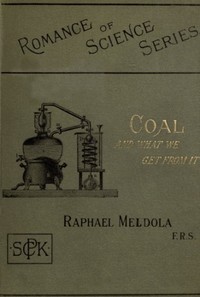
Coal, and What We Get from It — A Closer Reading

(1 User reviews)   373
Meldola, Raphael, 1849-1915 Project Gutenberg 2010
Coal; Coal-tar products Readers of public-domain and historical texts
Project Gutenberg digital edition en

Edition facts

Words: 46,892
Reading time: 204 min
Text sections: 6
Raphael Meldola's 1891 lecture-turned-book traces coal's transformation from ancient plant matter into dyes, explosives, and medicines, emphasizing the chemical ingenuity behind coal-tar derivatives without using a single formula.
Share
Editorial Edition Score 4.7/5

Calculated from edition completeness, EPUB availability, text structure and catalogue metadata. Not a user rating.

Edition quality

Read the Text

Origin of Coal, 9. Coal of various ages, 11. Graphite, 12. Recent Vegetable Deposits, 13. Mode of occurrence of Coal, 13. Structure of Coal, 15. Uses of Coal, 16. Coal a source of Energy, 17. Mechanical Equivalent of Heat, 19. Value of Coal as a Fuel, 20. Small efficiency of Steam-engines, 21. Mechanical value of Coal, 22. Whence Coal derives its Energy, 22. Chemical Composition of Coal, 23. Growth of Plants, 26. Solar Energy, 28. Transformation of Wood into Coal, 30. Destructive Distillation of Coal, 33. Experiments of Becher, 34; of Dean Clayton, 35; of Stephen Hales, 37; of Bishop Watson, 37; of the Earl of Dundonald, 39. Coal-gas introduced by Murdoch, 40. Spread of the new Illuminant, 41. Manufacture of Coal-gas, 42. Quantitative results, 45. Uses of Coke, 47. Goethe's visit to Stauf, 48. Bishop Watson on waste from Coke-ovens, 50. Shale-oil Industry, 50. History of Coal-mining, 57. Introduction of Coal into London, 58. The Coal resources of the United Kingdom, 60. Competition between Electricity and Coal-gas, 62.

Ammoniacal Liquor of Gas-works, 64. Origin of the Ammonia, 65. Ammonia as a Fertilizer, 65. Other uses of Ammonia, 67. Annual production of Ammonia, 68. Utilization of Coal-tar, 69. The Creosoting of Timber, 70. Early uses of the Light Tar Oils, 71. Discovery of Benzene by Faraday; isolation from Tar Oil by Hofmann and Mansfield, 73. Discovery of Mauve by Perkin, 74. History of Aniline, 75. The Distillation of Coal-tar, 77. Separation of the Hydrocarbons of the Benzene Series, 82. Manufacture of Aniline and Toluidine, 87. History and Manufacture of Magenta, 89. Blue, Violet, and Green Dyes from Magenta, 92. The Triphenylmethane Group, 97. The Azines, 108. Lauth's Violet and Methylene Blue, 111. Aniline Black, 114. Introduction of Azo-dyes, 115. Aniline Yellow, Manchester Brown, and Chrysoidine, 118. The Indulines, 121. Chronological Summary, 122.

Natural Sources of Indigo, 124. Syntheses of the Colouring-matter, 126. Carbolic Oil, its treatment and its constituents, 129. Phenol Dyes, 132. Salicylic Acid and its uses, 134. Picric Acid, 136. Naphthalene and its applications, 139. The Albo-carbon Light, 140. Phthalic Acid and the Phthaleins, 145. Magdala Red, 149. Azo-dyes from the Naphthols, Naphthylamines, and their Sulpho-acids, 150. Naphthol Green, the Oxazines, and the Indophenols, 161. Creosote Oil, 163. The Lucigen Burner, 163. Anthracene Oil, 167. The Discovery of Artificial Alizarin, and its effects on Madder growing, 167. The industrial isolation of Anthracene and its conversion into Colouring-matters, 171. Pitch, and its uses, 176. Patent Fuel, or Briquettes, 178. Coal-tar products in Pharmacy, 178. Aromatic Perfumes, 185. Coal-tar Saccharin, 186. Coal-tar Products in Photography, 188. Coal-tar Products in Biology, 192. Value of the Coal-tar Industry, 194. The Coal-tar Industry in relation to pure Science, 196. Permanence of the Artificial Colouring-matters, 198. Chronological Summary, 200. Addendum, 202.

COAL; AND WHAT WE GET FROM IT.

"Hier [1771] fand sich eine zusammenhaengende Ofenreihe, wo Steinkohlen abgeschwefelt und zum Gebrauch bei Eisenwerken tauglich gemacht werden sollten; allein zu gleicher Zeit wollte man Oel und Harz auch zu Gute machen, ja sogar den Russ nicht missen, und so unterlag den vielfachen Absichten alles zusammen."--Goethe, _Wahrheit und Dichtung_, Book X.

To get at the origin of the familiar fuel which blazes in our grates with such lavish waste of heat, and pollutes the atmosphere of our towns with its unconsumed particles, we must in imagination travel backwards through the course of time to a very remote period of the world's history. Ages before man, or the species of animals and plants which are contemporaneous with him, had appeared upon the globe, there flourished a vegetation not only remarkable for its luxuriance, but also for the circumstance that it consisted to a preponderating extent of non-flowering or cryptogamic plants. In swampy areas, such as the deltas at the mouths of great rivers, or in shallow lagoons bordering a coast margin, the jungles of ferns and tree-ferns, club-mosses and horse-tails, sedges, grasses, &c., grew and died down year by year, forming a consolidated mass of vegetable matter much in the same way that a peat bed or a mangrove swamp is accumulating organic deposits at the present time. In the course of geological change these beds of compressed vegetation became gradually depressed, so that marine or fresh-water sediment was deposited over them, and then once more the vegetation spread and flourished to furnish another accumulation of vegetable matter, which in its turn became submerged and buried under sediment, and so on in successive alternations of organic and sedimentary deposits.

But these conditions of climate, and the distribution of land and water favourable to the accumulation of large deposits of vegetable matter, gradually gave way to a new order of things. The animals and plants adapted to the particular conditions of existence described above gave rise to descendants modified to meet the new conditions of life. Enormous thicknesses of other deposits were laid down over the beds of vegetable remains and their intercalated strata of clay, shale, sandstone, and limestone. The chapter of the earth's history thus sealed up and stowed away among her geological records relates to a period now known as the Carboniferous, because of the prevalence of seams or beds of coal throughout the formation at certain levels. By the slow process of chemical decomposition without access of air, modified also by the mechanical pressure of superincumbent formations, the vegetable deposits accumulated in the manner described have, in the lapse of ages, become transformed into the substance now familiar to us as coal.

Although coal is thus essentially a product of Carboniferous age, it must not be concluded that this mineral is found in no other geological formation. The conditions favourable for the deposition of beds of vegetable matter have prevailed again and again, at various periods of geological time and on different parts of the earth, although there is at present no distinct evidence that such a luxuriant growth of vegetation, combined with the other necessary conditions, has ever existed at any other period in the history of the globe. Thus in the very oldest rocks of Canada and the northern States of America, in strata which take us back to the dawn of geological history, there is found abundance of the mineral graphite, the substance from which black-lead pencils are made, which is almost pure carbon. Now most geologists admit that graphite represents the carbon which formed part of the woody tissue of plants that lived during those remote times, so that this mineral represents coal in the ultimate stage of carbonization. In some few instances true coal has been found converted into graphite _in situ_ by the intrusion of veins of volcanic rock (basalt), so that the connection between the two minerals is more than a mere matter of surmise.

Then again we have coal of pre-Carboniferous age in the Old Red Sandstone of Scotland, this being of course younger in point of time than the graphite of the Archaean rocks. Coal of post-Carboniferous date is found in beds of Permian age in Bavaria, of Triassic age in Germany, in the Inferior Oolite of Yorkshire belonging to the Jurassic period, and in the Lower Cretaceous deposits of north-western Germany. Coming down to more recent geological periods, we have a coal seam of over thirty feet in thickness in the northern Tyrol of Eocene age; we have brown coal deposits of Oligocene age in Belgium and Austria, and, most remarkable of all, coal has been found of Miocene, that is, mid-Tertiary age, in the Arctic regions of Greenland within a few degrees of the North Pole. Thus the formation of coal appears to have been going on in one area or another ever since vegetable life appeared on the globe, and in the peat bogs, delta jungles, and mangrove swamps of the present time we may be said to have the deposition of potential coal deposits for future ages now going on.

Although in some parts of the world coal seams of pre-Carboniferous age often reach the dignity of workable thickness, the coal worked in this country is entirely of Carboniferous date. After the explanation of the mode of formation of coal which has been given, the phenomena presented by a section through any of our coal measures will be readily intelligible (see Fig. 1). We find seams of coal separated by beds of sandstone, limestone, or shale representing the encroachment of the sea and the deposition of marine or estuarine sediment over the beds of vegetable remains. The seams of coal, varying in thickness from a few inches to three or four feet, always rest on a bed of clay, known technically as the "underclay," which represents the soil on which the plants originally grew. In some instances the seams of coal with their thin "partings" of clay reach an aggregate thickness of twenty to thirty feet. In many cases the very roots of the trees are found upright in a fossilized condition in the underclay, and can be traced upwards into the overlying coal beds; or the completely carbonized trunk is found erect in the position in which the tree lived and died (see Fig. 2).

Owing to the chemical and mechanical forces to which the original vegetable deposit has been subjected, the organic structure of coal has for the most part been lost. Occasionally, however, portions of leaves, stems, and the structure of woody fibre can be detected, and thin sections often show the presence of spore-cases of club-mosses in such numbers that certain kinds of coal appear to be entirely composed of such remains. But although coal itself now furnishes but little direct evidence of its vegetable origin, the interstratified clays, shales, and other deposits often abound with fossilized plant remains in every state of preservation, from the most delicate fern frond to the prostrate tree trunk many yards in length. It is from such evidence that our knowledge of the Carboniferous flora has been chiefly derived.

Now this carbonized vegetation of a past age, the history of which has been briefly sketched in the foregoing pages, is one of the chief sources of our industrial supremacy as a nation. We use it as fuel for generating the steam which drives our engines, or for the production of heat wherever heat is wanted. In metallurgical operations we consume enormous quantities of coal for extracting metals from their ores, this consumption being especially great in the case of iron smelting. For this last operation some kinds of raw coal are unsuitable, and such coal is converted into coke before being used in the blast furnace. The fact that the iron ore and the coal occur in the same district is another cause of our high rank as a manufacturing nation.

It has often been a matter of wonder that iron ore and the material essential for extracting the metal from it should be found associated together, but it is most likely that this combination of circumstances, which has been so fortunate for our industrial prosperity, is not a mere matter of accident, but the result of cause and effect. It is, in fact, probable that the iron ore owes its origin to the reduction and precipitation of iron compounds by the decomposing vegetation of the Carboniferous period, and this would account for the occurrence of the bands of ironstone in the same deposits with the coal. In former times, when the area in the south-east of England known as the Weald was thickly wooded, the towns and villages of this district were the chief centres of the iron manufacture. The ore, which was of a different kind to that found in the coal-fields, was smelted by means of the charcoal obtained from the wood of the Wealden forests, and the manufacture lingered on in Kent, Sussex, and Surrey till late in the last century, the railings round St. Paul's, London, being made from the last of the Sussex iron. When the northern coal-fields came to be extensively worked, and ironstone was found so conveniently at hand, the Wealden iron manufacture declined, and in many places in the district we now find disused furnaces and heaps of buried slag as the last witnesses of an extinct industry.

From coal we not only get mechanical work when we burn it to generate heat under a steam boiler, but we also get chemical work out of it when we employ it to reduce a metallic ore, or when we make use of it as a source of carbon in the manufacture of certain chemical products, such as the alkalies. We have therefore in coal a substance which supplies us with the power of doing work, either mechanical, chemical, or some other form, and anything which does this is said to be a source of energy. It is a familiar doctrine of modern science that energy, like matter, is indestructible. The different forms of energy can be converted into one another, such, for example, as chemical energy into heat or electricity, heat into mechanical work or electricity, electricity into heat, and so forth, but the relationship between these convertible forms is fixed and invariable. From a given quantity of chemical energy represented, let us say, by a certain weight of coal, we can get a certain fixed amount of heat and no more. We can employ that heat to work a steam-engine, which we can in turn use as a source of electricity by causing it to drive a dynamo-machine. Then this doctrine of science teaches us that our given weight of coal in burning evolves a quantity of heat which is the equivalent of the chemical energy which it contains, and that this quantity of heat has also its equivalent in mechanical work or in electricity. This great principle--known as the Conservation of Energy--has been gradually established by the joint labours of many philosophers from the time of Newton downwards, and foremost among these must be ranked the late James Prescott Joule, who was the first to measure accurately the exact amount of work corresponding to a given quantity of heat.

In measuring heat (as distinguished from temperature) it is customary to take as a unit the quantity necessary to raise a given weight of water from one specified temperature to another. In measuring work, it is customary to take as a unit the amount necessary to raise a certain weight at a specified place to a certain height against the force of gravity at that place. Joule's unit of heat is the quantity necessary to raise one pound of water from 60 deg. to 61 deg. F., and his unit of work is the foot-pound, _i.e._ the quantity necessary to raise a weight of one pound to a height of one foot. Now the quantitative relationship between heat and work measured by Joule is expressed by saying that the mechanical equivalent of heat is about 772 foot-pounds, which means that the quantity of heat that would raise one pound of water 1 deg. F. would, if converted into work, be capable of raising a one-pound weight to a height of 772 feet, or a weight of 772 lbs. to a height of one foot.

This mechanical equivalent ought to tell us exactly how much power is obtainable from a certain weight of coal if we measure the quantity of heat given out when it is completely burnt. Thus an average Lancashire coal is said to have a calorific power of 13,890, which means that 1 lb. of such coal on complete combustion would raise 13,890 lbs. of water through a temperature of 1 deg. F., if we could collect all the heat generated and apply it to this purpose. But if we express this quantity of heat in its mechanical equivalent, and suppose that we could get the corresponding quantity of work out of our pound of coal, we should be grievously mistaken. For in the first place, we could not collect all the heat given out, because a great deal is communicated to the products of combustion by which it is absorbed, and locked up in a form that renders it incapable of measurement by our thermometers. In the next place, if we make an allowance for the quantity of heat which thus disappears, even then the corrected calorific power converted into its mechanical equivalent would not express the quantity of work practically obtainable from the coal.

In the most perfectly constructed engine the whole amount of heat generated by the combustion of the coal is not available for heating the boiler--a certain quantity is lost by radiation, by heating the material of the furnace, &c., by being carried away by the products of combustion and in other ways. Moreover, some of the coal escapes combustion by being allowed to go away as smoke, or by remaining as cinders. Then again, in the engine itself a good deal of heat is lost through various channels, and much of the working power is frittered away through friction, which reconverts the mechanical power into its equivalent in heat, only this heat is not available for further work, and is thus lost so far as the efficiency of the engine is concerned. These sources of loss are for the most part unavoidable, and are incidental to the necessary imperfections of our mechanism. But even with the most perfectly conceivable constructed engine it has been proved that we can only expect one-sixth of the total energy of the fuel to appear in the form of work, and in a very good steam-engine of the present time we only realize in the form of useful work about one-tenth of the whole quantity of energy contained in the coal. Although steam power is one of the most useful agencies that science has placed at the disposal of man, it is not generally recognized by the uninitiated how wasteful we are of Nature's resources. One of the greatest problems of applied science yet to be solved is the conversion of the energy latent in coal or other fuel into a quantity of useful work approximating to the mechanical equivalent much more closely than has hitherto been accomplished.

But although we only get this small fraction of the whole working capability out of coal, the actual amount of energy dormant in this substance cannot but strike us as being prodigious. It has already been said that a pound of coal on complete combustion gives out 13,890 heat units. This quantity of heat corresponds to over 10,000,000 foot-pounds of work. A horse-power may be considered as corresponding to 550 foot-pounds of work per second, or 1,980,000 foot-pounds per hour. Thus our pound of coal contains a store of energy which, if capable of being completely converted into work without loss, would in one hour do the work of about five and a half horses. The strangest tales of necromancy can hardly be so startling as these sober figures when introduced for the first time to those unaccustomed to consider the stupendous powers of Nature.

If energy is indestructible, we have a right to inquire in the next place from whence the coal has derived this enormous store. A consideration of the origin of coal, and of its chemical composition, will enable this question to be answered. The origin of coal has already been discussed. Chemically considered, it consists chiefly of carbon together with smaller quantities of hydrogen, oxygen, and nitrogen, and a certain amount of mineral matter which is left as ash when the coal is burnt. The following average analyses of different varieties will give an idea of its chemical composition:--

------------------------------------------------------------------- Variety of Coal. | Carbon. | Hydrogen. | Oxygen. | Nitrogen. | Ash. -------------------+---------+-----------+---------+-----------+----- S. Staffordshire | 73.4 | 5.0 | 11.7 | 1.7 | 2.3 Newcastle (Caking) | 80.0 | 5.3 | 10.7 | 2.2 | 1.7 Cannel (Wigan) | 81.2 | 5.6 | 7.9 | 2.1 | 2.5 Anthracite (Welsh) | 90.1 | 3.2 | 2.5 | 0.8 | 1.6 ---------------------------------------------------------------------

There are in addition to these constituents small quantities of sulphur and a certain variable amount of water (5 to 10 per cent.) in all coals, but the elements which most concern us are those heading the respective columns.

From the foregoing analyses, which express the percentage composition, it will be seen that carbon is by far the most important constituent of coal. Carbon is a chemical element which is found in a crystalline form in nature as the diamond, and which forms a most important constituent of all living matter, whether animal or vegetable. Woody fibre contains a large quantity of this element, and the carbon of coal is thus accounted for; it was accumulated during the growth of the plants of the Carboniferous period.

Raphael Meldola opens his 1891 work by framing coal-tar chemistry as a 'romance of dirt'—an industry born from gas-works waste. The preface admits the difficulty of making applied science intelligible to a general reader, and the book delivers on that promise by weaving historical discovery with technical explanation, all without a chemical formula. Meldola, a professor at Finsbury Technical College, dedicates the volume to William Henry Perkin, founder of the coal-tar colour industry, signaling the narrative's focus on human ingenuity.

The text moves from coal's geological origins to its role as a source of energy, then into the cascade of derivatives: benzene, toluene, aniline, and the dyes that followed. Meldola's voice is that of a patient lecturer, guiding readers through oxidation processes, the rise of aniline black, and the commercial competition with natural dyes like logwood.

From Lecture Hall to Printed Page

The book's structure retains the rhythm of its origin: a single lecture delivered at the London Institution on January 20, 1890, expanded into six chapters. Meldola addresses his audience directly, using phrases like 'we can consider the history of some of these colours now' to maintain a conversational pace. The preface confesses 'great misgivings' about success, yet the text proceeds with confidence, alternating between historical narrative and technical explanation. This hybrid form—part lecture, part treatise—creates a distinctive voice that is both authoritative and approachable.

Meldola frequently pauses to acknowledge the limits of his audience's knowledge, as when he notes that popular lectures 'generally treated in a superficial way' leave listeners with only the bare fact that dyestuffs come from coal-tar. His aim is to go 'somewhat beyond this,' and the book's pacing reflects that ambition: slow enough to explain oxidation and electrolysis, yet brisk enough to cover a century of innovation.

The Language of Applied Science

Meldola's prose is precise but not dry. He describes aniline black as 'a most valuable and important black' and notes that its production 'created an increased demand for the hydrochloride of aniline.' Technical terms like 'nascent oxygen' and 'electrolysis' appear without apology, but he anchors them in practical outcomes: the dyeing of cotton, the competition with logwood, the role of vanadium salts. The text is studded with names—Runge, Perkin, Lightfoot, Lauth, Coquillion, Goppelsröder—that map a network of chemists and inventors.

Meldola also uses economic language: processes 'spread rapidly,' compounds are 'manufactured in enormous quantities,' and new dyes 'have had an enormous influence.' This blend of chemical and commercial vocabulary reflects the book's dual purpose: to explain science while showing its industrial impact. The result is a narrative that feels both educational and urgent, as if Meldola is arguing for the value of applied knowledge.

Pacing Through Process and Discovery

The book's pace shifts between broad overviews and detailed case studies. Early chapters on coal's origin and energy value move quickly, compressing geological time into a few pages. Later sections slow down for extended treatments of specific dyes: aniline black receives several paragraphs tracing its development from Runge's 1834 observations to Lightfoot's 1863 process and beyond. Meldola uses these deep dives to illustrate scientific principles—oxidation, electrolysis, the action of nitrous acid—without resorting to formulas.

This variation in pace mirrors the lecture format: a rapid survey to establish context, then a focused examination of key innovations. The effect is cumulative; readers emerge with a sense of how individual discoveries built on each other. Meldola's closing remarks on the future of electrolytic processes hint at ongoing change, leaving the narrative open-ended rather than concluded.

Readers approaching this book should expect a work that rewards patience. Meldola assumes no chemical knowledge but demands attention to process and chronology. The absence of formulas is deliberate, not a simplification but a translation: he renders chemical reactions as stories of human effort and industrial need. For those interested in the history of technology, the book offers a rare glimpse into how a late-Victorian scientist made complex material accessible—and why he believed that effort mattered.

Lucas Robinson
3 weeks ago

5
5 out of 5 (1 User reviews )

Add a Review

Your Rating *
  • ...
    Susan Fisher - 3 weeks ago
    {'rating': 5, 'text': "An enlightening read that explains the vital role of coal in our industrial history and daily lives. The book presents complex chemical processes in an easy-to-understand manner, making it perfect for students and curious minds alike. It's amazing how relevant these insights remain today."}

  • ...
    Heather Gonzalez - 1 week ago
    {'rating': 2, 'text': "The content is dry and lacks modern relevance, given that we've moved beyond coal in many areas. The book also fails to address the environmental impacts, which is a significant oversight. It reads more like a dated textbook than an engaging resource."}

  • ...
    Melissa Rodriguez - 1 week ago
    {'rating': 3, 'text': 'Offers a solid introduction to the uses of coal, but the information is somewhat dated, as expected from its publication era. Still, it provides a good historical perspective and clear explanations.'}


Reader reflection

Take a moment to reflect on this book

Create a short personal record of your experience with this book.

Your progress 0 / 10
1

How far have you progressed with this book?

2

How did the book work for you overall?

3

Would you pass this book on to a friend?

4

Did the language feel accessible?

Related eBooks