1

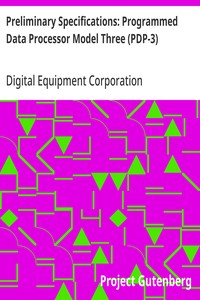
Preliminary Specifications: Programmed Data Processor Model Three (PDP-3) October, 1960 — Background and Themes
(0 User reviews)
1499
Project Gutenberg
2009
Not confirmed
Electronic digital computers; PDP-3 (Computer)
Readers of public-domain and historical texts
Project Gutenberg digital edition
en
Edition facts
Words
12,840
Reading time
56 min
Text sections
2
The source record for Preliminary Specifications: Programmed Data Processor Model Three (PDP-3) October, 1960 — Background and Themes measures this digital text at 12,840 words, 56 min estimated reading time, and 2 detected text sections.
The text analysis averages about 16.6 words per sentence, while the detected sections provide another way to judge how the source is divided.
Project Gutenberg metadata also associates the work with “Electronic digital computers,” connecting these edition facts with the source record’s subject description.
Source:
Project Gutenberg record #29461
This 1960 technical specification for the PDP-3 computer details its architecture, instruction set, and input-output systems, using precise engineering language and a modular structure that reveals design priorities in speed, reliability, and expandability.
Editorial Edition Score
4.5/5
★★★★★
★★★★★
Calculated from edition completeness, EPUB availability, text structure and catalogue metadata. Not a user rating.
How this score is calculated
- Description quality20 pts
- Title & short description10 pts
- Source metadata20 pts
- Text length15 pts
- Chapters / structure15 pts
- EPUB file integrity20 pts
Total of 100 points, scaled to a 2.5-5.0 range. Editions with an empty description or a missing EPUB file are not scored.
Edition quality
Public-domain source text
Read the source text
The source text is kept in the dedicated reader, separate from this catalogue record and its commentary.
The PDP-3 specification opens with a claim that combines speed, economy, and reliability, achieved through "very fast, reliable, solid state circuits coupled with system design restraint." This phrase sets the tone for a document that values simplicity and exclusion of "marginal or superfluous features." The language is consistently technical and imperative, describing operations like "the left 6 bits of this register communicate with the Instruction Register" with exactness. The document's structure—moving from general description to detailed subsystem breakdowns—mirrors the modularity it advocates.
Design Philosophy in the Introduction
The introduction frames the PDP-3 as a machine built on restraint. The phrase "system design restraint" is not merely descriptive but prescriptive, suggesting a deliberate avoidance of complexity. The text states that this restraint "excludes many marginal or superfluous features and thus their attendant cost and maintenance problems." This language positions the PDP-3 as a practical tool for "complex real time control applications" and "the center of a modern computing facility." The emphasis on economy and reliability over raw power is evident in the average instruction rate of 100,000 operations per second, with a peak of 200,000. The document does not boast of theoretical maxima but presents a balanced performance profile.
Instruction Format and Addressing Details
The central processor section describes a single-address, single-instruction machine operating on 36-bit numbers. It features "multiple step indirect addressing and indexing of addresses," with 511 registers available as index registers. The instruction format is not fully excerpted, but the mention of "left 6 bits" communicating with the Instruction Register hints at a fixed-width opcode. The memory is organized in 4096-word core modules, with a cycle time of five microseconds. The system can address 8 modules natively and expand to 64. This modular memory design aligns with the overall philosophy of scalability without overcomplication.
Input-Output Modes and Asynchronous Operation
The input-output section reveals careful attention to real-time interaction. The paper tape reader operates in alphanumeric and binary modes, with the binary mode using the eighth hole for synchronization. The typewriter input is described as "completely asynchronous," handled by setting a program flag when a key is struck. The text notes that the code "will remain at the gate for a relatively long time by virtue of the slow mechanical action," a rare moment where the document acknowledges physical constraints. The optional Sequence Break System introduces 16 interrupt channels in a priority chain, enabling concurrent device operation. This system stores register contents in fixed memory locations, showing early interrupt handling design.
Readers approaching this specification should note its dual audience: engineers evaluating the machine and programmers needing exact operational details. The document's clarity and avoidance of marketing language make it a reliable primary source for understanding 1960s computer design. Pay attention to the interplay between hardware descriptions and the implied programming model, especially in the input-output sections where asynchronous behavior is explicitly addressed.
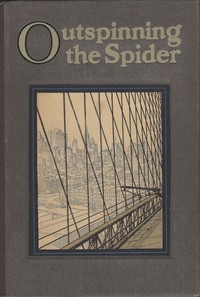
Reading this PDP-3 specification, I remembered my father’s old workshop manuals—pages of exact diagrams that felt like quiet promises. The precision here, the careful modularity, reminds me of leafing through Outspinning the Spider: The Story of Wire and Wire Rope — Inside the Classic years ago, where the tensile strength of simple strands became something almost human. Both books hum with the same patient faith in structure holding firm.
There are no reviews for this eBook.
There are no comments for this eBook.
Reader reflection
Before you leave, reflect on the book
Use these questions to collect your thoughts before moving on.
Your progress
0
/
10
2
How much did you enjoy the reading experience?
3
Would you encourage someone else to read it?
4
How easy was the book to follow?
5
Which part made the strongest impression?
6
Is this a title worth rereading?
7
How personally connected did you feel to the book?
8
Did the book meet your expectations?
9
What did this book teach you most?
10