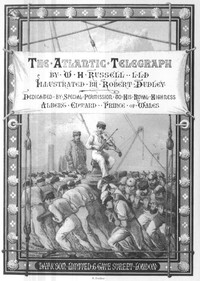
The Atlantic Telegraph (1865) — A Closer Reading
Edition facts
Calculated from edition completeness, EPUB availability, text structure and catalogue metadata. Not a user rating.
Read the Text
mportant line of submarine telegraph ever attempted. In the year 1850, Mr. Brett obtained a concession from the French Government for effecting this object,--an object regarded at the time as one purely chimerical, and decried by the press as a gigantic swindle. The cable which was made for the purpose consisted of a solid copper wire, covered with gutta percha. When tested by Mr. Woollaston, it was found to be so imperfect from air holes in the gutta-percha, that the water found its way to the copper wire,--an imperfection which was however shortly repaired. This cable was manufactured at the Gutta Percha works, on the Wharf Road, City Road, under the superintendence of the late Mr. Samuel Statham; was then coiled on a drum, and conveyed by steam-tug to Dover, and in the year 1850 was payed out from Dover to Calais. The landing-place in France was Cape Grisnez, from which place a few messages passed, so as to comply with the terms of the concession and test the accuracy of the principle. The communication thus established between the Continent and England was, after a few hours, abruptly stopped. A diligent fisherman, plying his vocation, took up part of the cable in his trawl, and cut off a piece, which he bore in triumph to Boulogne, where he exhibited it as a specimen of a rare seaweed, with its centre filled with gold. It is believed that this “pescatore ignobile” returned again and again to search for further specimens of this treasure of the deep: it is, at all events, perfectly certain that he succeeded in destroying the submarine cable.
This accident caused the attention of scientific men to be directed to the discovery of some mode of preserving submarine cables from similar casualties, and a suggestion was made by Mr. Küper, who was engaged in the manufacture of wire ropes, to Mr. Woollaston and to Mr. T. R. Crampton, that the wire insulated with gutta-percha should form a core or centre to a wire rope, so as to give protection to it during the process of paying out and laying down, as well as to guard it from the anchors of vessels and the rocks, and to secure a perfect electrical continuity.
Mr. Crampton, who had already accepted the contract for laying the cable between England and France, and had given up much of his time to the study of the subject, adopted this idea, and in 1851 he and several gentlemen associated for the purpose laid the cable between Dover and Calais, where it has since remained in perfect order, constituting the great channel of electrical communication between England and the Continent. It was made by Wilkins & Weatherly, Newall & Co., Küper & Co., and Mr. Crampton. The exertions of the last-named eminent engineer in laying the first cable under water, and his devotion to an object towards which he largely contributed in money, are only known to a few, and have never been adequately acknowledged.
The success of that form of cable having been thus completely established, several lines of a similar character were laid during the following years between England and Ireland and parts of the Continent: one, 18 miles long, across the Great Belt, made by Newall & Co.; one from Dover to Ostend, by the same makers and by Küper & Co.; one from Donaghadee to Portpatrick, by Newall & Co.; one from Holyhead to Howth; and one from Orfordness to the Hague.
The superiority of a line with wire-rope cover to other descriptions of cable was illustrated in 1853. At that period the Electric and International Telegraph Company determined upon laying down four wires between England and the Continent, but they rejected the heavy cable, and adopted the suggestion of their engineer to use four separate cables of light wire. The cost of maintaining these light cables from injury by anchors, &c., was so great that they were picked up, and heavy cables of great strength were substituted, which have given no trouble or anxiety, and have always been in good order.
The Old World had twelve lines of submarine cable laid ere the United States turned their attention to the uses of such forms of telegraph. Italy had been connected with Corsica by a line 110 miles long, and Denmark had joined one of her little islands to the other, ere the Great Republic gave a thought to the matter. But there were excuses for such indifference. The Telegraphic system, to which Morse, Bain, House, and others, had given such development, although the first line was not constructed till 1844, extended rapidly all over the vast extent of the Atlantic and Gulf States. The people were on the same continent, the land was all their own, their greatest rivers could be traversed by wires; and so it was that, whilst Mr. Morse was engaged in protecting his patents, and the Americans, self-contained, were not looking beyond the limits of their shores, a British North American Province took the first step which was made at the other side of the Atlantic to lay down a submarine cable. In 1851-2 a project was started in Newfoundland, to run a line of steamers between Galway and St. John’s in connection with a telegraph to Cape Ray, where a submarine Cable was to be laid to Cape Breton, and thence the news was to be carried by means of another cable from New Brunswick to Prince Edward’s Island. The Roman Catholic Bishop of Newfoundland is stated to have been the original proposer of a scheme for connecting the island with the United States, but the credit of actually laying down the first submarine cable at the other side of the Atlantic belongs to Mr. F.N. Gisborne, an English engineer. He had been previously engaged in the telegraph department at Montreal, and had some knowledge of the subject, but he happened to be in London at the time of Brett’s success. On his return to America he applied himself to get up a Company for the purpose of facilitating telegraphic communication between Europe and the United States. After much difficulty the Company was formed, and an Act was passed by the Legislature of Newfoundland, in 1852, conferring the important privileges upon it, in event of the completion of the project in Newfoundland, which are now possessed by the Atlantic Telegraph Company. Mr. Gisborne was superintendent and engineer of the Company, and he set to work with energy to construct a road from St John’s to Cape Ray, over a barren and resourceless tract of 400 miles, and made a survey of the coast line, during which he was exposed to great hardships. He succeeded at last in laying an insulated cable, made by Newall & Co., from New Brunswick to Prince Edward’s Island across the Straits of Northumberland, 11 miles long, in 22 fathoms of water; but was not successful in a similar attempt to connect Newfoundland with Cape Breton. Meantime the Company became involved in pecuniary difficulties, and Mr. Gisborne, early in 1854, on the suspension of the works, proceeded to New York, where he hoped to find money to enable him to carry out the telegraphic scheme among the keen speculators and large-pursed merchants. Through an accidental conversation at the hotel in which he was staying, he obtained an interview with Mr. Cyrus Field. He laid his plans before that gentleman, who had no desire to resume an active career, having just returned from travelling in South America, with the intention of enjoying the fortune his industry and sagacity had secured ere he had arrived at the middle term of life. But Mr. Field listened to Mr. Gisborne with attention, and then began to think over the project--“To lay these submarine cables so as to connect Newfoundland with Maine?--Good. To run a line of steamers from St. John’s to Galway?--Certainly. It would shorten the time of receiving news in New York from Europe four or five days.” And so the brain worked and thought. Then suddenly, “But if a cable can be laid in the bed of these seas--if the Great Atlantic itself could be spanned?” Here was an idea indeed. Deep and broad seas had been traversed in Europe, but here was one of the great oceans of the world, of depth but faintly guessed at, and of nigh 2000 miles span from shore to shore! Would it be within the limits of human resources to let down a line into the watery void, and to connect the Old World with the New? What a glorious thought! Was it a vision, or was it one of those inspirations from which originate grand enterprises and results which change the destinies of the world? Mr. Field terminated his reflections that night by an eminently practical measure. Ere he retired to rest he sat down and wrote two letters,--one to Lieut. Maury, U.S.N., to ask his opinion concerning the possibility of laying down a cable in the bottom of the Atlantic; the other to Professor Morse, to inquire whether he thought it practicable to send an electric current through a wire between Europe and America. Lieut Maury, in answering in the affirmative, wrote, “Curiously enough, when your letter came I was looking over my letter to the Secretary of the Navy on that very subject.” And, in fact, on the 22nd February, 1854, Lieut. Maury made a long communication to Mr. Dobbin, Secretary, United States Navy, from the Observatory, Washington, respecting a series of deep-sea soundings made by Lieut. Berryman, U.S.N., brig Dolphin, from Newfoundland to Ireland, in connection with researches on the winds and currents, carried on for the National Observatory. It is obvious that Lieut. Maury, as well as many others probably, had thought of the same idea as Mr. Field. He says, “The result is highly interesting, in so far as the bottom of the sea is concerned, upon the question of a submarine telegraph across the Atlantic;” and he goes on to make it the subject of a special report, in which occur the following passages;--
“This line of deep-sea soundings seems to be decisive of the question as to the practicability of a Submarine Telegraph between the two continents, in so far as the bottom of the deep sea is concerned. From Newfoundland to Ireland, the distance between the nearest points is about 1,600 miles;[1] and the bottom of the sea between the two places is a plateau, which seems to have been placed there especially for the purpose of holding the wires of a Submarine Telegraph, and of keeping them out of harm’s way. It is neither too deep nor too shallow; yet it is so deep that the wires, but once landed, will remain for ever beyond the reach of vessels’ anchors, icebergs, and drifts of any kind, and so shallow that the wires may be readily lodged upon the bottom. The depth of this plateau is quite regular, gradually increasing from the shores of Newfoundland to the depth of from 1,500 to 2000 fathoms as you approach the other side. The distance between Ireland and Cape St. Charles, or Cape St. Lewis, in Labrador, is somewhat less than the distance from any point of Ireland to the nearest point of Newfoundland. But whether it would be better to lead the wires from Newfoundland or Labrador is not now the question; nor do I pretend to consider the question as to the possibility of finding a time calm enough, the sea smooth enough, a wire long enough, a ship big enough, to lay a coil of wire 1,600 miles in length; though I have no fear but that the enterprise and ingenuity of the age, whenever called on with these problems, will be ready with a satisfactory and practical solution of them.
“I simply address myself at this time to the question in so far as the bottom of the sea is concerned, and as far as that the greatest practical difficulties will, I apprehend, be found after reaching soundings at either end of the line, and not in the deep sea. * * Therefore, so far as the bottom of the deep sea between Newfoundland, or the North Cape, at the mouth of the St. Lawrence, and Ireland, is concerned, the practicability of a Submarine Telegraph across the Atlantic is proved.”
Professor Morse, in 1843, indicated his conviction that a magnetic current could be conveyed across the Atlantic, and his reply to Mr. Field was now given with increased confidence to the same effect. Thus encouraged, Mr. Field took measures to form a Company to purchase the rights of the Newfoundland Company, and to connect Newfoundland with Ireland by means of a submarine telegraph across the Atlantic. He entered into an agreement with Mr. Gisborne for the purchase of the privileges of the Company for 8000_l._, under certain conditions. Then he put down the names of ten of the principal capitalists in New York, and proceeded to unfold his project to each in succession; and having secured the adhesion of Mr. Cooper, Mr. Taylor, Mr. Roberts, Mr. White, and the advice of his brother, Mr. D. Field, he called a meeting of these gentlemen at his house on 7th March. Similar meetings took place at his residence on 8th, 9th, and 10th, and after full discussion and consideration it was resolved to form “The New York, Newfoundland, and London Telegraph Company,” of which Peter Cooper was President; Moses Taylor, Treasurer; Cyrus Field, C. White, M. O. Roberts, Directors; and D. D. Field, Counsel. Mr. C. Field, his brother, and Mr. White were commissioned to proceed to Newfoundland, to obtain from the Legislature an act of incorporation, and set out for that purpose on March 15th. On their arrival at St. John’s, the Governor convoked the Executive Council. He also sent a special message to the Legislature, then in session, recommending them to pass an act of incorporation, with a guarantee of interest on the Company’s bonds to the amount of 50,000_l._, and to make them a grant of fifty square miles of land on the island of Newfoundland, conditional on the completion of the Telegraph.
After some little delay, the Legislature, with one adverse member only, granted the valuable privileges to the Company which were subsequently transferred to the Atlantic Telegraph Company. They constitute, in fact, a monopoly of telegraphic rights in Newfoundland, the value of which was enhanced afterwards by similar concessions from the state of Maine, Nova Scotia, Prince Edward’s Island; and liberal encouragement from Canada. There is much to be said against concessions, and monopolies, and patents, on abstract grounds; but it is quite clear that in certain circumstances men will not venture money and spend time, without the prospect of the ulterior advantages such protection is calculated to ensure. The Government has, however, informed Colonial and Provincial Legislatures that in future Her Majesty will be advised not to give her ratification to the creation of similar monopolies. By their chartered rights the new Company obtained the exclusive privilege for fifty years of landing cables on Newfoundland and Labrador, which embraces a coast extending southwardly to Prince Edward’s Island, Cape Breton, Nova Scotia, the State of Maine, and their respective dependencies; and westwardly to the very entrance of Hudson’s Straits. The Company also secured a grant of fifty square miles of land on the completion of Telegraph to Cape Breton; a similar concession of additional fifty square miles when the Cable shall have been laid between Ireland and Newfoundland; a guarantee of interest for twenty years at 5 per cent. on 50,000_l._; a grant of 5000_l._ in money towards building a road along the line of the Telegraph; and the remission of duties on the importation of all wires and materials for the use of the Company.
The Company also obtained from the Legislature of Prince Edward’s Island, in May, 1854, the exclusive privilege for fifty years of landing cables on the coast; a free grant of one thousand acres of land; and a grant of 300_l._ currency per annum for ten years.
From Canada the Company obtained an Act authorising the building of telegraph lines throughout the Provinces, accompanied by the remission of duties on all wires and materials imported for the use of the Company.
Nova Scotia, in 1859, gave the Company a grant of exclusive privilege, for twenty-five years, of landing telegraphic cables from Europe on the shores of the Province.
The State of Maine accorded the Company a grant of the exclusive privilege, for twenty-five years, of landing European telegraph cables on the seaboard.
From Great Britain eventually the Company obtained an annual subsidy of 14,000_l._ sterling until the net profits of the Company should reach 6 per cent. per annum, on the whole capital of 350,000_l._ sterling, the grant to be then reduced to 10,000_l._ sterling per annum, for a period of twenty-five years; two of the largest steamships in the navy to lay the cable, and two steamers to aid them; and a careful examination of the soundings by vessels of the Royal Navy.
From the United States the Company obtained an annual subsidy of $70,000 until the net profits yielded 6 per cent. per annum, then to be reduced to $50,000 per annum, for a period of twenty-five years, subject to termination of contract by Congress after ten years, on giving one year’s notice. The United States government also granted the steamship Arctic to make soundings, and steam-ships Niagara and Susquehanna to assist in laying the cable. A government steamer was also ordered to make further soundings on the coast of Newfoundland.
Long ere the Company had been placed in possession of such beneficial rights, and obtained such a large amount of favour, Mr. Field, who threw every energy of body and mind into the work, and was entrusted by his brother directors with the general management of affairs, proceeded to carry out the engagements the Company had entered into with the local legislatures. It has been said that the greatest boons conferred on mankind have been due to men of one idea. If the laying of the Atlantic Cable be among these benefits, its consummation may certainly be attributed to the man who, having many ideas, devoted himself to work out one idea with a gentle force and a patient vigour which converted opposition and overcame indifference. Mr. Field may be likened either to the core, or to the external protection, of the Cable itself. At times he has been its active life; again he has been its iron-bound guardian. Let who will claim the merit of first having said the Atlantic Cable was possible, to Mr. Field is due the inalienable credit of having made it possible, and of giving to an abortive conception all the attributes of healthy existence.
The first step in the great enterprise, now fairly inaugurated, was the connection of St. John’s with the telegraphic lines already in operation in Canada and the United States.
Mr. Field was despatched to England, as there were no firms established for the manufacture of submarine cables in the United States, to order the necessary work to be done, and to raise money. He previously ordered specimens of cable to be made, so that when he landed in England they were ready for his inspection; and soon after his arrival he entered into a contract with Messrs. Küper & Co. (subsequently Glass, Elliot, & Co.) for a cable to be laid across the Gulf of St. Lawrence. He held interviews with eminent engineers and electricians, among whom were Mr. Brunel, Mr. (now Sir C.) Bright, Mr. Brett, and Mr. Whitehouse, respecting his larger project, which led to extended and valuable experiments. The cable for Newfoundland was formed in three strands, and had three conducting wires; and Mr. Field undertook to lay it, under the direction of Mr. Canning. In August, 1855, the first attempt was made; but off Cape Ray a violent gale arose, and it was deemed necessary by the master of the vessel to cut the cable. This disappointment was not in the least a discouragement. Another contract was made by Mr. Field with Messrs. Küper & Co. to make and lay a cable at their own risk, which was executed by Mr. Canning in the Propontis the following year. The station is at Point-au-Basque, near the western extremity of Newfoundland, and the telegraph runs across the island to Trinity Bay.
W.H. Russell structures his narrative as a day-by-day journal, beginning with the departure from Valentia on July 23, 1865. The text moves between the deck of the Great Eastern and the surrounding fleet, tracking the cable's progress through precise nautical coordinates and mechanical details. Russell's eye for contrast—the ship's vast scale against the slender cable—shapes the account from the first entry.
The Cable as a Living Thread
Russell repeatedly describes the cable in organic terms. On July 25, the Great Eastern hangs over the cable “as if fearful of breaking the slender cord,” and the ship handling the line is compared to “an elephant taking up a straw in its proboscis.” The cable is not merely a machine; it sways, it is picked up like a thread, and when a fault is found, the wire fragment is described as “two inches long or so—rather bent in the middle.” This personification extends to the ship itself, which “lay in restless quiet” after communication failed. The recurring image of the cable as a fragile, almost sentient line ties the technical to the dramatic.
The Rhythm of Repair and Setback
The journal entries follow a pattern: progress, fault, repair, hope, then renewed failure. On July 25, after picking up over ten miles of cable, the crew discovers a piece of wire forced through the gutta-percha. A splice is made, tests are run, and the cable begins paying out again—only for all communication to cease “altogether.” Russell captures the emotional swing: “From great contentment there was sudden blank despair.” The electricians work frantically, “connecting and disconnecting,” but no signal returns. This cycle repeats, giving the narrative a rhythmic tension between human ingenuity and the ocean's resistance.
Shipboard Society and Hierarchy
Russell notes the division of labor and expertise aboard the Great Eastern. The electricians work in a separate room, their tests invisible to most; anxious groups gather outside, “the bolder” peering in. The fleet communicates via signal flags—the Terrible replies “I congratulate you” when the fault is found—but the cable itself carries news back to shore. The Hawk is sent with letters, a reminder that the expedition is not isolated. Russell, as a journalist, observes both the technical elite and the general crew, whose moods shift with each electrical pulse.
The Ocean as a Character
Russell's setting is not static. The sea is “fine but cloudy” on July 25, and the wind “light.” The cable comes up coated with “thin greyish mud,” revealing the Atlantic floor as “soft ooze.” These details ground the drama in a specific environment. The ship's behavior—how it “hangs lightly” over the cable—depends on wind and current. The ocean is not a backdrop but an active participant, its conditions dictating the pace of work. When the cable breaks, the ship lies “in restless quiet,” the water itself seeming to hold its breath.
Russell's journal offers a close-up view of a single expedition, not a history of the cable. Readers should attend to the daily entries as discrete scenes, each with its own arc of hope and disappointment. The technical details—splices, tests, wire fragments—are not obstacles but the core of the story. The book rewards those who read for process, not outcome.
-
Gregg Rebecca Larson - 3 weeks ago
{'review_type': 'neutral', 'text': "The book provides a comprehensive account of the 1865 cable-laying attempt, with plenty of technical information. It's well-researched, though at times the pace slows down with excessive detail. The human interest stories help keep it engaging, but it may not appeal to casual readers."} -
Erica Hammond - 3 weeks ago
{'review_type': 'negative', 'text': 'Despite the dramatic subject matter, this book is a letdown. The writing is clunky, and the author gets lost in minute technical explanations, losing the human drama. The characters are underdeveloped, and the narrative lacks tension. A missed opportunity to tell a thrilling story.'} -
Tracy Harris - 3 days ago
{'review_type': 'positive', 'text': "A gripping narrative of one of the greatest engineering feats of the 19th century. The author masterfully captures the drama, the setbacks, and the triumph of the 1865 Atlantic Telegraph expedition. With rich detail and vivid storytelling, this book makes you feel like you're on board the Great Eastern. A superb read."}
What was your reading experience?
Capture what you thought, learned, and would like to remember.
Mila Adams
1 week ago