1

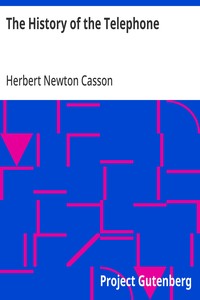
The History of the Telephone — Edition Insights
(0 User reviews)
1600
Project Gutenberg
1997
Not confirmed
Telephone -- History
Readers of public-domain and historical texts
Project Gutenberg digital edition
en
Edition facts
Words
57,982
Reading time
253 min
Text sections
6
The History of the Telephone — Edition Insights can be approached with a clearer sense of reading commitment from its source measurements: 57,982 words, 4 hr 13 min estimated reading time, and 6 detected text sections.
The text analysis averages about 20.5 words per sentence, while the detected sections provide another way to judge how the source is divided.
Project Gutenberg metadata also associates the work with “Telephone -- History,” connecting these edition facts with the source record’s subject description.
Source:
Project Gutenberg record #819
Herbert N. Casson's 1910 history traces the telephone's first thirty-five years, from invention to global industry, blending technical narrative with business chronicle and social observation.
Editorial Edition Score
4.7/5
★★★★★
★★★★★
Calculated from edition completeness, EPUB availability, text structure and catalogue metadata. Not a user rating.
How this score is calculated
- Description quality20 pts
- Title & short description10 pts
- Source metadata20 pts
- Text length15 pts
- Chapters / structure15 pts
- EPUB file integrity20 pts
Total of 100 points, scaled to a 2.5-5.0 range. Editions with an empty description or a missing EPUB file are not scored.
Edition quality
Public-domain source text
Read the source text
The source text is kept in the dedicated reader, separate from this catalogue record and its commentary.
Casson begins his 1910 account with a striking claim: the telephone, once ridiculed, is now taken for granted as "a part of the natural phenomena of this planet." He promises a story "such as the telephone itself might tell"—non-technical, non-statistical, and deliberately brief. The preface immediately establishes the book's dual focus: the invention's rapid growth (three million phones abroad, seven million in the U.S.) and the personalities behind it. Casson lists dozens of telephone leaders he consulted, acknowledging both the living and the dead, which signals that this history will be built from insider testimony rather than dry records.
A Preface That Sets the Tone
Casson's preface is not a mere formality; it is a compact manifesto. He dates it "PINE HILL, N. Y., June 1, 1910," grounding the work in a specific moment. He calls the telephone "an indispensable help to whoever would live the convenient life" and frames pre-telephonic existence as a state of being "deaf and dumb to all absent persons." This rhetorical flourish—equating silence with disability—reveals his persuasive aim: to make readers feel the telephone's necessity. The preface also names over a dozen industry figures, from William R. Driver to Charles S. Gleed, establishing an insider network that will recur throughout the book. Readers should note that Casson openly admits omissions, hinting at a second volume that never appeared in this edition.
The Telephone Girl and Politeness
In a later excerpt, Casson turns to social effects, arguing that the telephone operator—"the telephone girl"—taught refinements of politeness. He contrasts the blunt "Who are you?" with the gentler "Who is this?" and credits the rising inflection as a civilizing habit. This observation is specific and traceable: Casson claims that profane or abusive callers are "cut off from the use of it" and "cast out as unfit for a telephone-using community." The passage suggests that Casson sees the telephone not merely as a machine but as a force reshaping manners. Readers should watch for similar moments where technology and etiquette intertwine, though the excerpts do not reveal how fully this theme is developed.
The Western Electric as Industrial Marvel
Casson devotes considerable space to the Western Electric Company, calling it "the mother factory" of telephone apparatus. He supplies concrete numbers: 26,000 employees, $40,000,000 in capital, and half a day's output worth $100,000—a sum that equals what Western Union refused to pay for the Bell patents in 1877. The description is sensory: wire wrapped at "nine thousand miles a day," cables dried in ovens, and platinum imported from the Ural Mountains. Casson's prose here is factual yet vivid, mixing statistics with images of "absurd sea-monsters" that are really switchboard nerve systems. This section exemplifies his method of making industrial processes accessible without oversimplifying.
Structure and Scope from the Table of Contents
The table of contents reveals a clear arc: nine chapters move from invention ("The Birth of the Telephone") through business building and holding, to technical development, expansion, notable users, national efficiency, and foreign countries. This structure suggests that Casson intends a comprehensive survey, not a narrow technical history. The chapter on "Notable Users" hints at anecdotal material, while "The Telephone and National Efficiency" points to a progressive-era concern with productivity. Readers should note that the excerpts do not cover all chapters; the later portions shift to Project Gutenberg boilerplate. Thus, the book's full argument about national efficiency remains inferred, not confirmed.
Casson's history is best approached as a period piece—a 1910 insider's account that blends boosterism with genuine detail. The preface and early chapters establish a voice that is confident, anecdotal, and occasionally grandiose. Readers should watch for the interplay between technical description and business narrative, and note that Casson's claims about politeness and national efficiency reflect early twentieth-century values. The excerpts offer a reliable sample of his style: concrete, name-dropping, and eager to prove the telephone's transformative power.
Reading about Casson’s patient chronicle of the telephone’s spread, I remembered my grandfather’s quiet pride in his first switchboard, a clunky wooden thing. That feeling returned with Tinting and toning of Eastman positive motion picture film — Themes and Context, where craft and memory interlace so gently. Old technologies hold our small lives, whispering their origins like a familiar voice. Tinting and toning of Eastman positive motion picture film — Themes and Context reminded me of that same tender permanence.
There are no reviews for this eBook.
There are no comments for this eBook.
Reader reflection
Record your reading impressions
A brief reflection can help important ideas stay with you longer.
Your progress
0
/
10
2
How much did you enjoy the reading experience?
3
Would you recommend this book to another reader?
4
Did the language feel accessible?
5
Was the book moving at the right speed?
6
How useful did the reading feel?
7
How strong was your personal connection to the text?
8
Did anything about the book feel genuinely new?
9
What changed or sharpened your thinking?
10