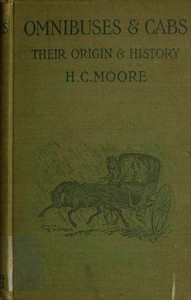
Omnibuses and cabs — Edition Insights

(4 User reviews)   660
In Category - Civil Engineering
Moore, Henry Charles, 1862-1933 Project Gutenberg 2024
Carriages and carts; Cab and omnibus service; Horse-drawn omnibuses Readers of public-domain and historical texts
Project Gutenberg digital edition en

Edition facts

Words: 53,481
Reading time: 233 min
Text sections: 23
Henry Charles Moore's 1902 history traces London's horse-drawn omnibuses and cabs from their origins, focusing on the vehicles, their operators, and the social dynamics of street travel, with detailed accounts of early routes, fraud, racing, and the eccentric characters who rode and worked on them.
Share
Editorial Edition Score 4.9/5

Calculated from edition completeness, EPUB availability, text structure and catalogue metadata. Not a user rating.

Edition quality

Read the Text

before vehicles of the omnibus class were again tried in Paris, but one or two feeble and unsuccessful attempts to start them in England were made in the year 1800. A vehicle with six wheels and drawn by four horses was the most noticed of these ventures.

In 1819 Monsieur Jacques Laffitte, the banker-politician, who became, later, the Minister of Louis Philippe, introduced the vehicles now called “omnibuses” into Paris. They carried sixteen or eighteen passengers, all inside, and the fare was twopence halfpenny from one side of Paris to the other. From the day that they began running they were highly successful, and the first year’s profits, it is said, repaid the outlay.

Monsieur Laffitte must not, however, be given the credit of applying the name “omnibus” to the vehicles which he introduced, for it belongs to Monsieur Baudry, a retired military officer. In 1827 Baudry was the proprietor of some hot-water baths in the suburbs of Nantes, and for the convenience of his patrons ran a vehicle at fixed hours to and from the town. This coach, which was similar in build to the Parisian ones, he named the “Voiture des Bains de Richebourg,” but quickly came to the conclusion that the title was too long, and therefore endeavoured to think of a more suitable one.

It happened that just at that time a local grocer named Omnès caused considerable amusement in the town by painting over his shop “Omnès Omnibus.” No sooner did Baudry see this than he declared that he had found the very word which he required, and straightway renamed his vehicle “L’Omnibus.” Later, he started lines of omnibuses at Paris and Bordeaux, but they were not very successful, and the severe winter of 1829, which made forage very dear and the streets almost impassable, ruined him completely and drove him to commit suicide. But before he died he had made the word “omnibus” familiar to Parisians. Many of the vehicles belonging to other proprietors bore the inscription “Enterprise Générale des Omnibus,” which, while not making people believe that the coach so inscribed was one of Baudry’s, ensured its being called an Omnibus.

George Shillibeer introduces omnibuses into England--The first omnibus route--Shillibeer’s conductors defraud him--His plans for preventing fraud--An omnibus library--Shopkeepers complain of omnibus obstruction.

Laffitte’s omnibuses were so exceedingly well managed that they continued to prosper in spite of the many new lines started in opposition to them. With a view to maintaining the superiority of his omnibuses over those of his rivals, Laffitte decided to have two vehicles built which should eclipse in comfort and appearance any others on the streets. He gave the order to Mr. George Shillibeer, a well-known Parisian coach-builder. Shillibeer had been a midshipman in the British Navy, but quitted the service and went to Hatchett’s, in Long Acre, to learn coach-building. Later, he started business for himself in Paris, and as English carriages were then becoming very fashionable, he met with considerable success, and built carriages and coaches for the most influential men of the day.

While executing Laffitte’s order it occurred to Shillibeer that he might, with considerable advantage to himself, start omnibuses in London. He decided to do so, and, disposing of his business, returned to London and took premises at Bury Street, Bloomsbury, whence he made it known that he was about to introduce “a new vehicle called the omnibus.” The word “omnibus” was received with marked disapproval by every person to whom Shillibeer spoke concerning his new venture. “If one vehicle is to be called an omnibus, what are two or more to be called?” people said to him.

“Omnibuses,” Shillibeer replied promptly, but his questioners were horrified, and to their dying days preferred to call them “Shillibeers.” Some people called them “omnis,” and Mr. Joseph Hume, speaking years later in the House of Commons, created much laughter by referring seriously to the vehicles as “omnibi.”

The route which Shillibeer chose for his first omnibus was from the Yorkshire Stingo at Paddington, along the New Road to the Bank. The New Road was the name by which Marylebone, Euston and Pentonville Roads were then known.

Three or four short-stage-coaches had been running on that road for many years, but as they took three hours to get from Paddington to the City, and charged two shillings for outside seats and three shillings for inside ones, they were not patronised by able-bodied people, who usually preferred to walk. Moreover, the short-stage-coaches were uncomfortably loaded with luggage, which they collected and delivered every journey.

On the morning of July 4, 1829, Shillibeer’s two new omnibuses began to run. A large crowd assembled to witness the start, and general admiration was expressed at the smart appearance of the vehicles, which were built to carry twenty-two passengers, all inside, and were drawn by three beautiful bays, harnessed abreast. The word “Omnibus” was painted in large letters on both sides of the vehicles. The fare from the Yorkshire Stingo to the Bank was one shilling; half way, sixpence. Newspapers and magazines were provided free of charge. The conductors, too, came in for considerable notice, for it had become known that they were both the sons of British naval officers--friends of Shillibeer. These amateur conductors had resided for some years in Paris, and were, therefore, well acquainted with the duties of the position which they assumed. The idea of being the first omnibus conductors in England pleased them greatly, and prompted them to work their hardest to make Shillibeer’s venture a success. They were attired in smart blue-cloth uniforms, cut like a midshipman’s; they spoke French fluently, and their politeness to passengers was a pleasing contrast to the rudeness of the short-stage-coach guards--a most ill-mannered class of men.

Each omnibus made twelve journeys a day, and was generally full. So great a success were they that the takings averaged a hundred pounds a week. Nevertheless, Shillibeer had much to contend with. The short-stage-coach proprietors, disliking competition, endeavoured to incite the populace against Shillibeer by declaring that he was a Frenchman, and ought not to be allowed to run his foreign vehicles in England. Moreover, the aristocratic and wealthy residents of Paddington Green objected strongly to the omnibuses coming into their select neighbourhood, and petitioned the local authorities to prevent their doing so. And when they found that their endeavours were futile, they declared solemnly that Paddington Green was doomed. If they saw the neighbourhood to-day, they would consider, no doubt, that their prophecy was fulfilled, although, as a matter of fact, it was railways and not omnibuses that, from a residential point of view, ruined the neighbourhood. But the threatened doom of Paddington Green did not deter the sentimental poke-bonneted young ladies, who resided in the charming suburb, from spending a considerable amount of their time in watching the omnibuses start. In the middle of the day many of them were in the habit of taking a ride to King’s Cross and back, for the sole purpose of improving their French by conversing with the conductors. That praiseworthy amusement was short-lived, however, for as soon as the omnibuses were in good working order, the gentlemen-conductors relinquished their posts and were succeeded by paid officials.

The new conductors were dressed in dark velvet suits, and as far as politeness was concerned were all that could be desired. Unfortunately they became possessed of the belief, not yet quite extinct, that to rob an omnibus proprietor was no sin. The amount of money handed in to Shillibeer grew less daily--a very suspicious decrease, considering that people living on the road which the omnibuses travelled declared that the vehicles were as well patronised as ever. Shillibeer therefore made arrangements with various trustworthy people to ride in his omnibuses, as ordinary passengers, and check the number of people carried and the amount of fares which they paid. For a few days every journey that the omnibuses made there was a male or female passenger watching the conductors, and from their reports Shillibeer discovered that the two men were, between them, robbing him to the extent of £20 a week. This was corroborated by the conductors themselves, whose style of living had become decidedly luxurious. In their time of affluence they did not forget their poorer friends, and one night, after work was finished, they treated a number of them to a champagne supper at the Yorkshire Stingo. The whole party became hilariously drunk, and while in that condition the hosts threw discretion to the winds, and bragged loudly that they made £10 each a week out of the omnibuses, in excess of their pay. Among their guests were detectives employed by Shillibeer, who repeated the confession of fraud to their employer, with the result that the first professional omnibus conductors were discharged. Shillibeer’s leniency, due to his anxiety not to have his omnibuses mixed up in any scandal, encouraged succeeding conductors to steal. Shillibeer was at his wits’ end what to do, when a man called on him with a patent register guaranteed to put a stop to the conductors’ pilferings. The register was designed to be placed underneath the omnibus, and people entering or leaving the vehicle trod on a plate fixed in the step, the register recording every person who stepped upon it. Shillibeer liked the idea, and bought one of the registers on the condition that the inventor acted as conductor until its reliability had been proved thoroughly.

For two weeks everything went well, and the conductor was anticipating an order for a second register, when a gang of men, in sympathy with the discharged conductors, attacked the omnibus while it was standing outside the Yorkshire Stingo, smashed the patent register with sledge-hammers, and half murdered its inventor. Shillibeer, who had paid £300 for the demolished register, did not order another one to be made, but tried a new and less expensive check, which was in use in the Paris omnibuses. A specially made clock was fixed in a prominent position in each omnibus, with a notice beneath it informing the public that it was the conductor’s duty to move the hand a certain distance whenever a passenger entered, and requesting that any neglect of that duty should be reported to the proprietor. But, in spite of that appeal, the conductors neglected persistently to act according to instructions, and not one report of their breach of duty was ever received by Shillibeer from an ordinary passenger. Some of them, indeed, amused themselves by turning the hand round until the register showed that the omnibus had carried an impossible number of people. This amusement was getting very popular when Shillibeer put an end to it by removing the clocks and trusting to his conductors’ honour--a confidence which was proved, time after time, to be entirely misplaced.

But, in spite of all obstacles, Shillibeer prospered, and in less than nine months had twelve omnibuses at work. A few of these were two-horse omnibuses carrying twelve passengers inside and two outside. Some ran from Paddington to the Bank, _viâ_ Oxford Street and Holborn. On all these new vehicles “Shillibeer” was painted in large letters on the sides, instead of “Omnibus.”

The Post Office authorities were the first to copy Shillibeer’s vehicles. They had four built, resembling the originals in every respect save the painting and lettering. On September 23, 1829, these vehicles--accelerators they were called--started at half-past eight in the morning from the back of the General Post Office for the western and north-western districts. Each accelerator carried twelve or thirteen letter-carriers, who were put down at various points to begin their delivery.

A little later, Shillibeer’s brother-in-law started some omnibuses which ran along the Caledonian Road, and were known as “Caledonians.” These, too, were successful, and many years later became the property of Mr. Wilson, the once famous Islington omnibus proprietor. Wilson’s “Favorites” were known to every Londoner, and the “Caledonians” were merged into them. At the present day the “Favorites” belong to the London General Omnibus Company, Limited, and on their way from the Nag’s Head, Holloway, to West Kensington and Fulham traverse their original road.

In 1832, wishing to still further increase the number of his omnibuses, Shillibeer took into partnership Mr. William Morton, a Southwell publican, who sold his business to join him. The partnership was dissolved in January, 1834, Morton taking as his share of the business the whole of the New Road omnibuses. He failed, however, to make them pay, and sold them at a great loss. Eventually he became so reduced in circumstances that he applied for, and obtained, a position as an omnibus conductor, but was discharged for drunkenness, and, in a fit of despondency, committed suicide at his lodgings in Little Carlisle Street, Edgware Road. At the inquest, Shillibeer’s enemies--of whom he had a large number among short-stage-coach proprietors--endeavoured to prove that the deceased had been swindled over his omnibus partnership. But these charges were shown to be the outcome of jealousy and petty spite, and it was proved that, in giving over the New Road omnibuses to his late partner, Shillibeer had behaved with great generosity, for that was the only line on which there was no opposition. The omnibuses were paying excellently at the time of the dissolution of partnership, but Morton mismanaged them. The person to whom he sold them soon made them as remunerative as they had been under Shillibeer’s management. In fact, the New Road route was the best patronised, and, in 1837, there were fifty-four omnibuses on that road. The fares were then sixpence any distance.

In the same year that Shillibeer took Morton into partnership, there were several lines of omnibuses running in opposition to him, for the old short-stage-coach proprietors were now alive to the fact that there was much money to be made out of omnibuses; but the original vehicles had the reputation of being excellently conducted, and, consequently, were preferred by the public. Aware of this, the proprietors of some opposition omnibuses had the impudence to paint on the panels of their vehicles the word “Shillibeer.” Shillibeer then named his omnibuses “Shillibeer’s Original Omnibuses.”

Some of the opposition proprietors, however, were men of sufficient enterprise to object to remaining mere imitators of Shillibeer, and tried their hardest to make their omnibuses more attractive than those of their great rival. One man made all his coachmen wear a wooden ring on each arm with strings attached to them which ran along each side of the roof of the omnibus and out at the back to the conductor. The passenger would then pull the cord or tell the conductor which side he wished to be put down, and if it were the near side the left string would be pulled; but if the passenger desired to get out on the off side the conductor would pull the right string, and the coachman would drive across the road and come to a standstill on what is now the wrong side of the road. It seems strange that such a proceeding should have been allowed in London, but the arrangement was very popular with passengers, who grumbled and wrote letters to the proprietors if the strings were absent or defective. Very soon after the introduction of such strings there were few omnibuses in London without them, and they remained in fashion for many years.

Many omnibuses had clocks fixed in them for the convenience of passengers, and to ensure conductor and coachman keeping their time. Bells did not come into use until many years later. When a conductor wanted his coachman to stop he usually shouted to him. When he wished him to go on he shouted again or banged the door.

Mr. Cloud, who ran omnibuses from the White Horse, Haymarket, to Chelsea and Hammersmith--fares one shilling and half a crown--eclipsed Shillibeer in one respect. Shillibeer supplied his patrons with newspapers and magazines; Cloud provided his with books by well-known authors. A little bookcase, well filled, was fixed in each of his omnibuses at the end near the horses. Books were expensive in those days, and many people rode to Hammersmith and back for the sole purpose of reading a particular one which they knew to be in the omnibus library. But this admirable innovation was abused shamefully by the passengers, who appeared to consider it no sin to purloin the volumes. Disgusted at the dishonesty of his patrons, Mr. Cloud announced publicly that, in consequence of the thefts, his libraries would be discontinued. The bookcases were removed, and in place of each a seat was fixed, thereby enabling the omnibus to accommodate thirteen inside passengers instead of twelve. Other omnibus proprietors decided that their vehicles should also carry thirteen passengers, but provided no additional accommodation. A conductor would tell a person that there was room inside, but when the passenger entered he would find the six seats on either side occupied. If he happened to be a stout party, the burning question was on which side ought he to sit. The matter was generally settled by the new-comer flopping down on some one’s lap. Then a quarrel would ensue. As late as 1882 an omnibus with a seat in front of the fareboard was running from Oxford Circus to Hendon, _viâ_ Kilburn. It was a most uncomfortable seat, but, nevertheless, it was nearly always occupied, for the conductor, being a very amusing fellow, had a knack of quickly soothing passengers who protested against sitting on a small, cramped seat.

Soon after the removal of the bookcases, some of the Hammersmith omnibuses acquired the habit of loitering, and thereby obstructing the streets. By Act of Parliament, the police had the power to take into custody the driver of any public vehicle who obstructed the high road and refused to move on. One morning they exercised their power by pulling two omnibus-drivers from their boxes and taking them to the police-station. The following day the drivers were fined forty shillings or a month’s imprisonment. For a few days there was no loitering on the Hammersmith Road. But one Saturday evening an omnibus pulled up at Knightsbridge in such a position as to obstruct the traffic. A policeman shouted fiercely to the driver to move on, but the coachman calmly shook his head and would not budge an inch. Two policemen promptly rushed forward to pull him from his seat and take him into custody, but, to their astonishment, found that he was chained to the box and the chain fastened by a huge padlock. Their attempts to remove him were useless. Then several other omnibuses came along, and pulled up close to the first one. The drivers of these were also chained to their boxes, and amused themselves and the crowd by chaffing the police and shaking their chains at them. After remaining at Knightsbridge for some considerable time, they drove away in triumph, only, however, to be fined a few days later.

About this time shopkeepers began to complain that omnibuses prevented their customers driving up to their doors in their carriages, and Mr. Shufflebotham, a silk mercer of Ludgate Hill, championing their cause, applied for summonses against twenty-four conductors for loitering. Under an old Act of Parliament, any stage-coach driver taking up or setting down passengers in the streets was liable to a penalty of not less than £5. All the conductors were fined, but public opinion was by no means favourable to the shopkeepers, and further attempts to prove that private carriages had a greater right to the public streets than omnibuses failed completely. On one occasion an alderman had before him a hundred and twenty conductors charged with the fearful offence--in tradesmen’s eyes--of stopping their omnibuses a few moments in front of a shop when a carriage was waiting to pull up there. The alderman discharged every one of the defendants, and his action was so popular that, until a year or two ago, no one had the impudence to suggest that the days of class legislation should be restored--that omnibuses which carry twenty-six passengers should be turned out of the main streets to make room for private carriages with their burden of four.

On January 7, 1832, a new Stage-Coach Act came into force. It had been passed specially to permit omnibuses and short-stage-coaches to take up and set down passengers in the streets.

Shillibeer runs omnibuses in opposition to a railway--Extraordinary action of the Stamp and Taxes Office--Shillibeer is ruined--He appeals to the Government for compensation--Government promises not fulfilled--Shillibeer becomes an undertaker.

Henry Charles Moore's Omnibuses and Cabs (1902) opens not with a sweeping claim but with a note of thanks to George A. Glover for rare pictures and to the Worshipful Company of Coach Makers. This specificity signals a work built on archival material and personal collections, not hearsay. The book moves chronologically through the invention of the carrosses à cinq sous in Paris, the introduction of omnibuses to London by George Shillibeer, and the subsequent rise of competing companies, steam omnibuses, and the London General Omnibus Company. Moore's method is to anchor each development in concrete details—a particular route, a legal dispute, a design innovation—rather than in abstract trends.

Shillibeer's Experiment and Its Perils

Moore devotes considerable space to George Shillibeer, the coachbuilder who launched London's first omnibus service in 1829. The narrative is not a simple success story. Shillibeer's conductors defrauded him, and his plans to prevent fraud are described in practical terms. When he ran omnibuses in opposition to a railway, the Stamp and Taxes Office took extraordinary action against him, and Shillibeer was ruined. His appeal to the government for compensation went unfulfilled, and he eventually became an undertaker. Moore presents this arc without moralizing, letting the sequence of events—and the government's broken promises—speak for themselves. The episode illustrates how early omnibus entrepreneurs operated in a regulatory vacuum, vulnerable to both dishonest employees and official caprice.

The Men Behind the Horses

Moore's most vivid passages concern the drivers and conductors. Conductors, he notes, earned six shillings a day after a year's service, attracting clerks, shopmen, failed businessmen, and even an Oxford graduate. He is at pains to correct what he sees as a literary misrepresentation: conductors do not say 'lidy' or 'lydy,' but 'lady as distinctly as ever the word was uttered.' Drivers, by contrast, are portrayed as intellectually inferior, earning eight shillings a day but lacking ambition beyond backing a horse in a race. Many, Moore observes, 'are not a penny richer after forty years' regular work.' These character sketches are grounded in occupational detail—the driver's lifelong familiarity with horses, the conductor's badge and punch—and they resist sentimentalism.

Eccentric Passengers and Street Spectacles

The book records a gallery of recurring urban types. One is the 'running man' who darts in front of an omnibus, leads the horses through the streets, and 'delights in long runs,' sometimes covering the entire route from Bayswater to Burdett Road. Another is the gentleman who stands at corners giving 'a searching look' at each omnibus, refusing to board for a hundred vehicles, and answering conductors with 'Take your departure.' Moore does not explain these figures; he simply presents them as observed phenomena. The effect is to make the streets of late-Victorian London seem populated by characters whose motives remain opaque, adding a layer of mystery to the otherwise practical history of vehicle design and company finance.

Structure: From Invention to Institution

The book's 23 chapters move from the Parisian carrosses à cinq sous to the formation of the London General Omnibus Company and beyond. Moore interleaves technical developments—the knife-board omnibus, longitudinal seats, yellow wheels—with social history: passenger behaviour, conductor fraud, omnibus racing. The chapter on the opening of Holborn Viaduct notes that an omnibus was the first vehicle to cross it, and introduces 'Viaduct Tommy' and the skid-men. This alternating rhythm between innovation and anecdote gives the work a cumulative texture. Moore does not argue a thesis; he assembles evidence. The result is a history that feels both exhaustive and episodic, held together by the author's steady attention to the material culture of horse-drawn transport.

Readers approaching Omnibuses and Cabs should expect a work that moves between company ledgers and street-level observation. Moore's evidence is drawn from newspapers, company records, and personal communications, but he never loses sight of the human scale—the conductor's wages, the driver's betting habits, the passenger who lets a hundred omnibuses pass. The book rewards those who read for detail rather than narrative arc. It is less a story than a collection of carefully documented scenes, each one a window into the workings of a vanished urban system.

Harper Ramirez
1 month ago

Owen Martin
2 weeks ago

Charlotte Scott
2 weeks ago

Theodore Young
1 month ago

5
5 out of 5 (4 User reviews )

Add a Review

Your Rating *
There are no comments for this eBook.

Reader reflection

What did you think of this book?

Answer a few questions and save a private reflection on this device.

Your progress 0 / 10
1

How far have you progressed with this book?

2

Did this book hold your interest?

3

Would you recommend this book to another reader?

4

Did the language feel accessible?

Related eBooks