1

Rat Proofing Buildings and Premises — Reading Notes
(0 User reviews)
1783
Project Gutenberg
2020
Not confirmed
Building; Ratproof construction
Readers of public-domain and historical texts
Project Gutenberg digital edition
en
Edition facts
Words
13,312
Reading time
58 min
Text sections
2
Rat Proofing Buildings and Premises — Reading Notes can be approached with a clearer sense of reading commitment from its source measurements: 13,312 words, 58 min estimated reading time, and 2 detected text sections.
The text analysis averages about 26.3 words per sentence, while the detected sections provide another way to judge how the source is divided.
Project Gutenberg metadata also associates the work with “Building,” connecting these edition facts with the source record’s subject description.
Source:
Project Gutenberg record #62608
This editorial note examines how a 1930 U.S. Department of Agriculture bulletin structures its argument for rat-proofing through building design, contrasting temporary extermination with permanent construction-based solutions, and tracing recurring images of concrete, steel, and sanitation.
Editorial Edition Score
4.5/5
★★★★★
★★★★★
Calculated from edition completeness, EPUB availability, text structure and catalogue metadata. Not a user rating.
How this score is calculated
- Description quality20 pts
- Title & short description10 pts
- Source metadata20 pts
- Text length15 pts
- Chapters / structure15 pts
- EPUB file integrity20 pts
Total of 100 points, scaled to a 2.5-5.0 range. Editions with an empty description or a missing EPUB file are not scored.
Edition quality
Read the Text
Text emphasis is denoted as =Bold= and _Italics_.
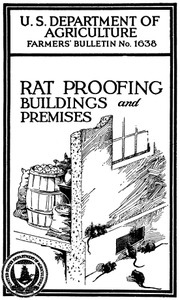
U. S. DEPARTMENT OF AGRICULTURE
FARMERS' BULLETIN No. 1638
FOOD AND SHELTER are as essential to rats as to other animals, and the removal of these offers a practical means of permanent rat control. The number of rats on premises and the extent of their destructiveness are usually in direct proportion to the available food supply and to the shelter afforded. Rat proofing in the broadest sense embraces not only the exclusion of rats from buildings of all types but also the elimination of their hiding and nesting places and cutting off their food supply. Through open doors and in other ways, rats may frequently gain access to structures that are otherwise rat proof, but they can not persist there unless they find safe retreats and food. When rat proofing becomes the regular practice the rat problem will have been largely solved.
Washington, D. C. Issued December, 1930
RAT PROOFING BUILDINGS AND PREMISES
By James Silver, _Associate Biologist_, and W. E. Crouch, _Senior Biologist, Division of Predatory-Animal and Rodent Control, Bureau of Biological Survey_, and M. C. Betts, _Senior Architect, Division of Agricultural Engineering, Bureau of Public Roads_.
General principles of rat proofing 2
Rat-proofing farm buildings 2 Barns 5 Corncribs 7 Granaries 9 Poultry houses 9 Other farm structures 11
Rat proofing city buildings 13 Markets 18 Warehouses 19
Rat proofing the city 20 Model rat-proofing ordinances 21
THE PRINCIPLES of modern construction of buildings are opposed to everything conducive to the best interests of the rat. They call for the liberal use of indestructible and noncombustible materials, as well-made concrete and steel, and these are too much for even the sharpest of rodent incisors. They include, also, fire stopping in double walls and floors and the elimination of all dead spaces and dark corners, and the rat is left no place in which to hide. They embody sanitary features that provide for hygienic storage of food, and the rat can not live without something to eat.
Many men have devoted their lives to a study of methods of rat control, and as a result countless preparations, devices, and contrivances are constantly being made available. Trapping, snaring, trailing, flooding, digging, hunting, ferreting, poisoning, and fumigating are employed, and rat limes, rat lures, rat repellents, and bacterial viruses are resorted to, and even antirat laws, local. State, and national, are constantly being passed in a world-wide effort to conquer this rodent. These have been important factors in keeping down the surplus, but all destructive agencies that have been used have utterly failed to reduce materially the total number of rats in the world. Rat proofing, however, is at last making definite headway against the age-old enemy of mankind, and it is upon this that the ultimate solution of the rat problem will depend.
The destruction of rats for temporary relief and for keeping them under control in places where rat proofing is not possible or practicable will always be necessary, and knowledge of the best means of destroying rats is essential to any rat-control program. Information on poisoning, trapping, and other means of destroying rats is given in Farmers' Bulletin 1533, Rat Control. Permanent freedom from rats, however, should be the goal of everyone troubled with the pests and rat proofing offers the best means to this end.
GENERAL PRINCIPLES OF RAT PROOFING
Every separate structure presents its individual problem, but there are two general principles that apply in all cases and that should be kept in mind when the rat proofing of any building is being considered. First, the exterior of those parts of the structure accessible to rats, including porches or other appurtenances, must be constructed of materials resistant to the gnawing of rats, and all openings must be either permanently closed or protected with doors, gratings, or screens; second, the interior of the building must provide no dead spaces, such as double walls, spaces between ceilings and floors, staircases, and boxed-in piping, or any other places where a rat might find safe harborage, unless they are permanently sealed with impervious materials.
This bulletin, issued by the U.S. Department of Agriculture in 1930, opens with a stark contrast: while countless methods of rat control have been tried—trapping, poisoning, fumigating—none have materially reduced the world's rat population. The authors argue that only rat-proofing, defined as exclusion through building design, offers a permanent solution. The text moves methodically from general principles to specific structures, then to city-wide ordinances, creating a logical progression from farm to urban environment.
From Farm to City: A Structured Argument
The bulletin is divided into two main parts: farm buildings and city buildings, each with its own subsections. The farm section covers barns, corncribs, granaries, poultry houses, and other structures, while the city section addresses markets, warehouses, and the city as a whole. This structure mirrors the authors' belief that rat-proofing must be adapted to different environments. The text repeatedly emphasizes that modern construction—concrete, steel, fire-stopping—is inherently opposed to rat habitation. The final section presents model ordinances, suggesting that legal enforcement is the ultimate tool.
Recurring Images: Concrete, Steel, and Sanitation
Throughout the bulletin, certain materials and concepts recur as symbols of rat-proofing. Concrete and steel are described as “indestructible” and “noncombustible,” too strong for rodent incisors. Fire-stopping in double walls and elimination of dead spaces are presented as dual-purpose features that also deny rats hiding places. Sanitation is another key image: garbage must be kept in rat-proof containers, and waste accumulation is framed as a public nuisance. The text returns to these images in each section, reinforcing the idea that good construction and cleanliness are inseparable.
Movement Between Scales: From Single Building to City
The bulletin moves fluidly from the micro-scale of a single barn to the macro-scale of an entire city. In the farm section, the focus is on specific entry points: doors, foundations, walls. The city section broadens to include sewers, catch basins, and dumping grounds. This shift in scale is accompanied by a shift in agency: individual farmers are addressed directly, while city officials are urged to enact ordinances. The text notes that in 1930, at least 13 U.S. cities had rat-proofing laws, and more than 30 had fire-stopping requirements. The movement between scales underscores the authors' argument that rat-proofing is both a personal and a civic responsibility.
The Role of Evidence and Authority
The bulletin relies on the authority of its authors—biologists and an architect—and on the institutional backing of the U.S. Department of Agriculture. It cites the United States Public Health Service's experience with bubonic plague as the basis for the model ordinances. The text is careful to acknowledge limitations: it admits that enforcing rat-proofing on existing structures may not be feasible except during plague outbreaks. This cautious tone lends credibility. The authors also note that modern construction already conforms closely to rat-proofing principles, suggesting that builders will face little opposition. The evidence is presented as practical and experience-based, not theoretical.
Readers should approach this bulletin as a historical document of applied science, noting how its arguments are shaped by the built environment of 1930. The text's emphasis on prevention over extermination, and its movement from farm to city, reflect a systematic approach that remains relevant. Pay attention to the interplay between technical detail and policy recommendation, and consider how the authors balance practicality with idealism.
Reading the old bulletin’s insistence on concrete and steel as lasting answers made me think of something quieter, almost domestic. There’s a relief in permanence, a patience to choosing structure over quick fixes. That same sturdy, honest warmth seems to live in Mission Furniture: How to Make It, Part 1 — Background and Themes, where wood and joinery feel like a similar promise of endurance.
There are no reviews for this eBook.
There are no comments for this eBook.
Reader reflection
How will you remember this book?
Save your reaction, strongest insight, and memorable passage.
Your progress
0
/
10
2
Did this book hold your interest?
3
How likely are you to recommend this book?
4
How easy was the book to follow?
5
Did the book meet your expectations?
6
Did the story or argument move comfortably?
7
Did any part of the book feel personally relevant?
8
Did you gain anything practical from the text?
9
What is the main idea you are taking away?
10