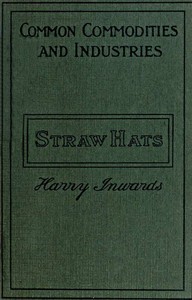
Straw Hats: Their history and manufacture — Background and Themes

(2 User reviews)   485
Inwards, Harry Project Gutenberg 2015
Hats; Straw industries Readers of public-domain and historical texts
Project Gutenberg digital edition en

Edition facts

Words: 41,270
Reading time: 180 min
Text sections: 27
Harry Inwards traces the evolution of straw hat manufacture through detailed descriptions of blocking machines, wood and metal molds, and the specialized tools used to shape boaters and other styles, drawing on trade advertisements and technical diagrams from the early 20th century.
Share
Editorial Edition Score 4.8/5

Calculated from edition completeness, EPUB availability, text structure and catalogue metadata. Not a user rating.

Edition quality

Read the Text

s for straw hat production. According to Cesare Cantu, a well-known Italian historian, the manufacture of hats of straw in the neighbourhood of Florence, for distribution outside the locality, can be traced back to the fourteenth century. This is probably quite true, but unfortunately the statement is not corroborated by any contemporaneous evidence. But in the year 1574, Signa, a village near Florence, was entitled “the original seat of the industry.” (From a consular report.) It is, therefore, almost safe to declare that the commercial life of the straw hat began in the district of Florence, and here, probably, for the first time in history, were to be found gathered together in sufficiently large numbers to make their wares marketable, persons both male and female engaged in weaving straws into hats, or _capelli_, or in plaitting straws into braids, which were called _paglia_ or plait.

From Tuscany to Piedmont is not a “far cry,” and Coryat in his _Crudities_ (a work published in 1611 and consisting of a series of observations made in a journey through Europe) says, “at many places in Piemont I observed most delicate strawen hats, which both men and women use in most places of that Province.”

Again, Piedmont is not very distant from Lorraine, and it is from this latter district, which was the country of the birthplace of her mother, that Mary, Queen of Scots, is said to have brought plaitters to Scotland in 1552, and thus to have introduced the art to the British Isles.

Some writers on this subject, failing to discriminate between plait and hats, adduce many adverse arguments (_see_ below) when the claim is made that the unfortunate queen established the trade in the coasts of Britain. These point to the undoubted fact that straw hats were made both in Scotland and England before her time. That, of course, is quite true, but what is not equally certain is whether the hats made in the British Isles before 1552 were hats woven in one piece, or hats made of plaitted braid sewn afterwards in some manner to the required shape. In the old account of the transaction one reads that in Lorraine Mary noticed the people “profitably employed, some in plaitting straws and others in working (_sic_) the straw plait into hats.” It is, therefore, evident that it was an established industry in Lorraine and that _both_ operations were being carried on. One may also deduce that, while the weaving of hats may have been common in Scotland, the making of plait and the subsequent making into hats was a novelty to Mary, and, therefore, in the interests of her Scottish subjects, she endeavoured to promote a similar industry in which they also might be “profitably employed.”

The late Mr. John Waller, of Luton, a member of one of the oldest families connected with the straw trade, after a careful and apparently unbiased investigation, says that the statement about Mary being the founder of the industry “can only be regarded as pleasing fiction”; and to support this quotes from Oldmixon’s _History of England_ (edition of 1724) “That the manufacture of straw plait had thriven for about 100 years in the neighbourhood of Hemel Hempstead and Dunstable.” But from 1552 to 1624 is a long period, and one can easily imagine the natives of sunny Lorraine feeling none too homelike in “Caledonia, stern and wild.” With the accession of James I (Mary’s son) to the English throne, what could be more natural than the migration of these workers to more genial southerly temperatures, bringing with them their art? As James became king in 1603 there would have been plenty of time for the industry of making plait for sewing into hats being established between then and 1624, which would be exactly 100 years before Oldmixon’s account! And speaking of the advent of the Lorrainers into Beds and Herts, Mr. Thomas George Austin, in his book on the _Straw Hat and Bonnet trade of the Luton District_, writes, “It is said to be the true history of the introduction of the handicraft into England.”

One must, therefore, come to the conclusion that the system of making hats from plait, as distinct from the weaving the hat in one piece, was introduced by Mary, Queen of Scots, to Scotland, and from thence the method came south, and for reasons which will be set out hereafter, settled itself in the regions of South Bedfordshire, North-east Hertfordshire, and East Buckinghamshire.

COMMERCIAL RISE AND GROWTH

The history of a straw hat has thus been traced down to the latter half of the eighteenth century.

Prior to this period all kinds of straws, grasses, and fibres of vegetables had been utilized in the operation, the only limit as to material being the growths peculiar to the locality in which hat-making was carried on, so one may see that, as each locality probably grew different kinds of fibres, the result of the finished hats was different.

This difference early gave rise to local nomenclature, perhaps the first collective term was “Leghorn” (_circ._ 1650. Tomlinson’s Cyclopaedia, 1867). This now well-known variety of straw hat, woven first in braids and then cunningly put together in spiral sequence to the required shape, is not sewn overlapping, but with the braids laid edge to edge, and a fine tough straw or other fibre threaded through every other head on the impinging edges of the plait, and then drawn tight, so that the opposite heads fitting between and inside each other assumed the appearance of being woven in one piece, except that where the join took place, the thickness caused by the heads of the plait and the threading material, produced a ridge which, starting from the centre and running spirally to the edge of the brim, is one of the prominent characteristics of a “Leghorn.” This term, therefore, embodies, first, the place of origin; second, the material used; third, the method of using. If other local terms were thus early applied to straw productions, they have not, as far as the Continent of Europe is concerned, come down to modern times, all other names now in use (and they are legion) are the products of the late eighteenth and the nineteenth centuries.

All the materials used for plaitting up to about 1745 had been worked _whole_, that is, the fibre whether rush, grass or straw, was plaitted as it was grown, and consequently the hats of coarse weaving largely predominated; there being naturally a preponderance of the coarser parts of any vegetable growth.

Further, the manipulation of the bigger fibres was easier to fingers perhaps only infrequently devoted to the work, and therefore up to this period the majority of straw hats were thick and weighty. There were exceptions such as _Leghorns_ that were plaitted from a variety of bearded wheat or rye (_Triticum turgidum_) grown in Tuscany. This was light in weight, comparatively tough, and of a fine natural golden colour. The upper part of the straw called _Punta_ (or point) was used for all Leghorn hats, and also for making plait which was called _Tuscan_, from the locality of growth. When _Tuscan_ was the only straw plait exported from Italy, Great Britain was one of the purchasers, and during the early part of the nineteenth century up to the repeal of the Corn Laws and the abolition of protective duties on other goods, British importers of _Tuscan_ plait had to pay a duty of 8s. per lb. weight.

The desire to produce straw hats of less weight brought the bottom half of the straw column into use. That portion generally has a sheath, protecting it from the sun, which being stripped disclosed the under part of pearly white colour, this from being at the foot was called _pedale_, and although not so tough as the _punta_, was sufficiently so for plaitting purposes, and was very much lighter in weight. The first parcel of _pedale_ plait arrived in Great Britain in 1878, and is supposed to have been purchased by Messrs. Carruthers & Co., of Luton.

But even then the quantity of fine _pedale_ straws grown did not suffice for the increasing demands for straw hats.

The Italian straw, being so well established as the best material, caused workers to endeavour to find similar straw in other countries which had adopted straw hat making as a commercial undertaking.

It is probable that the climate of Scotland was not alone the cause for the migration of the Lorrainers; the search for fine white, light, straws, impossible to obtain in the cold north, may have drawn these operatives to the southern parts of England. Whatever the actual reason or reasons, it is certain that by 1624 the neighbourhood of South Bedfordshire (Dunstable), North-west Hertfordshire (Hemel Hempstead), and probably East Buckinghamshire was producing higher grade straw hats than any hitherto obtainable in the British Isles. The district comprises practically the whole of the Eastern ranges of the Chiltern Hills, an area of chalky subsoil. The discriminating Lorrainers quickly discovered the extreme beauty of colour of the Chiltern straws, and it is almost certain that for this reason alone the art of making plait braid was introduced into the locality, which from 1624 onwards has been undoubtedly the centre of the British straw hat industry.

Later on the straw plait making spread to portions of Essex and Suffolk, and although the plaits produced there were of much inferior quality and colour to those produced in the Chilterns, and, generally speaking, were not utilized for the highest class work, they formed a very useful adjunct to the plait stocks required by hat manufacturers when large quantities were needed. Another English centre for straw plaitting was Ripon in Yorkshire, the district around being the seat of quite a fair-sized industry. It is interesting to note this, for it seems to show that the Lorrainers in their southerly migration, had stopped _en route_, and had sampled the straws grown on the Yorkshire chalk.

But all this evidence tends to prove that the nature of the soil which produced the proper straw for plaitting caused the trade to localize around Dunstable. This ancient borough, practically in the centre of the plaitting districts, situated on the Watling Street, along which passed all the traffic between London and the north-west of England and Northern Wales, at the junction of the Icknield way (another ancient Roman road crossing the Watling Street towards the east and west), was in the middle of the fifteenth century alive all day with the hum of people and merchandise travelling to and fro. Sitting astride of the trunk roads leading everywhere in Great Britain, it is small wonder that this little town, of vast ecclesiastical importance in the Middle Ages, but much decayed since the time of Henry VIII, became the place from whence all the products of the neighbourhood could be dispatched.

And, therefore, the name of “Dunstable,” another of the now world-known local names, was given to the plait, hats and bonnets which emanated from the whole vicinity.

The great preponderance of coarse straws, combined with the increasing demands for hats made of fine plaits, caused straw workers to endeavour to make the straws smaller by splitting the “pipes” (as the whole straw is called) into narrower portions called “splints.” This was done at first with a knife, but the result was generally unsatisfactory, although some skilled workers managed to acquire really wonderful deftness in the operation. It was plait called “Patent Dunstable” made of these split straws that gave this plaitting area its first textile claim to distinction. Some one, now unknown, found out that two fine _splints_ of straw laid together, inside to inside, produced when plaitted an effect equal to that of the _whole_ straw, and yet enabled plaitters to make the finest and narrowest widths of plait. The clumsy method of cutting with a knife was apparently the only possible way of making _splints_ until the time of the Napoleonic Wars.

The French prisoners at Yaxley Barracks, near Stilton, produced “pretty and useful articles such as baskets, workboxes, mats, etc.” (Mr. Alfred Tansley Soc. Art., 1860). These were decorated with “laid work,” a kind of mosaic pattern made of coloured straw splints, cut to various sizes and pasted on suitable foundations. “For the purpose of making these splints, they used a straw splitter made of bone, about two inches long, brought to a point behind which a set of cutters was arranged in a circle, the point entered the straw pipe separating it into so many equal sized splints” (Tansley). This instrument was soon copied by a Dunstable blacksmith named Janes (some authorities say Norman) who made some in iron and turned the cutting parts at right angles to an elongated stem, which could be used as a handle. These were subsequently also made in brass, and in 1815 other varieties, in the form of metal wheels set in wooden frames, appeared. Mr. Tansley says, “To this invention may be attributed the success which in after times has attended the manufacture of straw plait in England.”

The two methods of working straws, either _whole_ or _split_, opened up a wide field for diversity of plaitting, and quickly novelties began to appear. From 1815 to the present day, at intervals sometimes short and sometimes very long, new designs of plait have been put on the market, and now there is no style of shape that cannot be suitably fitted up with one or more plaits.

British plaitters have not been content to use only the straws grown in the five counties. They have ransacked the world for materials, _wood_ cut into fine shavings or splints, _Manila grasses_ or _hemp_, manufactured splints of _cotton_, _silk_, or similar fibres, stuck together in a flat ribbon called a “_lame_,” _horsehair_, _bamboo_, _raffia_, and many other articles have been used for the purpose. At one time 30,000 persons were engaged in the plaitting industry, but by 1890 the number had dwindled to under 3,000. The reasons for this decline were manifold. Although the district had produced, and was still producing, straws better than any other continental centre, yet about 1855 the demand for something different from the plaits made solely of straw induced foreign plaitting communities to plait fancy materials which before had been used for other purposes. Switzerland and France began to make pretty and delicate patterns of plait or braid, woven both by hand and by machinery, of all kinds of fancy fibres such as silk, horsehair (or crinoline as termed by milliners), fine ribbons, etc., in various combinations of one or two or more of the above articles either with or without straws. Further attempts in the way of decoration were made by intermixtures of glass beads and bugles.

These very fanciful braids had a wonderful success, for they were especially adaptable for bonnets, which to about 1865 were much more in demand for fashionable wear than hats.

This invasion of a large quantity of displacing material adversely affected the volume of plaitting in England, and still further damage was done when Italy began to send over plain and fancy plaits made of willow shavings, as well as fine straw _punta_ and _pedale_ plaits similar to _Twist_, which was by then the mainstay of the fine plait trade. (_Twist_ was a 7 end straw with a twisted beadhead made of fine splints, two of which laid inside to inside formed one strand for plaitting.) In 1867 the “last nail in the coffin” of British straw plaitting was driven by the first import of plait from China, and in that same year the distress in and around Dunstable was so great that the then Mayor, Mr. Joseph Gutteridge, called a public meeting to discuss methods for its alleviation.

As the far eastern countries of China and Japan now play such an important part in the world’s straw hat trade, it will be of interest to note how British traders first came in contact with their goods. Doubtless from time immemorial the deft “Chinee” had been accustomed to the weaving of grasses, etc., into hats and mats, and it is stated that the attention of Luton hat makers was first drawn to the possibility of getting plait from China, by seeing some “hats (mats?) which had been used for lining chests of tea.”

Whatever the cause, in 1867, from plaitted samples sent to them, the Chinese were able to imitate, in their native grown straws, the products of England in such an excellent manner and at such a low price, that the fiercest competition was at once created. People engaged in the trade were so exasperated at the circumstance, that they made an effigy of the importer and burned it in the Luton Market Place. The competition of the increasing bulk of China straw plait imports, together with the Italian imitation of Dunstable twist (called at first “Milan,” and now generally known as “7 ends Pedal”) made the plaitting trade in the five counties to decrease rapidly.

“The Society of Arts have at various times rewarded many individuals for successful attempts to introduce bonnets formed of grasses indigenous to Britain,” says Tomlinson, in his _Cyclopaedia_ published in 1867, but all these well meant efforts to revive the industry were unavailing. Neither for price nor quantity (which latter was rapidly becoming almost the prime necessity) could British plaitters successfully compete with the Italians and the Chinese for plaits of narrow grades, although quantities of wider plaits both of plain and fancy designs continued to be made. About 1890 plait began to arrive from Japan, and just as the British straw was better than the Italian and Chinese, so the Japanese was superior to the British. It was of the most delicate pearly colour, it was infinitely lighter in weight, and it could be obtained in far bigger _pipes_ than any European or Chinese growths, and its adaptability both for _whole_ and _split_ plaits was equal to all.

In straw plait, therefore, the Japanese were able to compete successfully, but in a short time they put on the market an article made of wood splints plaitted with three strands, called “Chip 3 ends.” This plait, of Italian make originally, from its extremely low price and colour possibility, was the material backbone of the ladies’ hat trade for some years. In later times a braid made of hemp by machinery, called _Tagal_ or _Tégal_, originated in Switzerland and Italy. Quickly adopted by the Japanese, they have been able to supplant the earlier producers, and as with the _Chip 3 ends_, to provide varieties which have almost monopolized the hat making markets for the million.

In 1896 the plaitting trade was in such a bad state that some of the principal hat makers in the district determined to attempt the rescue of the plaitters. For that purpose the “British Straw Plaitting Company” was formed, the writer of this book being appointed Chairman of a very representative Board of Directors. Manufacturers were eager to assist, and for the first twelve months the company showed great promise. A revival of plaitting (although with other materials than straw and of fresh designs) ensued, and better prices were paid so that wages were much advanced. But the Swiss and Italians took fright, and for the next two years so successfully competed by cutting prices, that in 1899 the company was obliged to cease operations.

In fact, not only could better materials for plaitting be found in other parts of the world, but in those parts the natives, who (as the _Ency. Britt._ says about the Chinese) “could live where an Englishman would starve,” were able to produce plait at prices which made it impossible for plaitters in England to earn a living. But fortunately as the plaitting trade declined the hat and bonnet making of Dunstable and Luton was increasing as fast as its predecessor fell.

In 1865 the first attempts to sew plait by machinery were made, previously all had been sewn by hand, a long and tedious process, when fine plaits were involved.

This took the form of sewing several pieces of fine plait in a parallel form, making strips of an increased width, which were then sewn by hand to the desired shape. A little later an American named Bodsworth introduced a machine which was capable of sewing plait into hats and bonnets, but unlike all subsequent models, which start at the centre of the top of the crown, this machine started sewing at the edge of the brim. This materially lessened the field of shape variety, and although great improvements were effected by skilfulness of working, and although the machine was adopted by Messrs. Vyse Sons & Co., it was not taken up generally by the trade.

The opening pages of Harry Inwards's study immediately immerse the reader in the industrial landscape of straw hat production, where advertisements for pneumatic leathers and patent blocking machines jostle with technical descriptions of wood and metal molds. The work is structured as a sequence of short, focused chapters that move from raw materials to finished headwear, punctuated by full-page trade notices. One recurring image is the block—the wooden or metal form over which straw is shaped—described with precision in terms of its wood type, spindle hole, and hinged sections. The text shifts between workshop detail and broader historical context, often within a single paragraph.

The Block as Central Object

The block emerges as the pivotal tool in straw hat manufacture. Inwards devotes considerable space to its construction, noting that alder is preferred for its resistance to dry and damp heat, while poplar and chestnut serve for specialized shapes. The brim block, often made in two parts with a hinge and lock, allows the head entry to fit closely against the crown. The spindle hole—a square aperture in the block's base—receives an iron spindle whose upper portion is square and tapered, enabling quick adjustment. This mechanical vocabulary recurs throughout, grounding the narrative in tangible objects.

Movement Between Hand and Machine

The text repeatedly contrasts hand blocking with machine blocking. Wood blocks serve as patterns for metal casts in iron, aluminium, or spelter, and plaster of Paris copies are made for temporary use by sewers. Inwards describes how the same wooden model can generate both a permanent metal block and a disposable plaster version, illustrating a production chain that moves from artisan to factory. The description of the 'Tipper'—a metal scoop attached to a wooden spindle—shows how tools evolved to meet specific shapes, such as the close brim of the 1860s Pork Pie turban. The advent of two-piece hats, where crown and brim are blocked separately, rendered such instruments nearly obsolete.

Advertisements as Historical Evidence

Interspersed with technical chapters are full-page advertisements from suppliers like the Hat Manufacturers’ Supply Co., Ltd., and E. T. Raban & Sons. These ads name specific products—'Ivy' and 'Marvel' leathers, the 'Bon-Ton Ivy'—and claim that over twenty million have been sold for straw hats alone. Inwards does not comment on these claims, but their inclusion provides a contemporary record of marketing language and industrial networks. The ads also reveal the global reach of the trade, with agents in various parts of the world and telegrams addressed to Florence and London.

The Role of Diagrams and Visuals

The text frequently references figures and diagrams, such as Fig. 9 'Tipper,' which are not reproduced in the digital edition but are clearly essential to understanding the tools described. Inwards writes as if the reader has the illustrations before them, using phrases like 'see John Leech’s drawings in Punch' to evoke a visual reference. This reliance on images shapes the reading experience: the prose becomes a caption to absent pictures, and the technical descriptions demand a mental reconstruction of the machinery. The interplay between word and image is a structural feature of the work.

Readers will benefit from approaching this book as a technical manual embedded in a commercial context. The advertisements are not mere appendages but integral to understanding the industry's self-presentation. Pay attention to the verbs of making—blocking, stiffening, sewing—and the materials that constrain each process. The absence of diagrams in this edition means that careful reading of the verbal descriptions is essential to visualize the tools and their operations.

Madison Thompson
4 weeks ago

Ava Robinson
3 weeks ago

3.5
3.5 out of 5 (2 User reviews )

Add a Review

Your Rating *
There are no comments for this eBook.

Reader reflection

What did you think of this book?

Answer a few questions and save a private reflection on this device.

Your progress 0 / 10
1

Which reading stage best describes you?

2

Did this book hold your interest?

3

Is this a title you would suggest to others?

4

What was the reading difficulty like?

Related eBooks