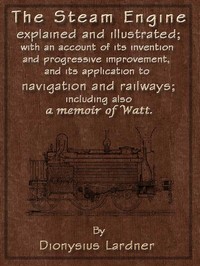
The Steam Engine Explained and Illustrated (Seventh Edition) With an Account of Its Invention and Progressive Improvement, and Its Application to Navigation and — Key Ideas to Explore

(3 User reviews)   488
Lardner, Dionysius, 1793-1859 Project Gutenberg 2013
Watt, James, 1736-1819; Steam-engines Readers of public-domain and historical texts
Project Gutenberg digital edition en

Edition facts

Words: 187,708
Reading time: 817 min
Text sections: 26
Dionysius Lardner's 1840 treatise on steam engines blends technical exposition with historical narrative, examining boiler design, steam condensation, and the contributions of inventors from Hero to Watt, using precise mechanical reasoning and period engravings.
Share
Editorial Edition Score 4.9/5

Calculated from edition completeness, EPUB availability, text structure and catalogue metadata. Not a user rating.

Edition quality

Read the Text

The Steam Engine, a Subject of popular Interest 4

Great Power of Steam 7

Object of this Work 9

Disputes respecting the Invention 11

Hero of Alexandria's Machine 13

Blasco De Garay's Proposition to propel Vessels by a Machine 16

Giovanni Branca proposes to work Mills by Steam 22

Marquis of Worcester 23

Mechanical Properties of Fluids 25

Elastic and Inelastic Fluids 25

Elasticity of Gases 28

Application of these Principles to the Engines of Hero, De Caus, and Lord Worcester 30

Sir Samuel Morland 34

Atmospheric Pressure 38

Elastic Force of Air and Gases 42

Force obtained by a Vacuum 43

Rarefaction by Heat 44

Process of filling Thermometers 44

Papin's Method of producing a Vacuum 44

His Discovery of the Condensation of Steam 45

ENGINES OF SAVERY AND NEWCOMEN.

Boilers and their Appendages 50

Working Apparatus described 51

Defects of Savery's Engine 58

Newcomen's Engine described by Papin 62

Newcomen and Cawley obtain a Patent for Atmospheric Engine 65

Accidental Discovery of Condensation by Injection 69

Potter's Discovery of the Method of working the Valves 71

His Contrivance improved by the Substitution of a Plug Frame 72

Advantages of the Atmospheric Engine over that of Savery 72

The Power of Savery's Engine restricted 73

It contained no new Principle 73

Its practical Superiority 73

EARLY CAREER AND DISCOVERIES OF JAMES WATT.

Atmospheric Engine improved by Beighton 75

Smeaton's Improvements in the Atmospheric Engine 76

Brindley obtains a Patent for Improvement in 76

Invents the Self-regulating Feeder 76

Infancy of James Watt 77

His Descent and Parentage 77

Anecdotes of his Boyhood 78

His early Acquirements 79

Returns to Glasgow 80

Appointed Instrument-maker to the University 81

Opens a Shop in Glasgow 81

His Friends and Patrons 81

Professor Robison's Remarks on Watt's personal Character 82

His industrious and studious Habits 82

His Attention first directed to Steam 83

Experiments on High-pressure Engine 83

Repairs an Atmospheric Model 84

Experimental Inquiry consequent on this 84

Observes great Defects in the Atmospheric Engine 85

His first Attempt to improve it 85

His early Experiments on Steam 87

Discovery by Experiment of the Expansion which Water undergoes in Evaporation 90

Discovers the latent Heat of Steam 91

Informed by Dr. Black of the Theory of latent Heat 93

His Improvement not due to Black 93

EXPOSITION OF PHYSICAL PRINCIPLES.

Construction of Thermometer 98

Method of graduating it 99

Freezing and boiling Points 99

Latent Heat of Water 101

Quantity of Heat necessary to convert Ice into Water, first noticed by Dr. Black 101

Examination of the analogous Effects produced by the continued Application of Heat to Water in the liquid State 102

Process of Boiling 104

Reconversion of Steam into Water 104

Conversion of Water into Steam 105

Latent Heat of Steam 107

Boiling Point varies 108

Different in different Places 109

Inquiry whether a Diminution of Pressure will produce a corresponding Effect on the boiling Point 112

Table showing the Temperature at which Water will boil under different Pressures of the Atmosphere 113

Mechanical Force of Steam 115

Facts to be observed in 117

FURTHER DISCOVERIES OF WATT.

Watt finds that Condensation in the Cylinder is incompatible with a due Economy of Fuel 119

Conceives the Notion of condensing out of the Cylinder 120

Discovers separate Condensation 121

Invents the Air Pump 123

Substitutes Steam Pressure for Atmospheric Pressure 123

Invents the Steam Case, or Jacket 124

His first Experiments to realise these Inventions 125

His experimental Apparatus 125

His experimental Models fitted up at Delft House, in Glasgow 128

Difficulties of bringing the improved Engines into Use 129

Watt first employed by Roebuck as a Civil Engineer 130

His Partnership with Roebuck 130

Experimental Engine at Kinneal 131

Abstract of the Act of Parliament for the Extension of his Patent 132

Description of his single-acting Steam Engine 133

Correspondence of Watt with Smeaton 145

Failure of Condensation by Surface 146

Improvements in Construction of Piston 147

Method of Packing 148

Improvements in boring the Cylinder 149

Disadvantages of the new compared with the old Engines 150

Greatly increased Economy of Fuel 150

Economy of the Engine 151

Expedients to force the new Engines into Use 151

Correspondence of Boulton 153

Correspondence with Smeaton 155

Efficiency of Fuel in the new Engines 156

Discovery of the expansive Action of Steam 157

Watt states it in a Letter to Dr. Small 157

Its Principle explained 158

Mechanical Effects resulting from it 162

Computed Effect of cutting off Steam at different Portions of the Stroke 163

Produces a variable Power 163

Expedients for equalising the Power 164

Expansive Principle in Watt's Engines limited 165

Its more extensive Application in the Cornish Engines 165

DOUBLE-ACTING ENGINE.

Superheated Steam 170

Laws of Dalton and Gay Lussac 171

Relation between Temperature and Pressure of common Steam 171

Effects of the Expansion of common Steam 173

Mechanical Effects of Steam 173

Method of equalising the expansive Force 174

Hornblower's Engine 175

Watt's Attempts to extend the Steam Engine to Manufactures 178

Papin's projected Applications of the Steam Engine 178

Savery's Application of the Engine to move Machinery 180

Jonathan Hull's Application to Water Wheels 180

Champion of Bristol applies the Atmospheric Engine to raise Water 181

Stewart's Application of the Engine to Mill-work 182

Wasbrough's Application of the Fly-wheel and Crank 183

Reasons why Watt's single-acting Steam Engine was not adapted to produce continuous uniform Motion of Rotation 184

Watt's Second Patent 186

Sun-and-Planet Wheels 187

Valves of double-acting Engine 189

DOUBLE-ACTING ENGINE.

Methods of connecting the Piston-rod and Beam in the double-acting Engine 193

Connection of Piston-rod and Beam 195

Connecting Rod and Crank 203

Construction and Operation of the double-acting Engine 216

Single-clack Valves 227

Double-clack Valves 228

Common hemp-packed Piston 242

Cartwright's Engine 245

Cartwright's Piston 247

BOILERS AND FURNACES.

Process of Combustion 253

Heat evolved in it 254

Form and Structure of Boiler 255

Method of feeding it 257

Combustion of Gas in Flues 260

Williams's Patent for Method of consuming unburned Gases 260

Construction of Grate and Ash-pit 261

Magnitude of heating Surface of Boiler 262

Steam-space and Water-space in Boiler 263

Position of Flues 264

Method of feeding Boiler 265

Method of indicating the Level of Water in Boiler 266

Self-regulating Feeders 267

Watt's Invention of the Indicator 274

Self-regulating Damper 281

Brunton's Self-regulating Furnace 283

Gross and useful Effect of an Engine 285

Power and Duty of Engines 287

Horse-power of Steam Engines 289

Evaporation proportional to Horse-power 290

Sources of Loss of Power 292

Absence of good practical Rules for Power 292

Common Rules followed by Engine-makers 292

Duty distinguished from Power 294

Proportion of Stroke to Diameter of Cylinder 295

Cornish System of Inspection 297

Table showing the Improvement of Cornish Engines 298

Beneficial Effects of Cornish Inspection 299

Successive Improvements on which the increased Duty of Engines depends, traced by John Taylor in his "Records of Mining" 299

Watt's Friends and Associates at Birmingham 302

His Invention of the Copying Press 302

Heating Apartments and Buildings by Steam 303

Watt's Machine for drying Linen 303

His Share in the Discovery of the Composition of Water 303

The Merit of this Discovery shared between Cavendish, Lavoisier, and Watt 305

Anecdote of Watt's Activity of Mind 309

His Introduction of the Use of Chlorine in Bleaching 310

One of the Founders of the Pneumatic Institution at Clifton 310

His first Marriage 311

Death of his first Wife 311

His second Marriage 311

Death of his younger Son 311

Extracts from his Letters 312

Character of Watt by Lord Brougham 313

Extract from Sir Walter Scott's "Monastery" on the Character of Watt 314

Sketch of the Life of Watt from the "Scotsman" by Lord Jeffrey 315

Occupation of his old Age 318

His Invention of Machine for copying Sculpture 318

Monuments to his Memory 319

Inscription by Lord Brougham on the Pedestal of the Monument in Westminster Abbey 320

LOCOMOTIVE ENGINES ON RAILWAYS.

Page High-pressure Engines 322

One of the earliest Forms of the Steam Engine 322

Description of Leupold's Engine 323

Non-condensing Engine of Messrs. Trevethick and Vivian 324

Construction of a Machine for moving Carriages on Railroads 328

Effects of Railway Transport 329

Moral and political Consequences of 334

History of the Locomotive Engine 337

Construction of Locomotive Engine by Blinkensop 337

Messrs. Chapman's Contrivance 337

Mr. Stephenson's Engines at Killingworth 339

Liverpool and Manchester Railway 342

The Directors offer a Prize for the best Locomotive Engine 344

Experimental Trial 344

The "Rocket," "Sanspareil," and "Novelty" 344

Admirable Arrangement in the Rocket 345

Description of the "Sanspareil" 347

Description of the "Novelty" 349

The Superiority of the "Rocket" 350

Method of subdividing the Flue into Tubes 353

Progressive Improvement of Locomotive Engines 354

Dr. Lardner's Experiments in 1832 357

Adoption of Brass Tubes 360

Great Expense of Locomotive Power 361

Mr. Booth's Report 362

Detailed Description of the most improved Locomotive Engines 365

Substitution of Brass for Copper Tubes ascribed to Mr. Dixon 370

Power of Locomotive Engines 379

Position of the Eccentrics 379

Pressure of Steam in the Boiler 401

Dr. Lardner's Experiments in 1838 406

Resistance to Railway Trains 407

Dr. Lardner's Experiments on the Great Western Railway 408

Experiments on Resistance 409

Restrictions on Gradients 410

Compensating Effect of Gradients 412

Experiment with the "Hecla" 412

Disposition of Gradients should be uniform 415

Methods of surmounting steep Inclinations 415

LOCOMOTIVE ENGINES ON TURNPIKE ROADS.

Railways and Stone Roads compared 420

Gurney's Steam Carriage 423

The Boiler of Gurney's Engine 423

His Method of cleansing Boilers 428

Convenience and Safety of Steam Carriages 432

Two Methods of applying Locomotive Engines upon common Roads 434

Horse Carriages compared with Steam 435

Extract from Mr. Farey's Evidence before the House of Commons 435

Hancock's Steam Carriage 436

How it differs from that of Mr. Gurney 437

Ogle's Locomotive Carriage 438

Dr. Church's Steam Engine 439

Form and Arrangement of Marine Engines 441

Arrangement of the Engine-room 446

Effects of Sea Water in Boilers 450

Remedies for them 451

Indicators of Saltness 453

Seaward's Indicator 454

His Method of blowing out 454

Field's Brine Pumps 456

Tubular Condensers applied by Mr. Watt 457

Hall's Condensers 458

Substitution of Copper for Iron Boilers 460

Process of Stoking 462

Watt's Expedient of attaching Felt to the Boiler Surface 463

Means of economising Fuel 463

Number and Arrangement of Furnaces and Flues 463

Howard's Marine Engine 464

Application of the expansive Principle in Marine Engines 466

Recent Improvements of Messrs. Maudslay and Field 467

Humphrey's Marine Engine 470

Common Paddle-wheel 472

Feathering Paddles 474

Galloway's Patent for a Paddle-wheel with movable Paddles 476

Proportion of Power to Tonnage 480

Improved Efficiency of Marine Engines 482

Iron Steam Vessels 483

Steam Navigation to India 484

AMERICAN STEAM NAVIGATION.

Steam Navigation first established in America 487

Circumstances which led to it 488

Attempts of Fitch and Rumsey to apply the single-acting Engine to the Propulsion of Vessels 489

Stevens of Hoboken commences Experiments in Steam Navigation 489

Experiments of Livingstone and Fulton 489

Fulton's first Boat 490

The Hudson navigated by Steam 491

Extension and Improvement of River Navigation 492

American Steamers 494

Difference between them and European Steamers 494

Steamers on the Hudson 494

American Paddle-wheels 495

Sea-going American Steamers 496

Speed attained by American Steamers 497

The Mississippi and its Tributaries 499

Steam-boats navigating it 500

Their Structure and Machinery 500

New Orleans Harbour 503

_On the Relation between the Temperature, Pressure, and_ _Density of Common Steam._

Empirical Formula of Biot, showing the Relation between the Pressure and Temperature 505

Empirical formula of Southern 506 Tredgold 506 Mellet 506 De Pambour 506 MM. Dulong and Arago 506

Law of the Expansion of elastic Fluids, discovered by Dalton and Gay Lussac 506

Formula for the Relation between the Volumes and Temperatures 507

Table of Pressures, Temperatures, Volumes, and Mechanical Effects of Steam 509

Empirical Formulæ for the Relation between the Volume of Water and that of the Steam produced by its Evaporation under given Pressures 511

Formula of Navier 511

Modified by De Pambour 511

_On the Expansive Action of Steam._

Mechanical Effect produced during a given Extent of Expansion 511

Mechanical Effect produced during Evaporation and subsequent Expansion 512

Application to double-acting Engines 513

Formula for Pressure of Steam in Cylinders 514

Formula for total Mechanical Effect per Minute of Steam when cut off at any proposed Part of the Stroke 514

Formulæ exhibiting the Relation between the Resistance of the Load, the Resistances of the Engine, the Evaporation, the Speed of the Piston, and the Magnitude of the Cylinder 515

Formulæ showing the Relation between the Power of the Engine, the Evaporation, and the useful Load 516

Formulæ for the _useful Effect_ and the _Duty_ 517

Estimates of the several Sources of Resistances 518

Tables to facilitate the Computation of the Effects of Expansive Engines 519

Table of the Areas of Pistons 520

EXAMPLES of the Application of these Formulæ 521

THE STEAM ENGINE, A SUBJECT OF POPULAR INTEREST. — THE OBJECT OF THIS WORK. — DISPUTES RESPECTING THE INVENTION. — HERO. — DE GARAY. — DE CAUS. — BRANCA. — MARQUIS OF WORCESTER. — PHYSICAL PRINCIPLES. — ELASTIC AND INELASTIC FLUIDS. — THEIR PROPERTIES. — APPLICATION OF THESE PRINCIPLES TO THE ENGINES OF HERO, DE CAUS, AND LORD WORCESTER. — SIR SAMUEL MORLAND. — PAPIN. — ATMOSPHERIC PRESSURE. — THE WEIGHT OF AIR. — LESS AT GREATER HEIGHTS. — BAROMETER. — PRESSURE OF AIR. — ELASTIC FORCE OF AIR AND GASES. — FORCE PRODUCED BY A VACUUM. — COMMON PUMP. — RAREFACTION BY HEAT. — PAPIN'S METHODS OF PRODUCING A VACUUM. — HIS DISCOVERY OF THE CONDENSATION OF STEAM. — SAVERY.

(1.) That the history of the invention of a piece of mechanism, and the description of its structure, operation, and [Pg004] uses, should be capable of being rendered the subject matter of a volume, destined not alone for the instruction of engineers or machinists, but for the information and amusement of the public in general, is a statement which at no very remote period would have been deemed extravagant and incredible.

Advanced as we are in the art of rendering knowledge popular, and cultivated as the public taste is in the appreciation of the expedients by which science ministers to the uses of life, there is still perhaps but one machine of which such a proposition can be truly predicated: it is needless to say that that machine is the STEAM ENGINE. There are many circumstances attending this extraordinary piece of mechanism which impart to it an interest so universally felt. Whether we regard the details of its structure and operation, the physical principles which it calls into play, and the beautiful contrivances by which these physical principles are rendered available;—or, passing over these _means_, we direct our attention to the _ends_ which they attain, we are equally filled with astonishment and admiration. The history of the steam engine offers to our notice a series of contrivances which, for exquisite and refined ingenuity, stand without any parallel in the annals of mechanical science. These admirable inventions, unlike other results of scientific inquiry, have also this peculiarity, that, to understand their excellence and to perceive their beauty, no previous or subsidiary knowledge is necessary, save what may be imparted with facility and clearness in the progress of the explanation and development of the machine itself. A simple and clear exposition, divested of needless technicalities and aided by well-selected diagrams, is all that is necessary to render the construction and operation of the steam engine, in all its forms, intelligible to persons of plain understanding and moderate information.

But if the contrivances by which this vast power is brought to bear on the arts and manufactures, be rendered attractive by their great mechanical beauty, how much more imposing will the subject become when the effects which the steam engine has produced upon the well-being of the human race are considered. It has penetrated the crust of the earth, and drawn from beneath it boundless treasures [Pg005] of mineral wealth, which, without its aid, would have been rendered inaccessible; it has drawn up, in measureless quantity, the fuel on which its own life and activity depend; it has relieved men from their most slavish toils, and reduced labour in a great degree to light and easy superintendence. To enumerate its present effects, would be to count almost every comfort and every luxury of life. It has increased the sum of human happiness, not only by calling new pleasures into existence, but by so cheapening former enjoyments as to render them attainable by those who before could never have hoped to share them: the surface of the land, and the face of the waters, are traversed with equal facility by its power; and by thus stimulating and facilitating the intercourse of nation with nation, and the commerce of people with people, it has knit together remote countries by bonds of amity not likely to be broken. Streams of knowledge and information are kept flowing between distant centres of population, those more advanced diffusing civilisation and improvement among those that are more backward. The press itself, to which mankind owes in so large a degree the rapidity of their improvement in modern times, has had its power and influence increased in a manifold ratio by its union with the steam engine. It is thus that literature is cheapened, and, by being cheapened, diffused; it is thus that Reason has taken the place of Force, and the pen has superseded the sword; it is thus that war has almost ceased upon the earth, and that the differences which inevitably arise between people and people are for the most part adjusted by peaceful negotiation.

Deep as the interest must be with which the steam engine will be regarded in every civilised country, it presents peculiar claims upon the attention of the people of Great Britain. Its invention and progressive improvement are the work of our own time and our own country; it has been produced and matured almost within the last century, and is the exclusive offspring of British genius, fostered and sustained by British enterprise and British capital.

The steam engine is a mechanical contrivance, by which coal, wood, or other fuel is rendered capable of executing any [Pg006] kind of labour. COALS are by it made to spin, weave, dye, print and dress silks, cottons, woollens, and other cloths; to make paper, and print books upon it when made; to convert corn into flour; to express oil from the olive, and wine from the grape; to draw up metal from the bowels of the earth; to pound and smelt it, to melt and mould it; to forge it; to roll it, and to fashion it into every desirable form; to transport these manifold products of its own labour to the doors of those for whose convenience they are produced; to carry persons and goods over the waters of rivers, lakes, seas, and oceans, in opposition alike to the natural difficulties of wind and water; to carry the wind-bound ship out of port; to place her on the open deep ready to commence her voyage; to throw its arms around the ship of war, and place her side by side with the enemy; to transport over the surface of the deep persons and information, from town to town, and from country to country, with a speed as much exceeding that of the ordinary wind, as the ordinary wind exceeds that of a common pedestrian.

Such are the virtues, such the powers, which the steam engine has conferred upon COALS. The means of calling these powers into activity are supplied by a substance which nature has happily provided in unbounded quantity in every part of the earth; and though it has no price, it has inestimable value: this substance is WATER.

A pint of water may be evaporated by two ounces of coals. In its evaporation it swells into two hundred and sixteen gallons of steam, with a mechanical force sufficient to raise a weight of thirty-seven tons a foot high. The steam thus produced has a pressure equal to that of common atmospheric air; and by allowing it to expand, by virtue of its elasticity, a further mechanical force may be obtained, at least equal in amount to the former. A pint of water, therefore, and two ounces of common coal, are thus rendered capable of doing as much work as is equivalent to seventy-four tons raised a foot high.

The circumstances under which the steam engine is worked on a railway are not favourable to the economy of fuel. Nevertheless a pound of coke burned in a locomotive engine [Pg007] will evaporate about five pints of water. In their evaporation they will exert a mechanical force sufficient to draw two tons weight on the railway a distance of one mile in two minutes. Four horses working in a stage-coach on a common road are necessary to draw the same weight the same distance in six minutes.

A train of coaches weighing about eighty tons, and transporting two hundred and forty passengers with their luggage, has been taken from Liverpool to Birmingham, and back from Birmingham to Liverpool, the trip each way taking about four hours and a quarter, stoppages included. The distance between these places by the railway is ninety-five miles. This double journey of one hundred and ninety miles is effected by the mechanical force produced in the combustion of four tons of coke, the value of which is about five pounds. To carry the same number of passengers daily between the same places by stage-coaches on a common road, would require twenty coaches and an establishment of three thousand eight hundred horses, with which the journey in each direction would be performed in about twelve hours, stoppages included.

The circumference of the earth measures twenty-five thousand miles; and if it were begirt with an iron railway, such a train as above described, carrying two hundred and forty passengers, would be drawn round it by the combustion of about thirty tons of coke, and the circuit would be accomplished in five weeks.

Dionysius Lardner opens his seventh edition with a dedication to Henry Lord Brougham and a note acknowledging illustrations borrowed from Tredgold's work on steam navigation. The book's structure immediately signals a dual purpose: it is both a technical manual and a historical account. Lardner writes in a measured, expository voice, often qualifying his statements with phrases like "it is, however, right to repeat that this (like almost every other so called rule) is the result not of any exact general calculation." This caution reflects the state of steam engineering in 1840, where practice often outpaced theory.

Boiler Design and the Risk of Overheating

Lardner devotes considerable attention to the proportions of steam boilers, treating the boiler as a system with two distinct spaces: one for water and one for steam. He notes that the steam space must hold at least five to ten times the volume consumed per stroke, but admits that no universal rule exists. More striking is his warning about the danger of exposing boiler plates to heat when they are not in contact with water. He explains that steam, being a "slow recipient of heat," fails to cool the metal, causing plates to soften and joints to open. This passage reveals Lardner's reliance on physical reasoning rather than empirical formulas, and his concern for practical safety.

The Vocabulary of Early Steam Engineering

Lardner's terminology reflects a field still in flux. He uses phrases like "ready made steam" and speaks of steam "becoming latent" in bubbles—a nod to the caloric theory of heat. His description of water circulation in the boiler, where heated water becomes "bulk for bulk, lighter than the strata of water above it," shows an effort to explain convection in plain language. The text is peppered with references to "flues," "feed water," and "evaporating power," terms that would become standardized but here carry the weight of a developing discipline. Lardner often contrasts theoretical ideals with the customs of manufacturers, grounding his explanations in workshop practice.

Narrative Threads: From Hero to Watt

The table of contents traces a lineage from Hero of Alexandria's machine through Blasco de Garay, Solomon de Caus, Giovanni Branca, the Marquis of Worcester, Sir Samuel Morland, Denis Papin, Thomas Savery, and finally James Watt. Lardner frames these inventors as contributors to a progressive improvement, but he also notes disputes over priority. The inclusion of a memoir of Watt and an engraved frontispiece of the inventor suggests that Watt is the culminating figure. However, the excerpts do not reveal Lardner's evaluative stance toward earlier figures; he may simply be cataloging their efforts as steps toward the modern engine.

Illustrations as Evidence

Lardner's seventh edition is "illustrated by engravings on wood," and he credits Mr. Weale for permission to use plates from Tredgold's work. The frontispiece—a portrait of Watt engraved by H. Adlard from a drawing by H. Corbould, taken with Watt's permission—is a deliberate choice. It presents Watt as a dignified, authoritative figure, reinforcing the book's emphasis on his contributions. The engravings are not merely decorative; they are integral to Lardner's explanatory method. In the boiler section, for instance, a diagram would clarify the relationship between flues and water level. The text repeatedly refers to visual aids, though the excerpts do not include them.

Readers approaching Lardner's work should expect a hybrid text: part historical narrative, part engineering handbook. The author's voice is that of a lecturer who values clarity over brevity, often repeating key points and qualifying his claims. The book rewards careful attention to its technical passages, where Lardner's reasoning about pressure, heat, and mechanical forces is laid out step by step. For those interested in the development of steam technology, this edition offers a snapshot of mid-nineteenth-century knowledge, complete with its uncertainties and practical wisdom.

Jack Jones
3 weeks ago

Mila Nguyen
3 weeks ago

Ella Flores
4 weeks ago

5
5 out of 5 (3 User reviews )

Add a Review

Your Rating *
  • ...
    Ashley Sara Davies - 1 month ago
    This seventh edition of 'The Steam Engine Explained and Illustrated' is a treasure trove for anyone fascinated by industrial history. The detailed account of the engine's invention and its progressive improvements is both educational and engaging. The sections on its application to navigation and railways are particularly insightful, offering a clear understanding of how steam power revolutionized transport. The memoir included adds a personal touch, making this a comprehensive and highly recommended read for enthusiasts and students alike.

  • ...
    Larry Bennett - 2 weeks ago
    A thorough historical reference on the steam engine, covering its development and uses in transport. The illustrations are helpful, but the text is quite dense and may feel dated for casual readers. Still, it's a valuable resource for those interested in the technical evolution of steam power.

  • ...
    Jesse Wilson - 1 week ago
    While this book provides a wealth of historical information on the steam engine, it reads more like a technical manual than an engaging narrative. The language is archaic and the lack of modern analysis makes it less accessible to today's readers. Those without a strong background in engineering or history may find it difficult to follow. It serves better as a reference than a casual read.


Reader reflection

Take a moment to reflect on this book

Create a short personal record of your experience with this book.

Your progress 0 / 10
1

Where are you in your reading?

2

Was reading this book enjoyable?

3

Would you encourage someone else to read it?

4

Did the language feel accessible?

Related eBooks