1

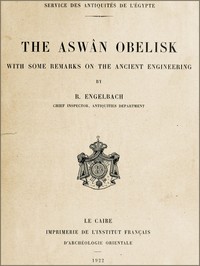
The Aswân Obelisk With some remarks on the Ancient Engineering — Edition Insights
(0 User reviews)
449
Project Gutenberg
2019
Not confirmed
Egypt -- Antiquities; Obelisks
Readers of public-domain and historical texts
Project Gutenberg digital edition
en
Edition facts
Words
28,368
Reading time
124 min
Text sections
20
The catalog record for The Aswân Obelisk With some remarks on the Ancient Engineering — Edition Insights provides practical reading context through 28,368 words, 2 hr 4 min estimated reading time, and 20 detected text sections.
The text analysis averages about 15.6 words per sentence, while the detected sections provide another way to judge how the source is divided.
Project Gutenberg metadata also associates the work with “Egypt -- Antiquities,” connecting these edition facts with the source record’s subject description.
Source:
Project Gutenberg record #59320
Engelbach's 1922 study of the unfinished Aswân obelisk uses on-site evidence—trenches, pounders, guide-lines—to reconstruct ancient quarrying, transport, and erection methods, grounding technical arguments in specific archaeological features.
Editorial Edition Score
4.8/5
★★★★★
★★★★★
Calculated from edition completeness, EPUB availability, text structure and catalogue metadata. Not a user rating.
How this score is calculated
- Description quality20 pts
- Title & short description10 pts
- Source metadata20 pts
- Text length15 pts
- Chapters / structure15 pts
- EPUB file integrity20 pts
Total of 100 points, scaled to a 2.5-5.0 range. Editions with an empty description or a missing EPUB file are not scored.
Edition quality
Public-domain source text
Read the source text
The source text is kept in the dedicated reader, separate from this catalogue record and its commentary.
Engelbach opens not with a general history of obelisks but with a precise account of clearing the site around the unfinished Aswân obelisk, describing the removal of top layers of rock by burning and wedging. The book's structure follows the logical sequence of quarrying: from the obelisk's dimensions and cracks, to the trenches and dolerite pounders used to cut them, then to extraction, transport, and erection. Each chapter builds on physical traces—test-shafts, ancient guide-lines, scales drawn on rock—rather than on textual sources alone.
Evidence from the Unfinished Obelisk
The core of Engelbach's method is close observation of the abandoned monolith. He notes that the obelisk's cracks and fissures likely caused its abandonment, and he examines the test-shafts dug to assess the rock quality. The rough-dressing of the north wall of the north trench and the presence of ancient guide-lines show the stages of shaping. A later scheme for a smaller obelisk, traced on the same rock, indicates that the quarry was reused after the larger project failed. These details allow Engelbach to infer the sequence of work without relying on written records.
Dolerite Pounders and the Trench
Engelbach devotes a chapter to the dolerite pounders found at the site, hard stone balls used to pound trenches into granite. He describes their size, wear patterns, and the arrangement of workmen who used them. By estimating the volume of rock removed and the rate of pounding, he calculates the time needed to cut the trench—a rare quantitative approach in Egyptology of the period. The trench itself, he argues, was cut by teams working in shifts, with the pounders leaving characteristic marks that distinguish this method from chiseling or sawing.
Transport and the Problem of Loading
Engelbach reviews ancient accounts of obelisk transport, including the Dêr el-Baḥri relief showing two obelisks on a boat and the Papyrus Anastasi I reference to moving a colossus. He dismisses the idea of canals at Aswân, noting that no traces exist, and instead proposes that an embankment was built around the boat, the obelisk hauled over it, and then the embankment dug away. He compares this to modern methods used for the Luxor and Alexandria obelisks, where the vessel's bow was modified. The discussion is grounded in practical constraints: the obelisk's weight, the Nile's width, and the lack of evidence for large capstans or gyns.
Erection: Lowering into a Funnel
For erection, Engelbach rejects theories of direct raising or lowering off an embankment. Instead, he argues that the obelisk was probably lowered into a funnel-shaped pit above the pedestal, using rollers and levers. He calculates the weight and center of gravity of typical obelisks and the strains set up when supported at that point. The Papyrus Anastasi I, he notes, describes emptying sand-filled chambers under a monument, which he interprets as a controlled lowering process. Engelbach's approach is consistently skeptical of elaborate machinery, favoring methods that rely on simple tools and large workforces.
Engelbach's study is best read as a field report: he presents measurements, sketches, and comparisons with other sites, often leaving conclusions tentative. Readers interested in the practicalities of ancient engineering will find his attention to tool marks, rock fractures, and labor estimates more illuminating than any narrative of pharaonic achievement. The book rewards those who follow his reasoning step by step, from the pounder's impact to the obelisk's final position.
Leafing through Engelbach’s quarry notes, I kept picturing the patient, deliberate chipping away at stone—a slow fight against stubborn material. It reminded me, oddly, of those old manuals on fighting fires, all method and readiness. Both speak to quiet preparation against ruin. There is a comfort in that. Fire prevention and fire extinction — A Reader’s Guide feels like their distant cousin, same family of careful thought.
There are no reviews for this eBook.
There are no comments for this eBook.
Reader reflection
Your personal reading reflection
Build a private reading journal entry for this title.
Your progress
0
/
10
2
Was reading this book enjoyable?
3
How likely are you to recommend this book?
4
How easy was the book to follow?
5
Which aspect of the book did you value most?
6
Was the book easy to understand?
7
Did the book give you something worth debating?
8
How would you rate its originality?
9
What changed or sharpened your thinking?
10