The Dry Collodion Process — Key Ideas to Explore
Edition facts
Calculated from edition completeness, EPUB availability, text structure and catalogue metadata. Not a user rating.
Read the Text
Text emphasis is denoted as _Italics_ and =Bold=.
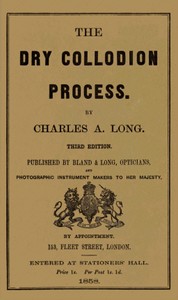
THE DRY COLLODION PROCESS.
PUBLISHED BY BLAND & LONG, OPTICIANS,
PHOTOGRAPHIC INSTRUMENT MAKERS TO HER MAJESTY,
153, FLEET STREET, LONDON.
ENTERED AT STATIONERS' HALL,
_Price 1s. Per Post 1s. 1d._
H. SILVERLOCK, PRINTER, WARDROBE TERRACE, DOCTORS' COMMONS, LONDON, E.C.
PREFACE TO FIRST EDITION.
The following pages shall be devoted to the description of a process on Dry Collodion, which I believe to be at once simple and effective. The experiments connected with the perfection of this process have occupied my leisure time for the space of two years or more, and have been conducted with all the care of which I was master. The constant repetition of them enables me to say, that whoever will follow diligently the process step by step, as detailed in this Pamphlet, must succeed in producing pictures in every way such as could be required by the most exacting critic.
The process is simple, clean, and expeditious; and the resulting Negatives possess the exquisite softness of Albumen, the brilliancy of the wet Collodion, and the fine artistic texture of the Paper process.
To disarm criticism, and to make peace with my fellow labourers in the art, I wish it to be understood that I do not claim the use of Collodion, of Gelatine, of Metagelatine, or of any of the Chemicals used in the process--most of these have been employed by others in various ways; I merely reserve to myself the pleasure of placing in the hands of Photographers a definite and simple plan by which pictures may be taken on Dry Collodion.
PREFACE TO SECOND EDITION.
In issuing a second edition of the Dry Collodion process, I would take occasion to remark, that after some months' practical working, it has not been found necessary to make any material alteration in the process; success has usually attended the adoption of it, and in those cases where good pictures have not resulted, the failure has always been traced to the use of a Collodion not suited to the process.
I cannot allow this opportunity to pass, without thanking those gentlemen whose opinions possess weight in matters photographic, for the very candid manner in which they have tested the capabilities of my process, and for the very flattering testimony they have borne to its efficiency, simplicity, and certainty.
PREFACE TO THIRD EDITION.
The process described in the following pages has now been in use for twelve months, and I have much satisfaction in stating that it has, in almost every instance where it has been adopted and carried out with care and attention, yielded results which leave scarcely anything to be desired.
The present Edition might more properly be termed a reprint, as the alterations in the text do not extend to more than a few matters of detail, which experience has shewn to be desirable, the principles of the process remaining undisturbed.
OPINIONS OF THE PRESS.
We have not merely examined the description given by Mr. Long of his dry collodion process, but we have witnessed the results obtained by following carefully his directions. It appears to us that, by it, a collodion plate may be prepared at home, wrapped in paper, and packed in portmanteau; that we may journey to Rome or Venice, then place our plate in the camera obscura, and allow it for a few minutes to receive the luminous image; remove it in a dark room; re-pack it and trouble ourselves no more about it until our return to England; when, in the room in which it was prepared, we may witness the magic process of development, and rejoice that we have, without much labour, secured a picture of the Coliseum or of the Bridge of Sighs.
_From the Journal of the Cambrian Archæological Association._
New Photographic Process.--Mr. Long, of the firm of Bland and Long, Opticians, Fleet Street, has recently put forth a valuable pamphlet, in the form of an essay on the dry collodion process. By means of this, plates prepared weeks beforehand may be exposed to objects, and then kept for weeks afterwards before they are developed, as he has proved it himself on the Continent. The advantage of this process to travellers, and especially to archæologists, is immense; because hitherto the main drawback upon photography has been the trouble and expense of carrying chemicals, tents, &c. &c., besides the camera, with its lenses, to the scene of operation. Now, however, it will be sufficient to carry merely the camera, with a suitable supply of plates prepared according to this process. The observer can then, by merely exposing his plates, with the proper precautions, _bag_ any number of views per diem, and on his return home can develop them--or have them developed--at leisure. If this process succeeds, it will have the effect of splitting photography into two distinct branches--the _æsthetic_, and the _practical_. The former will fall to the share of the intelligent observer, the traveller, the man of taste, who will go and search for objects, combine them, or use them, under the most favourable æsthetic circumstances, and then will carry them home to be handed over to the man of practice. Once in his hands, nothing will remain but to manipulate the plates according to the rules of photographic science, by means of all the best appliances that a well fitted laboratory can furnish. One branch will feed the other. One will be the department of observation, of search, of taste, of beauty; the other will be that of calm scientific development, of improvement, of preservation. One man will be like the artist who paints; the other like the artist who engraves. One will be like the author, the man who writes; the other like the printer, the man who perpetuates. We recommend members to enquire carefully about this new process; because if it becomes firmly established, any archæologist moving about the Country may get views of churches, castles, cromlechs, meini-hirion, seals, &c. &c., _usque ad satietatum_--we had almost said _ad nauseam_; but that word can never be connected with archæology! The upshot of this is,--"Read Mr. Long's pamphlet, and set up a portable camera with his prepared plates, as we intend doing ourselves!"
_From the Liverpool and Manchester Photographic Journal._
We must advise all who are interested in dry processes to obtain Mr. Long's clearly written pamphlet. (Leader, July 15th, 1857.)
_Extract from Proceedings of Charlton Photographic Society, October 8th, 1857. Paper by Mr. Hooper,--On the results of his experience in the practice of several Preservative Processes._
I commenced experimenting on the process of Mr. Long. The success I have met with from the first has convinced me that that process will ere long be generally adopted: the plates being easily and quickly prepared, and keeping well, is a great advantage.
_Extract from Letter from G. R. Smith, Esq., to the Editor of the London Photographic Journal, Sept 21, 1857._
My tour of a fortnight's duration having ended, I returned to London, and began developing (the dry plates). To my great delight, I found all Mr. Long had said in favour of his process fully realized. Picture after picture (I took twenty-eight) came out with great beauty, and so far as the process is concerned, I have not had a single failure.
_Mr. Long's Dry Collodion Process._
_Letter from Robert Hunt, Esq., F.R.S., to the Editor of the London Photographic Journal, October, 1857._
6, Green's Row, Chelsea.
Sir,--It is due to Mr. Long that I should state what my experience has been with his dry collodion plates, and I feel much satisfaction in doing so, being enabled fully to confirm all that Mr. Smith has said respecting the dry plates prepared as he has described (Photo. Journ. Sept. 21). On the 26th of August, Mr. Long, at my request, furnished me with some of his dry collodion plates. Absence from London, and the press of official engagements, prevented my trying any experiments with those plates until the 30th of September. Although the weather was very unfavourable, the result was superior to my expectations. On the 7th of October, at four in the afternoon, when the sky was covered with clouds and the weather stormy, I exposed a plate in the camera obscura for ten minutes to the dark brick building, Chelsea Hospital. I enclose you a positive print from the result of this experiment. When we remember that the sensitive plate had been kept by me for a period of _forty-two days_, and then exposed under very unfavourable circumstances, I think you will admit that the result is satisfactory. I should not content myself with this trial, but that I am again compelled to leave London for a long period, and I shall have no other opportunity of testing these plates for this year. I feel convinced that the traveller might with perfect safety use plates which have been prepared for a month, and thus relieve himself from much labour and frequent annoyance, by the use of Mr. Long's process.
_From the Illustrated London News, January 9, 1858._
It is but a few years since, when we heard with surprise, and some incredulity, that light could be made to delineate images of external objects upon chemically prepared tablets placed in the camera obscura,--now photography stares us in the face at every corner,--that which was wonderful has become familiar,--that which was mysterious is singularly common.
In cities, we see glass houses, on at least one roof in every street,--in villages, caravans, with Brown and Jones, photographers, are regularly found,--on the hills we discover the tent, and in the valleys the camera,--by the river-side there is the mysterious head hidden in the dark curtains of a dark box,--and upon the sea-shore the tripod-stand is securely fixed in the sands, and a biped is evidently focusing for the next fine ocean wave,--the sketcher has fled to his own especial solitudes, and the photographer has usurped his place.
It has been said of the most recent photographic processes, as was well said of the octo-syllabic verse, that it possesses "unfortunate facilities." This is true in many respects of the positive collodion process, by which the myriads of sad reflections on humanity are perpetrated. Not so, however, is it with the negative process, by which alone we can multiply the beautiful things which the solar pencil traces with such fidelity. The labour attendant upon a photographic tour is great, and real enthusiasm alone carries the amateur forward. The camera obscura and the stand are a burden, and with the tent and chemical box, they become a real load. Then there is the uncertainty attendant upon the processes. We deal with the nicest chemical adjustments. The balance is arranged with caution for a certain set of conditions,--alter but one of these, and all goes wrong. We leave home in the morning, we work in the dark all day, and we return jaded at night, to find we have obtained--nothing.
Sensitive as the collodion process is, and charming as are the results, when all goes on successfully, it has not hitherto been a process which can be practised out of doors, without many extraordinary, expensive, and troublesome appliances.
It is, therefore, with very much satisfaction that we have watched the progress of the so-called "dry collodion processes." Nearly all the processes that have been published,--the "gelatine,"--the "oxymel,"--the "glycerine," and others,--have much that is excellent in them; but it appears to us that a dry collodion process devised by Mr. Long, of which he has recently published a description, is more simple and effective than any other. We have seen beautiful pictures obtained in Belgium upon plates prepared in England, and which plates were brought to this country again before the pictures were developed.
Any man may, previously to starting on his journey, prepare, or purchase prepared, a stock of glass plates. Armed with these and his camera, he may proceed to
"Where the bleak Swiss their stormy mansion tread. And force a churlish soil for scanty bread;"
"------sea Cybele fresh from ocean Rising with her tiara of proud towers,"--
and, resting on his way, he may adjust his camera and his plate, and in the few minutes which, under any circumstances, he would spend in observation, he secures a picture for future study,--a photograph to give him pleasure in the quiet of his home.
Mr. Long has published a little treatise, with which we head this article, and by following out the simple directions which he gives, all may succeed in obtaining the important desideratum,--a parcel of highly sensitive plates, which can be packed in paper and stowed away in a portmanteau, to be drawn out as occasion may require, to be returned again to the same package (without having any of the annoyances attendant upon a box of liquid chemicals), and a plate which can be kept with its dormant picture quite uninjured until the photographer, on his arrival home, at his perfect leisure, in his own operating room, can develop the photograph which he has obtained.
Such are the facilities offered by this improvement, that we may expect almost every traveller will avail himself of it, and thus secure for his own portfolio, and the portfolios of his friends, views of scenes hallowed by their historical association,--of ruins rendered sacred from the sacred memories which still wrap them in their shadows, as the mantling ivy clothes their crumbling walls.
=DRY COLLODION PROCESS.=
Before describing in detail the manipulations of the process on Dry Collodion plates, it will be necessary to say a few words on the materials and apparatus to be employed, and also to give an account of the means of preparing the various solutions used in the process. First,
This being the principal material we have to use, we must exercise great care in the selection of a sample that possesses all the characteristics which fit it for a dry process. We must reject all samples that possess great tenacity and contractile power: the Collodion must not be too thick, and it must flow evenly over the plate, and not set in ridges. The best condition for the Iodized Collodion is that known as _powdery_, that is, being spread on the plate and partially dry, it cannot be removed as a film, but crumbles up on being pressed by the finger in its passage across the plate; in fact, such a condition as would arise from using gun cotton prepared with acids at a high temperature.
The following formula will be found to answer most admirably:
Gun Cotton 60 grains. Absolute Alcohol 5 ounces. Sulphuric Æther, sp. gr. ·730 15 ounces.
The cotton is to be shaken up with the mixture of alcohol and æther, and when dissolved, the bottle containing it must be stood aside, in order that any undissolved particles of cotton may subside. The clear liquid may then be decanted into a clean bottle for use.
It will be as well to test the quality of the Collodion thus prepared before coating any number of plates with it, for, although the above proportions are very excellent, some little latitude must be allowed for the different degrees of solubility of the various samples of cotton used from time to time. The film, when spread, on the glass plate and partially dry, should not be capable of being removed in the form of a skin, but should give before the finger and crumble up on its being rubbed across the plate.
Should any difficulty, however, occur, it would be better to obtain a sample of the Collodion made by an experienced hand, in order that a fair trial may be given to the process. If the Collodion be too contractile it will give rise to blisters in the film, and will wash off the plate during development.
The Iodizing Solution that I have found to give the best results in this process is made in the manner following:--
Absolute Alcohol 8 ounces. Iodide of Cadmium 64 grains. Iodide of Ammonium 64 grains.
The iodides are to be dissolved by agitation in the alcohol, and the resulting solution is to be carefully filtered, and preserved in a well stoppered bottle.
The Iodized Collodion consists of--
Iodizing Solution 2 drams } } 1 ounce Plain Collodion 6 drams }
The Collodion should always be iodized at least twelve hours before it is required; this interval allows any insoluble matters either from the iodizing solution or from the Collodion itself to fall to the bottom, and enables the operator to pour off the clear solution into a perfectly clean bottle for use.
Next in importance to the Iodized Collodion comes
THE PRESERVATIVE SOLUTION.
Some care is required in the preparation of this solution, in order that it may be clear and bright when finished, and not contain particles that would be deposited in its passage over the Collodion film when being used. The chief precaution to be observed is _not to allow it to boil too rapidly, and not to conduct the operation over too fierce a fire;_ attention to this will prevent many failures, and ensure a solution in every way suited for the process.
Take one ounce of the best transparent gelatine, and throw it into a pipkin in which has been previously placed one pint of distilled water; set this on a slow fire, or over a lamp, until the gelatine is completely melted; then weigh out half ounce of pure citric acid and dissolve it in two ounces of distilled water; add this to the solution of gelatine, stirring it during the addition with a glass rod. The solution in the pipkin is now to be gently boiled for about half an hour: remove it from the fire, and add sufficient distilled water to make up the bulk of liquid to one pint. When quite cold, the liquid in the pipkin is to be filtered through two thicknesses of pure white blotting paper into a bottle perfectly dry and clean. We now add to every pint of filtered preservative solution, two ounces of alcohol of the specific gravity of ·840.
The solution thus prepared is ready for use, and should be of a pale amber colour, without any signs of insoluble particles floating in it; should any appear after it has been prepared for some days, a second filtration will remove them, and render the liquid again bright and clear.
It will be found better to prepare this solution only in the quantity indicated above, unless the consumption be large, for, although it will keep good for a month or more, my experience points to the fact, that the most successful results follow the use of Preservative Solution freshly prepared.
THE NITRATE OF SILVER BATH.
The bath for rendering the plates sensitive does not differ from that recommended for taking negatives with wet Collodion. The formula for its preparation may not be out of place, however, and may assist those whose knowledge of the matter is not perfect.
Nitrate of Silver (fused) 1¼ ounces. Distilled Water 1 pint. Iodide of Cadmium 3 grains.
Dissolve the nitrate of silver in half the water and then add the iodide of cadmium; thoroughly agitate the mixture for five or ten minutes, then add ½ ounce of alcohol, sp. gr. ·840, and fill up with the remaining half of the distilled water; further agitation, and subsequent filtration through two thicknesses of white bibulous paper, will put us in possession of a negative bath. The nitrate of silver being fused, and consequently, pure and neutral, and as it is essential to obtain clean pictures that the bath should be slightly acid in its reaction, we find it necessary to add 5 or 6 minims or drops of pure glacial acetic acid to a bath of 20 ounces, in order that the above condition may obtain.
THE DEVELOPING SOLUTION
Is very simple in its nature, being merely a saturated solution of gallic acid in distilled water, to which has been added a small proportion of alcohol of sp. gr. ·840.
The exact formula is as follows:--
Distilled Water 1 pint. Alcohol sp. gr. ·840 1 ounce. Gallic Acid ½ ounce.
The gallic acid will not be entirely dissolved, but that left at the bottom of the bottle will ensure the solution being saturated; it is better not to filter the developing solution until it is required for use, as it is preferable to allow it to stand over an excess of gallic acid, than for it to be withdrawn after a slight agitation with the crystals; it is a great error to suppose that we obtain a saturated solution of gallic acid by merely agitating the crystals with water for a few moments.
Charles A. Long's 1857 pamphlet presents a dry collodion process refined over two years of leisure-time experiments. The author, an optician and photographic instrument maker at 153 Fleet Street, London, addresses fellow photographers with a tone of methodical assurance. He claims his process yields negatives combining 'the exquisite softness of Albumen, the brilliancy of the wet Collodion, and the fine artistic texture of the Paper process.' The work is structured as a step-by-step guide, with repeated cautions about collodion quality and exposure timing.
Authorial Voice and Claims of Originality
Long's prefaces reveal a careful rhetorical strategy. He disclaims invention of individual chemicals—collodion, gelatine, metagelatine—but reserves 'the pleasure of placing in the hands of Photographers a definite and simple plan.' This modesty is paired with confident assertions: 'whoever will follow diligently the process step by step... must succeed.' The third edition preface notes that failures 'have always been traced to the use of a Collodion not suited to the process,' shifting blame from method to materials. Long's language is direct and instructional, avoiding florid description in favor of commands like 'proceed to' and 'we will imagine.' The repeated phrase 'simple, clean, and expeditious' underscores his emphasis on practicality.
Exposure and the Education of the Tyro
Long devotes considerable space to exposure timing, offering concrete examples rather than rigid rules. He advises that with a 3-inch single lens, 16-inch focus, and ½-inch stop, a bright landscape requires about five minutes—'merely an approximation.' He then describes three exposure outcomes: under-exposure yields only high lights; over-exposure produces a 'flat, meagre, and unsatisfactory' negative; correct exposure reveals sky and high lights first, then half tones, then deep shadows within five minutes. This diagnostic approach, borrowed from his earlier 'Practical Photography,' aims to 'educat[e] the tyro in the appearances.' The language is observational: 'the image will come out under the developing solution with difficulty.'
Development Flexibility and Practical Choices
Long presents two development methods—immersion in baths or treatment on a levelling stand—and leaves the choice to the reader: 'try both ways, and make your own selection.' He notes that the levelling stand risks less film washing off, while immersion suits large plates more evenly. Crucially, development need not follow exposure immediately; 'any time that is convenient to the operator may intervene,' provided the plate's keeping limits are respected. This flexibility contrasts with wet collodion's urgency. Long's instructions are precise: the plate is placed face up in a dish, covered with distilled water for five minutes to soften the preservative. The tone remains advisory rather than dogmatic.
Revisions and the Stability of the Process
The three prefaces (1857–1858) document a process that Long considers essentially stable. The second edition reports 'no material alteration' after months of practical working; the third is 'more properly termed a reprint,' with only 'a few matters of detail' changed. This stability is presented as evidence of reliability. Long thanks 'those gentlemen whose opinions possess weight in photographic matters' for testing his method, framing external validation as proof of 'efficiency, simplicity, and certainty.' The prefaces also reveal the pamphlet's commercial context: published by Bland & Long, opticians 'to Her Majesty, by appointment,' and priced at one shilling. The author's dual role as instrument maker and process inventor shapes his credibility.
Long's dry collodion process is best approached as a period technical manual, not a general photography guide. Readers should note the author's reliance on specific equipment—lenses, stops, collodion brands—and his assumption that the operator already understands wet collodion basics. The pamphlet's value lies in its detailed troubleshooting and the window it opens into mid-19th-century photographic practice, where chemical precision and artistic texture were equally prized.
Liam Torres
1 week agoJohn Mitchell
1 week agoAlexander Lee
1 week agoJohn Jackson
2 weeks ago-
Jerry Black - 3 weeks ago
A disappointing read that gets bogged down in overly technical jargon without offering practical insights for beginners. The diagrams are outdated and the explanations are repetitive. It feels more like a historical reprint than a useful guide. I'd recommend a more modern photography manual if you actually want to try this technique. -
Maxwell Norman - 2 weeks ago
An indispensable guide for anyone interested in historical photographic techniques. This book explains the dry collodion process in meticulous detail, covering chemistry, coating, exposure, and development. The practical tips and troubleshooting advice are invaluable for modern practitioners of wet-plate collodion. A clear and well-illustrated manual that makes a complex process approachable. -
Michael Jackson - 4 days ago
Provides a thorough introduction to the dry collodion process, which is a significant improvement over the wet plate method. The step-by-step instructions are helpful, though some parts assume a basic chemistry background. It lacks a bit on the artistic aspects, but as a technical manual, it's quite good.
What did you think of this book?
Answer a few questions and save a private reflection on this device.
Ella Moore
2 weeks ago