1

The Dry Collodion Process — Key Ideas to Explore
(0 User reviews)
1261
Project Gutenberg
2020
Not confirmed
Photography -- Plates; Photography -- Developing and developers; Collodion
Readers of public-domain and historical texts
Project Gutenberg digital edition
en
Edition facts
Words
11,246
Reading time
49 min
Text sections
2
For The Dry Collodion Process — Key Ideas to Explore, the stored edition analysis reports 11,246 words, 49 min estimated reading time, and 2 detected text sections.
The text analysis averages about 25.4 words per sentence, while the detected sections provide another way to judge how the source is divided.
Project Gutenberg metadata also associates the work with “Photography -- Plates,” connecting these edition facts with the source record’s subject description.
Source:
Project Gutenberg record #63814
A precise 1857 manual for the dry collodion photographic process, detailing exposure, development, and plate preparation with an emphasis on replicable results and practical troubleshooting.
Editorial Edition Score
4.5/5
★★★★★
★★★★★
Calculated from edition completeness, EPUB availability, text structure and catalogue metadata. Not a user rating.
How this score is calculated
- Description quality20 pts
- Title & short description10 pts
- Source metadata20 pts
- Text length15 pts
- Chapters / structure15 pts
- EPUB file integrity20 pts
Total of 100 points, scaled to a 2.5-5.0 range. Editions with an empty description or a missing EPUB file are not scored.
Edition quality
Read the Text
Text emphasis is denoted as _Italics_ and =Bold=.
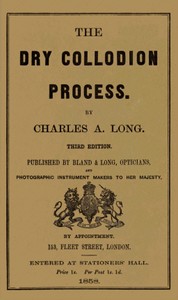
THE DRY COLLODION PROCESS.
PUBLISHED BY BLAND & LONG, OPTICIANS,
PHOTOGRAPHIC INSTRUMENT MAKERS TO HER MAJESTY,
153, FLEET STREET, LONDON.
ENTERED AT STATIONERS' HALL,
_Price 1s. Per Post 1s. 1d._
H. SILVERLOCK, PRINTER, WARDROBE TERRACE, DOCTORS' COMMONS, LONDON, E.C.
PREFACE TO FIRST EDITION.
The following pages shall be devoted to the description of a process on Dry Collodion, which I believe to be at once simple and effective. The experiments connected with the perfection of this process have occupied my leisure time for the space of two years or more, and have been conducted with all the care of which I was master. The constant repetition of them enables me to say, that whoever will follow diligently the process step by step, as detailed in this Pamphlet, must succeed in producing pictures in every way such as could be required by the most exacting critic.
The process is simple, clean, and expeditious; and the resulting Negatives possess the exquisite softness of Albumen, the brilliancy of the wet Collodion, and the fine artistic texture of the Paper process.
To disarm criticism, and to make peace with my fellow labourers in the art, I wish it to be understood that I do not claim the use of Collodion, of Gelatine, of Metagelatine, or of any of the Chemicals used in the process--most of these have been employed by others in various ways; I merely reserve to myself the pleasure of placing in the hands of Photographers a definite and simple plan by which pictures may be taken on Dry Collodion.
PREFACE TO SECOND EDITION.
In issuing a second edition of the Dry Collodion process, I would take occasion to remark, that after some months' practical working, it has not been found necessary to make any material alteration in the process; success has usually attended the adoption of it, and in those cases where good pictures have not resulted, the failure has always been traced to the use of a Collodion not suited to the process.
I cannot allow this opportunity to pass, without thanking those gentlemen whose opinions possess weight in matters photographic, for the very candid manner in which they have tested the capabilities of my process, and for the very flattering testimony they have borne to its efficiency, simplicity, and certainty.
PREFACE TO THIRD EDITION.
The process described in the following pages has now been in use for twelve months, and I have much satisfaction in stating that it has, in almost every instance where it has been adopted and carried out with care and attention, yielded results which leave scarcely anything to be desired.
The present Edition might more properly be termed a reprint, as the alterations in the text do not extend to more than a few matters of detail, which experience has shewn to be desirable, the principles of the process remaining undisturbed.
OPINIONS OF THE PRESS.
We have not merely examined the description given by Mr. Long of his dry collodion process, but we have witnessed the results obtained by following carefully his directions. It appears to us that, by it, a collodion plate may be prepared at home, wrapped in paper, and packed in portmanteau; that we may journey to Rome or Venice, then place our plate in the camera obscura, and allow it for a few minutes to receive the luminous image; remove it in a dark room; re-pack it and trouble ourselves no more about it until our return to England; when, in the room in which it was prepared, we may witness the magic process of development, and rejoice that we have, without much labour, secured a picture of the Coliseum or of the Bridge of Sighs.
_From the Journal of the Cambrian Archæological Association._
Charles A. Long's 1857 pamphlet presents a dry collodion process refined over two years of leisure-time experiments. The author, an optician and photographic instrument maker at 153 Fleet Street, London, addresses fellow photographers with a tone of methodical assurance. He claims his process yields negatives combining 'the exquisite softness of Albumen, the brilliancy of the wet Collodion, and the fine artistic texture of the Paper process.' The work is structured as a step-by-step guide, with repeated cautions about collodion quality and exposure timing.
Authorial Voice and Claims of Originality
Long's prefaces reveal a careful rhetorical strategy. He disclaims invention of individual chemicals—collodion, gelatine, metagelatine—but reserves 'the pleasure of placing in the hands of Photographers a definite and simple plan.' This modesty is paired with confident assertions: 'whoever will follow diligently the process step by step... must succeed.' The third edition preface notes that failures 'have always been traced to the use of a Collodion not suited to the process,' shifting blame from method to materials. Long's language is direct and instructional, avoiding florid description in favor of commands like 'proceed to' and 'we will imagine.' The repeated phrase 'simple, clean, and expeditious' underscores his emphasis on practicality.
Exposure and the Education of the Tyro
Long devotes considerable space to exposure timing, offering concrete examples rather than rigid rules. He advises that with a 3-inch single lens, 16-inch focus, and ½-inch stop, a bright landscape requires about five minutes—'merely an approximation.' He then describes three exposure outcomes: under-exposure yields only high lights; over-exposure produces a 'flat, meagre, and unsatisfactory' negative; correct exposure reveals sky and high lights first, then half tones, then deep shadows within five minutes. This diagnostic approach, borrowed from his earlier 'Practical Photography,' aims to 'educat[e] the tyro in the appearances.' The language is observational: 'the image will come out under the developing solution with difficulty.'
Development Flexibility and Practical Choices
Long presents two development methods—immersion in baths or treatment on a levelling stand—and leaves the choice to the reader: 'try both ways, and make your own selection.' He notes that the levelling stand risks less film washing off, while immersion suits large plates more evenly. Crucially, development need not follow exposure immediately; 'any time that is convenient to the operator may intervene,' provided the plate's keeping limits are respected. This flexibility contrasts with wet collodion's urgency. Long's instructions are precise: the plate is placed face up in a dish, covered with distilled water for five minutes to soften the preservative. The tone remains advisory rather than dogmatic.
Revisions and the Stability of the Process
The three prefaces (1857–1858) document a process that Long considers essentially stable. The second edition reports 'no material alteration' after months of practical working; the third is 'more properly termed a reprint,' with only 'a few matters of detail' changed. This stability is presented as evidence of reliability. Long thanks 'those gentlemen whose opinions possess weight in photographic matters' for testing his method, framing external validation as proof of 'efficiency, simplicity, and certainty.' The prefaces also reveal the pamphlet's commercial context: published by Bland & Long, opticians 'to Her Majesty, by appointment,' and priced at one shilling. The author's dual role as instrument maker and process inventor shapes his credibility.
Long's dry collodion process is best approached as a period technical manual, not a general photography guide. Readers should note the author's reliance on specific equipment—lenses, stops, collodion brands—and his assumption that the operator already understands wet collodion basics. The pamphlet's value lies in its detailed troubleshooting and the window it opens into mid-19th-century photographic practice, where chemical precision and artistic texture were equally prized.
Fingering the old manual’s pages, I felt its careful insistence on repeatable steps—a quiet faith in method. It put me in mind of that other volume, a patient guide to workshop logic, where every motion has its reasoned place. The Economy of Workshop Manipulation A logical method of learning constructive mechanics. Arranged with questions for the use of apprentice engineers and students. — Background and Themes shares that same unhurried confidence in practical order.
There are no reviews for this eBook.
There are no comments for this eBook.
Reader reflection
What did you think of this book?
Answer a few questions and save a private reflection on this device.
Your progress
0
/
10
2
Did this book hold your interest?
3
Would you recommend this book to another reader?
4
How easy was the book to follow?
5
Which aspect of the book did you value most?
6
What did you think about the pace?
7
How personally connected did you feel to the book?
8
Did you gain anything practical from the text?
9
Which lesson or insight stayed with you?
10