Dirigible Balloons — Context and Discussion
Edition facts
Calculated from edition completeness, EPUB availability, text structure and catalogue metadata. Not a user rating.
Read the Text
idents were numerous on account of the fabric becoming ignited from the fire in the pan.
*Improvements by Charles.* The physicist, Charles, was working along these lines at the same time. He coated his balloon with a rubber solution to close up the pores, and was thereby enabled to substitute hydrogen for the hot air. Shortly after the Montgolfiers’ first public exhibition, Charles sent up his balloon for the benefit of the _Academie des Sciences_ in Paris. The balloon, which weighed about 19 pounds, ascended rapidly in the air and disappeared in the clouds, where it burst and fell in a suburb of the city. The impression produced upon the peasants at seeing it fall from the heavens was hardly different from what could be expected. They believed it to be of devilish origin, and immediately tore it into shreds. Charles subsequently built a large balloon quite similar to those in use today. A net was used to support the basket, and a valve, operated by means of ropes from the basket, was arranged at the top to permit the gas to escape as desired.
*The Balloon Successful.* The English Channel was first crossed in 1785. Blanchard, an Englishman, and Jeffries, an American, started from Dover on January 7 in a balloon equipped with wings and oars. After a very hazardous voyage, during which they had to cast overboard everything movable to keep from drowning, they landed in triumph on the French coast.
An attempt to duplicate this feat was made shortly afterward by Rozier. He constructed a balloon filled with hydrogen, below which hung a receiver in which air could be heated. He hoped to replace by the hot air the losses due to leakage of hydrogen. Soon after the start the balloon exploded, due to the escaping gas reaching the fire, and Rozier and his companion were dashed on the cliffs and killed.
*Meusnier the Pioneer.* The fact that the invention of the dirigible balloon and means of navigating it were almost simultaneous is very little known today and much less appreciated. Like the aeroplane, its development was very much retarded by the lack of suitable means of propulsion, and the actual history of what has been accomplished in this field dates back only to the initial circular flight of La France in 1885. Still the principles upon which success has been achieved were laid down within a year of the appearance of Montgolfier’s first gas bag. Lieutenant Meusnier, who subsequently became a general in the French army, must really be credited with being the true inventor of aerial navigation. At a time when nothing whatever was known of the science, Meusnier had the distinction of elaborating at one stroke all the laws governing the stability of an airship, and calculating correctly the conditions of equilibrium for an elongated balloon, after having strikingly demonstrated the necessity for this elongation. This was in 1781 and Meusnier’s designs and calculations are still preserved in the engineering section of the French War Office in the form of drawings and tables.
But as often proved to be the case in other fields of research, his efforts went unheeded. How marvelous the establishment of these numerous principles by one man in a short time really is, can be appreciated only by noting the painfully slow process that has been necessary to again determine them, one by one, at considerable intervals and after numerous failures. Through not following the lines which he laid down, aerial navigation lost a century in futile groping about; in experiments absolutely without method or sequence.
Meusnier’s designs covered two dirigible balloons and that he fully appreciated the necessity for size is shown by the dimensions of the larger, which unfortunately was never built. This was to be 260 feet long by 130 feet in diameter, in the form of an ellipse, the elongation being exactly twice the diameter. In other words, a perfect ellipsoid, which was a logical and, in fact, the most perfect development of the spherical form. Although increased knowledge of wind resistance and the importance of the part it plays has proved his relative dimensions to be faulty, a study of the principal features of his machine shows that he anticipated the present-day dirigible of the most successful type at practically every point, barring, of course, the motive power, as there was absolutely nothing available in that day except human effort. As the latter weighs more than one-half ton per horse-power, it goes without saying that Meusnier’s balloon would have been dirigible only in a dead calm.
He adopted the elongated form, conceived the girth fastening, the triangular or indeformable suspension, the air balloonet and its pumps, and the screw propeller, all of which are to be found in the dirigibles of present-day French construction, Fig. 5. It need scarcely be added that the French have not only devoted a greater amount of time and effort to the development of the dirigible than any other nation, but have also met with the greatest success in its use. It was not until 1886, or more than a century after Meusnier had first elaborated those principles, that their value became known. They were set forth by Lieutenant Letourne, of the French engineers, in a paper presented to the _Academie des Sciences_ by General Perrier.
In one form or another, the salient features of Meusnier’s dirigible will be found embodied in the majority of attempts of later days. His large airship was designed to consist of double envelope, the outer container of which was to provide the strength necessary, and it was accordingly reinforced by bands. The inner envelope was to provide the container for the gas and was not called upon to support any weight. This inner bag or balloon proper was designed to be only partially inflated and the space between, the two was to be occupied by air which could be forced into it at two points at either end, by pumps, so as to maintain the pressure on the gas bag uniform regardless of the expansion or contraction of its contents. Here in principle was the air balloonet of today. Instead of employing a net to hang the car from the outer envelope, the former was attached by means of a triangular suspension system fastened to a heavy rope band, or girth, encircling the outer envelope. At the three points where the lifting rope members met, a shaft running the length of the car and carrying what Meusnier described as "revolving oars" was installed. These constituted the prototype of the screw propeller, invented for aerial navigation at a time long antedating the use of steam for marine use. Thus he devised: (1) The air balloonet to husband the gas supply and thus prevent the deformation of the outer container or support, as well as to provide stability; (2) the triangular suspension to attain longitudinal stability; and (3) the screw propeller for propulsion, beside selecting the proper location for the latter.
PROBLEMS OF THE DIRIGIBLE
*Ability to Float.* If ability to rise in the air depended merely upon a knowledge of the principle that made it possible, it undoubtedly would have been accomplished many centuries ago. As already mentioned, Archimedes established the fact that a body upon floating in a fluid displaces an amount of the latter equal in weight to the body itself, and upon this theory was formulated the now well-known law, that every body plunged into a fluid is subjected by this fluid to a pressure from below, equivalent to the weight of the fluid displaced by the body. Consequently, if the weight of the latter be less than that of the fluid it displaces, the body will float. It is by reason of this that the iron ship floats and the fish swims in water. If the weight of the body and the displaced water be the same, the body will remain in equilibrium in the water at a certain level, and if that of the body be greater, it will sink. All three of these factors are found in the fish, which, with the aid of its natatory gland, can rise to the surface, sink to the bottom, or remain suspended at different levels. To accomplish these changes of specific gravity, the fish fills this gland with air, dilating it until full, or compressing and emptying it. In this we find a perfect analogy to the air balloonet of the dirigible, which serves the same purposes. The method by which lifting power is obtained in the dirigible is exactly the same as in the case of the balloon.
But once in the air, a balloon is, to all intents and purposes, a part of the atmosphere. There is absolutely no sensation of movement, either vertically or horizontally. The earth appears to drop away from beneath and to sweep by horizontally, and regardless of how violently the wind may be blowing, the balloon is always in a dead calm because it is really part of the wind itself and is traveling with it at exactly the same speed. If it were not for the loss of lifting power through the expansion and contraction of the gas, making it necessary to permit its escape in order to avoid rising to inconvenient heights on a very warm day, and the sacrifice of ballast to prevent coming to earth at night, the ability of a balloon to stay up would be limited only by the endurance of its crew and the quantity of provisions it was able to transport. As the use of air balloonets in the dirigible takes care of this, the question of lifting power presents no particular difficulty. It is only a matter of providing sufficient gas to support the increased weight of the car, motor and its accessories, and the crew of the larger vessel, with a factor of safety to allow for emergencies, in order to permit of staying in the air long enough to make a protracted voyage.
*Air Resistance vs. Speed.* Unless a voyage is to be governed in its direction entirely by the wind, the dirigible must possess a means of moving contrary to the latter. The moment this is attempted, resistance is encountered, and it is this resistance of the air that is responsible for the chief difficulties in the design of the dirigible. To drive it against the wind, it must have power; to support the weight of the motor necessary, the size of the gas bag must be increased. But with the increase in size, the amount of resistance is greatly multiplied and the power to force it through the air must be increased correspondingly. The law is approximately as follows:
_Where the surface moves in a line perpendicular to its plane, the resistance is proportional to the extent of the surface, to the square of the speed with which the surface is moved through the air, and to a coefficient, the mean value of which is 0.125._
This coefficient is a doubtful factor, the figure given having been worked out years ago in connection with the propulsion of sailing vessels. Its value varies according to later experimenters between .08 and .16, the mean of the more recent investigations of Renard, Eiffel, and others who have devoted considerable study to the matter, being .08. This is dwelt upon more in detail under "Aerodynamics" and it will be noted that the values of the coefficient _K_, given here, do not agree with those stated in that article. They serve, however, to illustrate the principles in question.
In accordance with this law, doubling the speed means quadrupling the resistance of the air. For instance, a surface of 16 square feet moving directly against the air at a speed of 10 feet per second will encounter a resistance of 16 X 100 (square of the speed) X 0.125 = 200 pounds pressure. Doubling the speed, thus bringing it up to 20 feet per second, would give the equation 16 X 400 X 0.125 = 800 pounds pressure, or with the more recent value of the coefficient of .08, 512 pounds pressure. The first consideration is accordingly to reduce the amount of surface moving at right angles. The resistance of a surface having tapering sides which cut through or divide the molecules of air instead of allowing them to impinge directly upon it, is greatly diminished; hence, Meusnier’s principle of elongation. If we take the same panel presenting 16 square feet of surface and build out on it a hemisphere, its resistance at a speed of 10 feet per second will be exactly half, or a pressure of 100 pounds.
By further modifying this so as to represent a sharp point, or acute-angled cone, it will be 38 pounds. There could accordingly be no question of attempting to propel a spherical balloon.
It is necessary to select a form that presents as small a surface as possible to the air as the balloon advances, while preserving the maximum lifting power. But experience has strikingly demonstrated the analogy between marine and aerial practice—not only is the shape of the bow of the vessel of great importance but, likewise, the stern. The profile of the latter may permit of an easy reunion of the molecules of air separated by the former, or it may allow them to come together again suddenly, clashing with one another and producing disturbing eddies just behind the moving body. To carry the comparison with a marine vessel a bit further, the form must be such as to give an easy "shear," or sweep from stem to stern.
That early investigators appreciated this is shown by the fact that Giffard in 1852, Fig. 6, De Lome in 1872, Fig. 7, Tissandier in 1884, and Santos-Dumont in his numerous attempts, adopted a spindle-shaped or "fusiform" balloon. In other words, their shape, equally pointed at either end, was symmetrical in relation to their central plan. However, that the shape best adapted to the requirements of the bow did not serve equally well for the stern, was demonstrated for the first time by Renard, to whom credit must be given for a very large part of the scientific development of the dirigible. Almost a century earlier, Marey-Monge had laid down the principle that to be successfully propelled through the air, the balloon must have "the head of a cod and the tail of a mackerel." Nature exemplifies the truth of this in all swiftly moving fishes and birds. Renard accordingly adopted what may best be termed the "pisciform" type, viz, that of a dis-symmetrical fish with the larger end serving as the bow; and the performances of the Renard, Lebaudy, and Clement-Bayard airships have shown that this is the most advantageous form.
The pointed stern prevents the formation of eddies and the creation of a partial vacuum in the wake which would impose additional thrust on the bow. Zeppelin has disregarded this factor by adhering to the purely cylindrical form with short hemispherical bow and stern, but it is to be noted that while other German investigators originally followed this precedent, they have gradually abandoned it, owing to the noticeable retarding effect.
*Critical Size of Bag.* Next in importance to the best form to be given the vessel, is the most effective size—something which has a direct bearing upon its lifting power. This depends upon the volume, while the resistance is proportional to the amount of surface presented. Greater lifting power can accordingly be obtained by keeping the diameter down and increasing the length. But the resistance is also proportionate to the square of the speed, while the volume, or lifting power, varies as the cube of the dimensions of the container, so that in doubling the latter, the resistance of the vessel at a certain speed is increased only four times while its lifting capacity is increased eight times. Consequently the larger dirigible is very much more efficient than the smaller one since it can carry so much more weight in the form of a motor and fuel in proportion to its resistance to the air. As an illustration of this, assume a rectangular container with square ends 1 foot each way and 5 feet long. Its volume will be 5 cubic feet and if the lifting power of the gas be assumed as 2 pounds per cubic foot, its total lifting power will be 5 pounds. If a motor weighing exactly 5 pounds per horse-power be assumed, it will be evident that the motor which such a balloon could carry would be limited to 1 horse-power, neglecting the weight of the container.
Double these dimensions and the container will then measure 2 X 2 X 10 feet, giving a volume of 40 cubic feet, and a lifting power, on the basis already assumed, of a motor capable of producing 8 horsepower, and this without taking into consideration that as the size of the motor increases, its weight per horse-power decreases. The balloon of twice the size will thus have a motor of 8 horse-power to overcome the resistance of the head-on surface of 4 square feet, or 2 horse-power per square foot of transverse section, whereas the balloon of half the size will have only 1 horse-power per square foot of transverse section. It is, accordingly, not practicable to construct small dirigibles such as the various airships built by Santos-Dumont for his experiments, while, on the other hand, there are numerous limitations that will be obvious, restricting an increase in size beyond a certain point, as has been shown by the experience of the various Zeppelin airships.
To make it serviceable, what Berget terms the "independent speed" of a dirigible, i.e., its power to move itself against the wind, must be sufficient to enable it to travel under normally prevailing atmospheric conditions. These naturally differ greatly in different countries and in different parts of the same country. Where meteorological tables showed the prevailing winds in a certain district to exceed 15 miles an hour throughout a large part of the year, it would be useless to construct an airship with a speed of 15 miles an hour or less for use in that particular district, as the number of days in the year in which one could travel to and from a certain starting point would be limited. This introduces another factor which has a vital bearing upon the size of the vessel. Refer to the figures just cited and assume further that by doubling the dimensions and making the airship capable of transporting a motor of 8 horse-power, it has a speed of 10 miles an hour. It is desired to double this. But the resistance of the surface presented increases as the square of the speed. Hence, it will not avail merely to double the power of the motor. Experience has demonstrated that the power necessary to increase the speed of the same body, increases in proportion to the cube of the speed, so that instead of a 16-horse-power motor in the case mentioned, one of 64 horse-power would be needed. There are, accordingly, a number of elements that must be taken into consideration when determining the size as well as the shape of the balloon.
*Static Equilibrium.* Having settled upon the size and shape, there must be an appropriate means of attaching the car to carry the power plant, its accessories and control, and the crew. While apparently a simple matter, this involves one of the most important elements of the design—that of stability. A long envelope of comparatively small diameter being necessary for the reasons given, it is essential that this be maintained with its axis horizontal. In calm air, the balloon, or container, is subjected to the action of two forces: One is its weight, applied to the center of gravity of the system formed by the balloon, its car, and all the supports; the other is the thrust of the air, applied at a point known as the center of thrust and which will differ with different designs, according as the car is suspended nearer or farther away from the balloon. If the latter contained only the gas used to inflate it, with no car or other weight to carry, the center of gravity and the center of thrust would coincide, granting that the weight of the envelope were negligible. As this naturally can not be the case, these forces are not a continuation of each other. But as they must necessarily be equal if the balloon is neither ascending nor descending, it follows that they will cause the balloon to turn until they are a continuation of each other, and in the case of a pisciform balloon, this will cause it to tilt downward. Like a ship with too much cargo forward, it would be what sailors term "down at the head."
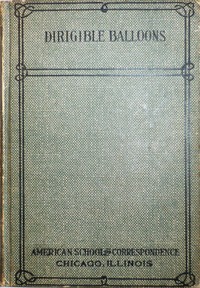
Charles B. Hayward's Dirigible Balloons opens not with a technical diagram but with the myth of Icarus and Daedalus, then moves through Xerxes' eagle-drawn throne and a Chinese emperor's balloon ascent in the fourteenth century. This historical sweep, covering Leonardo da Vinci's batlike wings and Francisco de Lana's vacuum-sphere airboat, establishes a narrative of human ambition that gradually narrows into engineering specifics. The instruction paper, prepared for the American School of Correspondence, carries a dual voice: the storyteller recounting early failures and the engineer dissecting modern airships. By the time Hayward describes the Zeppelin's navigating bridge—'the most formidable appearing piece of apparatus'—the reader has traveled from myth to instrument board.
From Myth to Mechanism
The opening pages treat flight as a sequence of inventive attempts, each with a telling detail. Meerwein of Baden, in 1781, calculated wing surface by studying wild ducks; his machine weighed 56 pounds and had 111 square feet of cloth-covered frames. Hayward notes that Lilienthal, a century later, confirmed Meerwein's figures—a quiet nod to cumulative knowledge. De Lana's plan to create vacuum by filling metal spheres with water and letting it run out is presented with a wry conclusion: he never built the ship, deciding 'God would never permit such a change in the affairs of men.' These early sections move briskly, each failure or near-success building a catalog of approaches. The prose is direct, almost clinical, yet the selection of anecdotes reveals a fascination with the gap between intention and result.
The Zeppelin as a System of Controls
Later chapters shift into dense technical description. Hayward details the Zeppelin's balloonets, each with a control button for increasing or decreasing air—'two for each balloonet, which fact necessitates a rather forbidding looking board.' The navigating bridge combines instruments from an ocean liner's engine room and bridge: aneroid barometer, clinometers, anemometer, manometers for each gas bag, drift indicators, electric bomb releasers. The coordination required, Hayward observes, seems 'an exceedingly difficult task for one man,' given the number of Zeppelins that 'have apparently wrecked themselves.' This dry understatement is characteristic. The crew is enumerated by role—commander, wireless operators, engine attendants, machine gunners, bombers—with sleeping accommodations reduced to 'canvas hammocks slung in the gangway.' The text treats the airship as a closed system of human and mechanical parts.
Pace and the Instructional Voice
Hayward's prose changes pace markedly between sections. The historical introduction uses short paragraphs and varied sentence lengths, while the technical descriptions become dense, list-like, and repetitive in structure. For example, the passage on the instrument board strings together items with commas: 'the aneroid barometer for indicating the altitude, transverse and longitudinal clinometers to show the amount of heel and the angle at which the airship is traveling with relation to the horizontal, the anemometer, or air-speed indicator, manometers, or pressure gauges, for each one of the gas bags.' This accumulation mimics the overwhelming array of dials and levers. The effect is pedagogical: the reader is meant to feel the complexity. Hayward occasionally breaks the catalog with a comparative remark—'so the navigating bridge of a Zeppelin combines in small space all the instruments to be found in the engine room and on the bridge of an ocean liner besides several which the latter does not require'—which serves as a landmark in the technical terrain.
Hayward's manual rewards a reader attentive to shifts in register. The early historical anecdotes, with their mythic and failed machines, set a tone of cautious progress. The later technical passages, with their exhaustive lists and understated warnings, demand a different kind of attention—one that tracks systems and their potential failures. Reading the two modes together reveals how the instructional genre itself shapes the story of flight: each failure becomes a lesson, each instrument a solution to a past problem. The book is best approached as a document of its time, when correspondence-school engineers were being trained to manage machines that still regularly wrecked themselves.
How will you remember this book?
Save your reaction, strongest insight, and memorable passage.
Alexander Brown
1 week ago