1

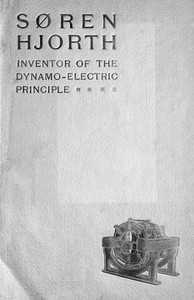
Søren Hjorth: Inventor of the Dynamo-electric Principle — Text and Context
(0 User reviews)
1028
Project Gutenberg
2021
Not confirmed
Hjorth, Søren, 1801-1870; Electric generators
Readers of public-domain and historical texts
Project Gutenberg digital edition
en
Edition facts
Words
11,479
Reading time
50 min
Text sections
11
The source record for Søren Hjorth: Inventor of the Dynamo-electric Principle — Text and Context measures this digital text at 11,479 words, 50 min estimated reading time, and 11 detected text sections.
The text analysis averages about 24.6 words per sentence, while the detected sections provide another way to judge how the source is divided.
Project Gutenberg metadata also associates the work with “Hjorth, Søren, 1801-1870,” connecting these edition facts with the source record’s subject description.
Source:
Project Gutenberg record #66046
Sigurd Smith's 1912 pamphlet, published in English and Danish, argues for Søren Hjorth's priority in inventing the dynamo-electric principle. Based on newly accessed letters, drawings, and sketch-books, it traces Hjorth's career from his childhood in Denmark to his later struggles, including failed partnerships and financial hardship, while detailing the construction and testing of his dynamo.
Editorial Edition Score
4.7/5
★★★★★
★★★★★
Calculated from edition completeness, EPUB availability, text structure and catalogue metadata. Not a user rating.
How this score is calculated
- Description quality20 pts
- Title & short description10 pts
- Source metadata20 pts
- Text length15 pts
- Chapters / structure15 pts
- EPUB file integrity20 pts
Total of 100 points, scaled to a 2.5-5.0 range. Editions with an empty description or a missing EPUB file are not scored.
Edition quality
Read the Text
it was not made with sufficient accuracy. The sum for which the car was to be made, was never granted, as petitioned for, although Hjorth had given up using his rotary engine for it; and the car itself was probably never built.
At that time, the use of steam-cars on the country roads attracted great attention in England, and many different constructions appeared. In 1834 Hjorth, aided by subventions from the »Rejersen Foundation« and the Government, went to England, in order to acquaint himself with the use of these steam-cars on high-roads and railroads. During these years he very actively investigated the use of steam-power, especially as a means of propulsion for vehicles and ships. With admirable interest and diligence he studied the steam propelled road-carriage, and for a long time he considered that to be the future means of conveyance. Although he did not succeed in getting his own steam-carriage put to practical use, he made many experiments on a steam car, and I am told by one of his passengers that on the level streets of Copenhagen and Frederiksberg all went very well, but the carriage could not climb Valby hill.
During these years, Hjorth also attended the lectures at the Polytechnic Institute, and he was especially interested in Ørsted’s lectures on the physics of the globe, and on electricity and magnetism.
Notwithstanding his unsuccessful experiments with the rotary steam-engine, Professors Ørsted, Zeiss and Forchhammer had to give him a warm recommendation, when he made a petition to the Ministry in order to get his expenses refunded by the Government. They mentioned his indefatigable zeal, his great diligence, and the considerable expense borne by him in the pursuit of his researches. The numerous and expensive experiments absorbed all the money Hjorth could procure: not only his salary was spent, but also such funds as he was able to raise among his friends.
In 1839 Hjorth made a journey to England, France and Belgium. By that time, he seems to have come to the conclusion that steam-carriages running on rails, are preferable to steam-carriages running on the high-road, at any rate he mainly studied locomotives and railroading during this journey.
After his return to Denmark, he spent some years as manager of Marschall’s piano factory, though still at work with his railroad schemes, and in 1840 he happened to find a man named Schram, a book-keeper, who shared his interests and was able to assist him in the realisation of his ideas. In 1840, these two men published a detailed calculation of the probable revenues and expenses of a railroad between Copenhagen and Roskilde. This project, however, did not arouse any interest, and people were mostly inclined to smile at the idea, and it appeared impossible to induce competent men to take, any interest in the scheme, much less to invest money therein.
Sigurd Smith’s 1912 pamphlet, issued simultaneously in English and Danish, opens with a letter fragment from Hjorth to H. C. Ørsted, dated Handsworth, Birmingham, 1851, in which Hjorth expresses pride that “the utilization thereof should be originated by a Dane.” This direct quotation sets the work’s central claim: that Søren Hjorth, not later figures, first devised the dynamo-electric principle. Smith, a civil engineer, writes after examining “the large collection of letters, rough-copies, drawings, and sketch-books left by Hjorth,” materials that became available only after the death of Hjorth’s step-daughter in 1908. The preface states that earlier accounts relied on “guesswork alone,” whereas the new documents allow Smith to “follow Hjorth’s train of ideas almost from his first, to his last invention.” The pamphlet thus positions itself as a corrective, based on primary sources, to the historical record.
From Vesterbygaard to the Workshop
The biographical opening is spare. Hjorth was born 13 October 1801 at Vesterbygaard, an estate rented by his father in Jordløse Parish. Of several children only three survived childhood. His parents “became early aware that their son possessed great mechanical genius,” and his first education came from the parish school-master. The text does not describe formal scientific training; instead, it emphasizes practical ingenuity. Smith later notes that Hjorth’s “lack of scientific education” was offset by “intrepid zeal,” a phrase that recurs in the narrative. The early sections rely on family records and the newly accessed papers to establish a foundation for Hjorth’s later inventive work, but the excerpts give no details of his youth beyond these few facts.
The Dynamo’s Eventful Existence
Smith traces the physical history of Hjorth’s dynamo through a series of modifications and relocations. The machine was tested repeatedly but “could not yield as much as might be expected from its size.” Its original cast-iron magnets were replaced with “more powerful steel magnets”; later, “every other magnet pole was removed.” In May 1857 the dynamo was donated to the Polytechnic Institute in London. Smith reports that “notwithstanding a thorough search of the London museums, it has been impossible to trace this machine,” though it was reportedly seen in London during the 1890s. The account is grounded in surviving visual evidence: “Among the papers left by Hjorth, there are a daguerreotype and a photograph of this machine,” from which the pamphlet’s Figure 6 is reproduced. This section demonstrates how Smith uses material artifacts—letters, photographs, drawings—to reconstruct the machine’s trajectory.
Hard Times and New Trades
After returning from England “quite destitute,” Hjorth faced a series of professional shifts. In 1857 he became a representative for Cyclop’s Steel Manufactory; in 1859 he obtained a licence as a translator of English in Copenhagen. He also ran “a kind of engineering and patent office,” assisting strangers with monopolies and working on railroad and bridge projects. His earlier contribution to Danish railways is acknowledged: a petition for a pension notes that “the idea of building the Sealand railroad, as well as the general location of this road, is mainly due to Secretary Hjorth.” From 1861–62 until his death he received 500 rixdollars yearly. The text records his marriage in 1845 to Vilhelmine Ancker, a widow, and his step-fatherhood to two daughters. A physical description appears: “This carefully dressed little man in top-hat and high-heeled shoes, was well known.” The excerpts end before covering his final years, but the pattern of tenacity and disappointment is clear.
Smith’s pamphlet is a focused argument for priority, not a full biography. Readers should note that the evidence is drawn from a single cache of family papers, and the author’s own position as a Danish engineer advocating for a national inventor shapes the narrative. The excerpts do not cover Hjorth’s later life or the ultimate fate of his patents. Those interested in the technical details of early dynamo design will find the descriptions of magnet substitutions and pole removals instructive, but the text assumes familiarity with electrical principles.
Reading about Søren Hjorth’s patient, lonely tinkering, I kept thinking how invention is mostly waiting—waiting for the world to catch up. Those sketch-books carry a quiet ache. The same ache lives in Preliminary Specifications: Programmed Data Processor Model Three (PDP-3) October, 1960 — Background and Themes, where a machine’s promise sits unread, a future already become past. Strange comfort, knowing both these efforts simply waited.
There are no reviews for this eBook.
There are no comments for this eBook.
Reader reflection
What did you think of this book?
Answer a few questions and save a private reflection on this device.
Your progress
0
/
10
2
How did the book work for you overall?
3
Would you encourage someone else to read it?
4
How easy was the book to follow?
5
How distinctive were its ideas or approach?
6
Was the book easy to understand?
7
Would you start a conversation about this book?
8
How did the reading compare with what you expected?
9
What did this book teach you most?
10