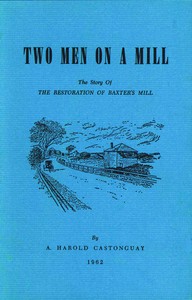
Two men on a mill — A Reader’s Guide

(2 User reviews)   499
Castonguay, A. Harold, 1905-1979 Project Gutenberg 2023
Flour mills -- Conservation and restoration -- Massachusetts -- Cape Cod; Flour mills -- Massachusetts -- Cape Cod -- History Readers of public-domain and historical texts
Project Gutenberg digital edition en

Edition facts

Words: 14,531
Reading time: 64 min
Text sections: 15
A firsthand account of restoring a 250-year-old water grist mill on Cape Cod, blending practical millwrighting details with the quirks of a two-man project. The narrative moves from historical ownership to the hunt for a turbine, offering a specific, unpolished view of Americana in action.
Share
Editorial Edition Score 4.7/5

Calculated from edition completeness, EPUB availability, text structure and catalogue metadata. Not a user rating.

Edition quality

Read the Text

container about the size of a large tea cup; and the starting was easy and positive, all by hand.

All the visitors seemed to be drawn to this piece of equipment when it was operating, and we signified our tribute by mounting a small flag on the pump every Saturday morning.

I should not forget to relate how Harvey Studley, a young, local contractor, sent up three men and all the shingles necessary to entirely re-do the roof of the mill itself. Harvey also gave us a goodly supply of 10 × 10 hard pine timbers which we put to good use in the sills and otherwise.

About six months before this project got underway, Harvey, who is generally a quiet, peaceful soul, delivered an impassioned speech at our annual Town Meeting, decrying the lack of interest by the townspeople in the preservation of some of our own landmarks.

The building itself had to be raised by Bob Hayden and his crew, and a new foundation completely made on the old. When this was done, new sills put in and the building lowered, things looked a little better, for at least the building sat upright.

Harvey gave concrete help, but although a good many people expressed their admiration of the job we were doing and the task which we had undertaken, we didn’t get too much actual help. It is always more fun to watch work being done.

We did, however, among other people, receive help from a photogenic barrister, Harold Hayes, who spent an afternoon in his boots with a shovel helping us to disturb the mud of the centuries. One kind gentleman, whom I do not know, was watching us one day as we were trying to pry off some of the rusted bolts and nuts from the old turbine. He showed up the next afternoon with a large, much-needed, Stilson wrench which he donated to the cause.

Ben Baxter, one of the living heirs of the “Baxter boys”, and a descendant of some of the best sea captains the Cape has ever produced, gave much of his time and effort and loaned us considerable equipment. Ben is an expert mariner, engaged in ferrying cargo back and forth to Nantucket, virtually bring “oil to the lamps of China”. I don’t think anyone knows Nantucket Sound better than Ben Baxter. Between his trips to the island, Ben found time to be with us every Saturday. He is a stout fellow.

My friend, John Doherty, who is engaged in the building of homes and selling of real estate, has delivered to us many loads of loam, fill, and sand.

Charles Cunningham, a local contractor and builder of large buildings, was most generous in offering the use of his stock pile, where a treasure was found of different sizes and shapes of all kinds of lumber and materials. He told us to take anything we could use, and the offer was music to our ears.

I do hope Mr. Cunningham didn’t feel too chagrined when he saw how much we were taking, but nevertheless he grinned and said to go ahead and take whatever we wanted.

The Hinckley Lumber Company of Hyannis graciously offered, and we quickly accepted, lumber and supplies from their mill and warehouse.

Our busy surveyor of highways, Chris Marsh, loaned to us from time to time a machine called a back hoe, which does marvelous things, and some men to help with the hard digging.

One generous soul, Tom Powers, has given us several beautiful trees which we are planting and hope will live to beautify the structure and the landscaping. Tom is a director and officer of several banks, owns most of the real estate on Cape Cod, and is a teller of tall tales in any dialect you wish.

The two signs, and especially the final sign, which grace the mill property were made by a sign painter and artist extraordinary, one H. O. Thurston, of Centerville, a friend of long-standing.

There were many times when it seemed to me we would never finish this job; that it really was perhaps too much for us to have ever started, what with our limited knowledge and seemingly insurmountable obstacles. Somehow we all kept going, hoping that we would finally have the mill completed as we envisioned from the beginning. It reminded me of the chap who had the tiger by the tail and didn’t dare let go.

This land on which we live, called Cape Cod, is visited by hundreds of tourists in the summer and dwelt upon by the year-round residents, most of whom are totally unaware of the richness of the tradition and of the way of life which is found here. This way of life is quite different than any one finds in any other part of our country. We do live close to the sea, and we have many little villages nestled around quiet, patient roads. We have innumerable ponds and lakes, and the vast seas on either side of us. Express highways bring crowds to the Cape, but there are many villages and communities not encroached upon as yet to a great degree by speed and hasty living.

Being close to Plymouth, the birthplace of liberty, and the second landing place of the Pilgrims, we, of course, are bound to history by close ties.

I think and I hope many people are becoming more and more aware of the gradual loss and decay of our historical landmarks, and my thought is to preserve the rich but dwindling heritage of our traditional land, not by or through the Federal Government or by the State Government, but by all the people in local communities through our own Town Government.

There are a few restoration projects now under way and some have been completed in the past few years. I can think quickly of the West Parish Meeting House in West Barnstable, which can be seen from the Mid-Cape Highway; the old Hoxie House in Sandwich; the Sandwich Water Mill, now being restored by the Town of Sandwich, which, by the way, has a most excellent setting at Shawme Pond, in which are reflected the tall, white buildings surrounding it; the Brewster Mill at Stony Brook, having been restored about three years ago by the Town of Brewster, where one can purchase corn meal every Saturday afternoon at twenty cents per pound.

I recently purchased some of the corn meal from the Brewster Stony Brook Mill, where it is slowly ground between old millstones, and if you have never tasted corn meal muffins made from this flour, you are in for a real treat. Ground in this manner, the corn apparently keeps the goodness and the natural nutrients of the grain. It is not processed and bleached to a point where it tastes like a blotter. It actually tastes like corn. We have also tried some of the wheat flour, and the bread made from it is something to be experienced.

Other restoration projects that come to mind are two or three windmills in Chatham and Eastham which have been restored or reproduced, and a few herring runs, but there are many other places and sites that are gradually going unless we all make some effort to preserve them.

We cannot, of course, entirely recapture the way of life in the 1800’s, nor probably would we want to, but it would seem that we could preserve and keep that which was good and those methods which were efficient, employed so long ago. I don’t think anyone wants to give up our electric lights for the old oil lamps, nor indoor bathrooms for the outside “privy” (notwithstanding hearsay that the outdoor “privy” was quite pleasant on a balmy summer afternoon), but there are many things which we can learn from the old people that certainly would make our mode of living and our existence a bit more pleasant, tranquil and serene.

Although it may cost a bit more to “post and beam” a house, a bit more for a bow roof, or box returns, or dental work on the trim, I do believe that many people would really prefer this type of construction once they have seen it, and I do know that most people could afford it. I will also go farther out on a limb and say that this type of construction is actually cheaper in the long run, and the long run means the lifetime of a house.

Plymouth is now embarking on a very ambitious program of rebuilding the old “Plimouth Plantation”.

I do not think that we on the Cape can do another Williamsburg, nor do I think that we should try to restore everything we find, but each town could do a little bit each year toward setting aside some of its historical treasures.

We have all kinds of beaches, public landing places, swimming pools, both public and private, for the two-week visitor in the summer, all kinds of dance halls and bowling alleys for their entertainment; but what a great wealth of information, interest, and education could be aroused through the restoration of some of the old buildings and landmarks.

The Yarmouth Historical Society, like many other similar groups, has been doing an excellent job. The Captain Bangs Hallett house has been authentically repaired, restored, and reconstructed by and through the Historical Society. Captain Bangs Hallett was one of the deep-water sailors who commanded some of the well-known clipper ships, the giants of the sea. This house is open to the public every afternoon in the summer and reflects the way of living at that time of the more well-to-do sea captains.

My idea is not to restore the Baxter Mill just as another museum which would be filled with all kinds of ancient bric-a-brac, furniture, glassware and curios for people to look at and pass by. My thought is that we should restore and reconstruct this mill, holding to exact authenticity, so that the final result would be exactly the same mill with its fundamental mechanisms and its simple dignity, and turn out the same products.

Snow and bitter weather came early to Cape Cod in December, 1960. We have always bragged about the mild winters enjoyed on the Cape, but we certainly had a real old fashioned one this year. Every Saturday it seemed that the very nastiest weather prevailed, but on Monday it was beautiful.

It was really hard work in this flume and in the wheel pit at ten and twelve above zero, notwithstanding our heavy winter clothing, but nevertheless about ten o’clock a welcome coffee break was taken. Time after time ice would form and congeal around our boots while we were working, and a penetrating, deadly chill arose from the wheel pit. I don’t know how many hours were spent in breaking up the ice before we could even start to work. Fortunately, no one seemed the worse for wear.

We collected all kinds of lumber, materials, and supplies of various descriptions, widths, and lengths, piling all of this around the mill site. It was a great source of concern to many passers-by where we possibly could be putting all this vast amount of lumber and supplies. Those that took the time to see could readily understand the large amount of lumber necessary to go into the wheel pit and the flume.

Joe Carapezza, the stone mason, was then employed and did a most excellent job in renewing the foundation and rebuilding the retaining walls, mostly out of old dressed granite blocks. These old fashioned dressed granite blocks are about two and a half feet long and about ten to twelve inches square and make a most attractive addition to the landscape of the mill. Not being accustomed to this heavy work, which was indeed difficult for a professional like Joe, you can well imagine that I gradually gravitated to an assistant hired hand, but in this weather one did not stand around and become solidified. It was necessary, for self preservation, to keep moving, and while you are moving you might as well be doing some work.

We did indulge in a welcome respite at ten o’clock on a Saturday morning of adjourning to my homestead where we would have some hot coffee and doughnuts. I don’t know how many gallons of coffee and how many doughnuts we consumed over this year and a half, and I don’t know how much mud my wife had to clean up in the kitchen after we all tramped in and out. We were all very thankful to her, however, for putting up with us.

Friend George is slow, meticulous, and very exacting. As for myself, I know that I am impatient and I have to do everything in a hurry. Naturally, both our natures at times clashed, but I think one was good for the other.

I did object strenuously to George’s most annoying habit of suddenly standing up and shouting,

“Harold, where is the rule?”

I found that ignoring him did not help, so I acquired some earmuffs which worked admirably until George resorted to making signs and perhaps lifting up one of the earmuffs and gently requesting the rule. Incidentally, the rule most of the time was sticking out of his own pocket.

Everyone slept fairly well after a day’s work at the mill, but I asked George one morning how he slept. He replied,

“Not too well. I had to turn over once.”

I furnished no small amount of amusement to my co-workers as I tried to fashion a fifteen-foot board to the floor of the mill. The board had to be fitted in about five places, and I would saw and cut and chisel and then saw and cut some more, finally ending up with a board about three feet long, much to the gratification and mirth of my so-called assistants.

It seems that shingles are always in demand no matter whether you are rebuilding an old building or building a new one. I never realized how handy shingles were until we began this project. Apparently, shingles were made not only for roofs and side-walls, but to take up the error in the professional’s work.

Somewhere in Maine George made a large speech to an assembled populace about the necessity of everyone having shingles at hand.

New England is especially favored with many rivers, streams, ponds and lakes, and it is with never-ending admiration that one reflects on the ingenuity of the early settlers putting to practical use all of the water power. Throughout the whole region will be found hundreds of remains of water mill sites, small and large, and the settlers soon found ways of putting a harness on them for water power.

If the stream happened to be small, the early millwright built a dam across it and in no time he acquired a small pond. The higher the dam, the greater the head of water.

Where there were large rivers, you can now find tremendous power plants, textile mills and other manufacturing establishments all using this water power.

Most of us today, when we think of power, think of electricity, gas, or steam, but it is very simple to consider the water in an ordinary little stream and the amount of power it can deliver.

Although the machinery built by the early millwrights was a bit crude, nevertheless it was functional and worked with efficient success.

On a recent scouting trip George and I took through Massachusetts, New Hampshire and Connecticut, we visited a few restored mills. One of them was in Rowley, Massachusetts, just off the Main Road, called the “Jewel Mill”. Here an enterprising and resourceful chap had rebuilt the outside water wheel on a fairly small stream and he was driving a small D C generator supplying electricity to his house and to a small lathe shop. This, he told me, had been going on for five or six years without interruption. The lights were steady and there was no fuss, clamor, or noise. The only thing one heard was the splashing of the water over the wheel. His mill was so named because he was actually cutting and polishing small, local, semi-precious stones.

I find that there is a small group of enthusiasts who are gradually picking up and collecting all the old turbines they can find of ancient vintage, so if one wishes to invest in the future, he might consider picking up one of these old turbines which in a few years will be extinct.

Another interesting site we visited was John Goffe’s Mill near Manchester, New Hampshire. Having read with fascination George Woodbury’s tale of restoring this mill, we were very anxious to actually see it. Mr. Woodbury, a very learned gentleman, former archaeologist and now author, had performed a most remarkable job.

Another mill, farther along the trail, was in Alstead, New Hampshire, where Heman Chase was conducting a class in woodworking, the power being supplied by an old refinished turbine. Mr. Chase, in addition, is a land surveyor, a teacher of mathematics and the philosophy of Henry George, as you can see from his letterhead.

At Weston, Vermont, at the Artists’ Guild, will be found a real old mill where they are grinding corn and wheat and other grains.

Late the first night of this expedition, George and I holed up in a modern motel somewhere in New Hampshire. I was not quite prepared for George’s night attire. It seems he still wears an old fashioned nightshirt, split up on each side, and I got a bit of a start to observe this character climbing into bed with this on. George will deny this, but he also had on an old night-cap.

Coming home we went to Monson, Massachusetts, and there found all kinds of mill apparatus in various states of repair, gradually rusting out and disappearing into the ground. I was a little sad to observe how the owner was tenaciously clinging to his old way of life: his machinery, tools, and all the things he had collected all his life. But how his eyes did light up with enthusiasm when he learned we were attempting to restore our own mill.

A tall, gaunt man, weather-beaten, with hands that had known many a piece of machinery, he was a living figure of the old millwright and gave us a great amount of information on the revolutions per minute and various other facets of millwrighting.

Most of us think of antique things as so many curios and objects to be placed in museums to be passed by, but we do not realize how much better some of these things did work than the ones we buy today. For instance, I have a small hand garden trowel, forged perhaps fifty or sixty years ago, and it is much more practical than the new trowels on sale in the hardware stores. I have often wondered why they couldn’t make one like this rather than the ones on display but perhaps this kind would last too long and the factory would go out of business.

We did not find on our pilgrimage a turbine suitable for us, but we did find the brilliant foliage of the hills and mountains, the quiet patience of the roads, and the beauty of the small towns of New England.

A few weeks later our fast trip in upper New England paid off, for we heard by mail of a turbine that seemed might be just right for our purposes. Chuck Stanley gave us the loan of his truck and George and I, fortified by a packed lunch, hot coffee, and sandwiches, started out at 4:00 A. M. one Sunday morning for Livermore Falls, Maine.

There, we found on the side of a hill an old turbine weighing about two ton, and after poking about this monster we decided we could use it.

The task of loading this beast upon the truck seemed formidable, so we finally located a mountaineer who possessed an oversized auto wrecker, and backing our truck against a strategic hump on the side of the hill we proceeded to load the turbine on the truck. The wrecker hooked onto the turbine, but the turbine proved too much for it, so much so that it turned it over on its side.

A goodly crowd had by this time gathered to watch the operation, and enlisting the aid of some husky boys, we finally managed to push the wrecker back on its four wheels.

The book opens with a precise date—a few days before Christmas 1961—and the promise that a pen gate in a flume will soon set a 250-year-old water grist mill grinding corn again. Author A. Harold Castonguay immediately frames the restoration as a rescue of “a vanishing part of Americana,” contrasting the mill’s quiet dignity with a world of jet airplanes and electric can openers. The opening chapter also traces the mill’s ownership from the Baxter brothers, John and Shubael, through a web of cousins and sales, grounding the project in local history. A four-line folk verse, already old in 1880, introduces the mill’s builders and sets a tone of affectionate, unpretentious storytelling.

The Baxter Line and the Mill’s Early Days

The narrative begins not with the restoration but with the mill’s origins. Castonguay reports that the original mill was probably built around 1710 by John and Shubael Baxter, sons of Thomas, a mason who lost a hand in King Philip’s War and became a millwright. The author draws on probate records—Thomas’s will from 1714 disposes of fulling mill equipment—and a genealogy by Amos Otis to trace ownership through generations: from John and Shubael to their children Richard and Jennie (first cousins who married), then to Prince, then Prince Jr., whose guardian sold half the mill to Timothy Baker and half to a remote cousin. This detailed chain of title, supported by the 1880 Genealogy of Barnstable Families, gives the restoration a firm historical footing. The author notes that extensive repairs were made around 1850, likely by Prince Sr., but does not speculate beyond the records.

The Search for a Turbine

Castonguay’s account of hunting for a replacement turbine is the most vivid section of the excerpts. He and his partner George drive to Livermore Falls, Maine, after a tip, and find a two-ton turbine “on the side of a hill.” Loading it becomes a comic ordeal: a borrowed auto wrecker tips over, a crowd gathers, and husky boys help right it. George, “in his unruffled manner,” secures the turbine with chunks of wood and plank. The author’s worry about the load getting away “going down some mountain” shows practical caution. A running joke about a missing shingle—George shouts from the tailboard, “Harold, where is the shingle?”—adds a personal, humorous layer. The episode reveals the improvisation and teamwork behind the restoration, and the author’s eye for the absurd.

Everyday Life on Cape Cod in the 1800s

In a later chapter, Castonguay pauses the restoration story to sketch the world the mill once served. He notes that between thirty and forty wind- or water-powered mills operated on the Cape, supplying flour and corn. “Corn then was more important than gold,” he writes. Families grew vegetables, traded eggs for milk, gathered shellfish, and fished from boats. Orchards were common; grape arbors have since disappeared. Cranberries were just developing in the 1880s, a detail the author recalls from his own memory. This section places the mill within a self-sufficient village economy, where the mill was as central as the country store, the blacksmith shop, and the church. The author’s tone is nostalgic but grounded in specific practices, not vague sentiment.

A Living Figure of the Old Millwright

Castonguay reflects on the expertise of an unnamed older millwright who advised them on “revolutions per minute and various other facets of millwrighting.” He contrasts antique tools with modern ones, using a hand garden trowel forged fifty or sixty years ago as an example: it is “much more practical than the new trowels on sale.” He wonders why factories cannot make tools that last, then wryly suggests that such durability would put them out of business. This digression reveals the author’s respect for old craftsmanship and his skepticism of planned obsolescence. It also connects the mill restoration to a broader appreciation for things built to work well and last, a theme that runs quietly through the narrative.

Castonguay’s account is best read as a personal chronicle rather than a technical manual. The humor—George’s shingle rant, the overturned wrecker—balances the historical detail. Readers interested in the mechanics of water mills will find specific information on turbines and millwrighting, but the book’s real subject is the collaboration and resourcefulness required to bring an old building back to life. The author’s voice is direct, occasionally wry, and always grounded in the particular challenges of this one project on Cape Cod.

Noah Thomas
2 weeks ago

Harper Moore
1 week ago

4
4 out of 5 (2 User reviews )

Add a Review

Your Rating *
  • ...
    Taylor Taylor - 4 weeks ago
    What a delightful story! 'Two Men On A Mill' is a charming tale of friendship and adventure. The author's witty dialogue and vivid descriptions of the mill and surrounding countryside had me laughing out loud and feeling like I was right there with them. It's a heartwarming read that reminds us of the simple pleasures of life. I couldn't put it down!

  • ...
    Ernest Terry - 2 weeks ago
    A pleasant, easy-going read about two friends spending a summer at an old mill. The character interactions are realistic and sometimes humorous. However, the plot is quite thin, and there are moments where the pace drags. Still, if you enjoy slice-of-life stories with a rustic setting, this is a decent choice.

  • ...
    Micheal West - 1 week ago
    The premise sounded interesting, but the execution fell flat. The story meanders aimlessly, with no real conflict or character development. The two men are indistinguishable in voice, and their conversations are mundane. I kept waiting for something meaningful to happen, but it never did. A tedious read that I struggled to finish.


Reader reflection

What did you think of this book?

Answer a few questions and save a private reflection on this device.

Your progress 0 / 10
1

Which reading stage best describes you?

2

Did this book hold your interest?

3

Is this a title you would suggest to others?

4

How demanding did the text feel?

Related eBooks